





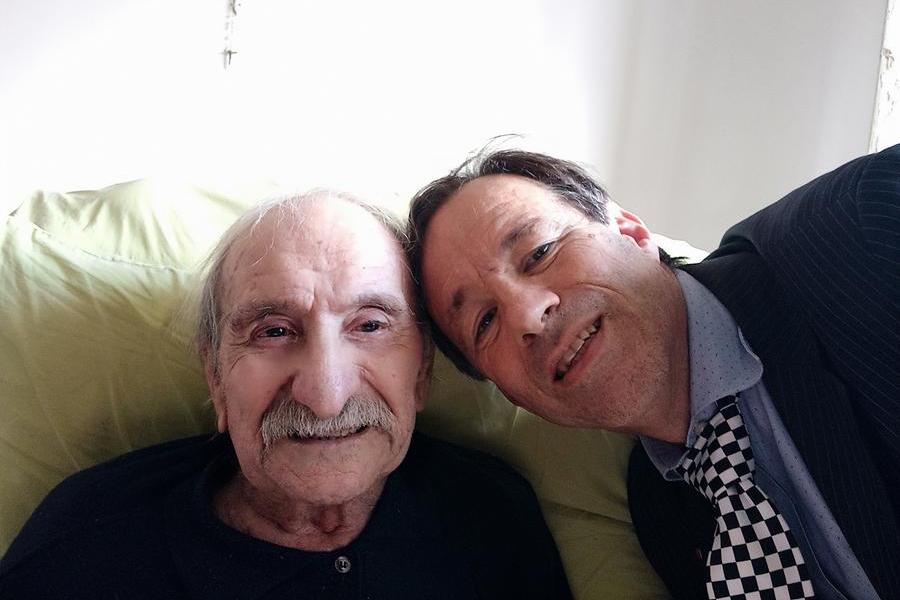
He would have reached his hundredth birthday in exactly one month, on February 4th Paolo Pesce, partisan battle name “Stone”. He passed away on Saturday, January 3rd at his home in Ligurian stone one of the last witnesses of the Resistance. This was communicated to us by his son Marco Pesce, who assisted him lovingly until the end and who had helped him in recent years to keep the memory of that historical period and his role in the Ligurian Resistance alive. We interviewed him last April on the occasion of the 80th anniversary of the liberation from Nazi-fascism. «The copy of Christian family with the article it accompanied him until his last days and he proudly showed it to those who still came to visit him”, his son Marco wrote to us. Below, we propose the report published in issue 18 of 2025 of our weekly magazine.
Paolo Pesce is about to reach the milestone of 100 years, time has taken away part of his sight and hearing and forces him to bed, but his mind is clear and he continues to dedicate energy to what he has done since the day after the Liberation: transmit the ideals of the Resistance for which he fought and keep alive the memory of his fallen comrades.
“A few days ago”, says his son Marco, who responded to the appeal of Christian family to report the story of his father, one of the very few partisans still alive, «dad met the children of a primary school via Zoom. I had the questions sent to me in advance so I could enlarge them and he could read them. And while the children spoke without him being able to hear them well, I pointed out the question on the paper and he answered. For the children, but also for him, it was really exciting.”
The struggle and memory
Paolo Pesce was only 17 years old when, in the aftermath of the Armistice, he met Angelo Gin BevilacquaIlva worker, former communist councilor of Savona, sent into exile by the regime for his anti-fascist positions and among the promoters of the strikes after the deposition of Mussolini to put an end to the war. Bevilacqua invited young people to join the partisan brigades, he spoke of the dream of a free Italy, of a Europe in which everyone could be brothers. Paolo Pesce’s heart was aflame with hope and he decided to go underground Manin Brigade, Rebagliati detachment, operating in the Rialto and Calice Ligure area, in the Savona area. Battle name: Pietra, which his companions had given him by virtue of the fact that he came from Pietra Ligure.
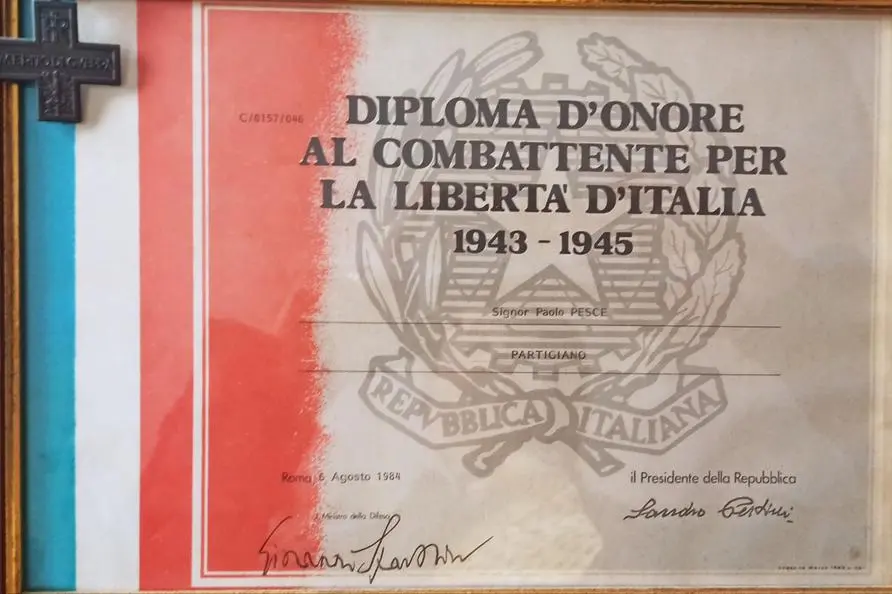
He took up the rifle and fought, especially against the black “San Marco” brigade, but he never attacked his adversaries. «In any case he always saw men in them», explains his son, «and when one day they discussed deciding the fate of a group of captured fascists, he opposed the idea of shooting them, despite having seen firsthand how ferocious they had been in raiding the homes of sick farmers, including his own».
Paolo Pesce’s most vivid memory is that of Liberation Day. He himself recalls it: «On April 24th we received the order to descend from the mountains and go to the city, to Savona. We didn’t know that Liberation was imminent and we were ready to fight. There were firefights in the streets with the Nazi-fascists who had not yet surrendered, and I risked being hit by a bullet. Then the skirmishes ended and it was time to party. A joy, however, marred by the faces of the women who came to meet us to find out from us if their children or companions who had gone up to the mountains to fight were still alive. And for them, that was the day of mourning. They put us up in the most luxurious hotel in Savona: used to sleeping out in the open, I felt like I was sinking into that soft mattress and to fall asleep I lay down on the floor.”
The Resistance in his eyes
After the war Paolo Pesce became a nurse, had two children, Nadia, who recently passed away, and Marco, raised “on bread and resistance”, he received many honors by virtue of his commitment to the partisan struggle and more today he is honorary president of the Anpi of Pietra Ligure (of which he had been secretary and president for a long time). As a member of the provincial board of directors he also had the opportunity to interact several times with Sandro Pertini, who he remembers as an intelligent and outspoken politician.
In recent years, however, the pride of having made history has been overshadowed by the signals coming from politics and society. “Too much aggression, not enough democracy.” And he remembers with regret when, under the tents, by candlelight, they all discussed together to make a decision, dreaming of a free world without wars.