






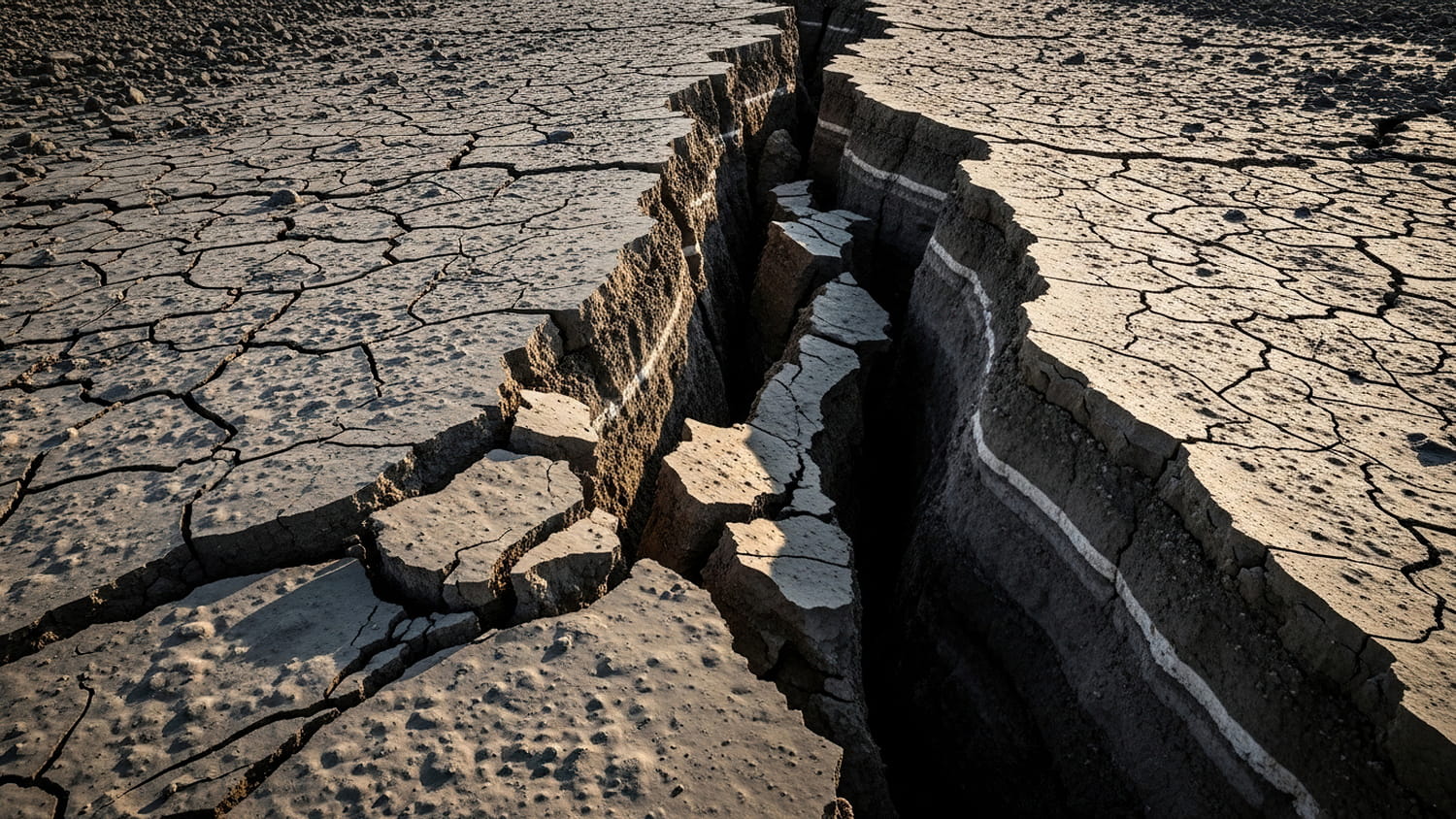
After more than three centuries of deceptive calm, this colossal rupture zone is accumulating such tension that seismologists fear “the earthquake of the century”.
Beneath our feet, the Earth is never really still: the earth’s crust is a set of tectonic plates which are constantly moving, brushing against each other or colliding in a movement invisible on a human scale. At first glance, the coastline of the American Northwest is a haven of peace. For more than 300 years, this region of the globe has not experienced any major earthquake. This apparent stability is in reality a geological paradox. For scientists, this dead calm is the sign of a total “locking”: two pieces of the earth’s crust are welded together and accumulate colossal pressure every year. If the surface remains immobile, the depths saturate.
Beneath the ground, a 1,000 kilometer long underwater fault is the scene of a titanic confrontation. The small oceanic plate, called Juan de Fuca, is trying to sink under the immense North American plate. But instead of sliding smoothly, the two rock masses are seized. In other words, the continental plate compresses and rises a few millimeters per year, waiting for the moment when the rock will give way under its own weight.
Unlike the famous San Andreas Fault in California, which produces horizontal earthquakes often limited to magnitude 8, this fault named Cascadia belongs to the category of “megathrusts”. It is one of the only faults capable of generating earthquakes of magnitude 9 or greater, like the one that struck Japan in 2011. Unlike classic earthquakes which last 30 seconds, a magnitude 9 earthquake can cause the ground to shake for 3 to 5 minutes.
When the rupture occurs, the ground will not only vibrate, it will suddenly collapse. In a few seconds, the North American plate will return to its initial shape in a violent burst, releasing energy equivalent to thousands of atomic bombs. Buildings that resist the first tremors could collapse due to structural fatigue. A tsunami would be the number one danger for coastal populations. The most pessimistic estimates speak of thousands of victims and a million displaced people.
How did geologists discover this threat when no seismograph existed 300 years ago? Thanks to an investigation worthy of the scientific police. By studying the tree rings of “ghost forests” on the coast and cross-referencing 18th-century Japanese manuscripts, they identified the exact date of the last rupture: January 26, 1700. On that day, a massive tsunami crossed the entire Pacific without warning, hitting Japan without an earthquake being felt on site. It was Cascadia’s shockwave.
By studying layers of marine sediment, researchers found that Cascadia ruptures on average every 250 to 500 years. With 326 years on the clock, the awakening of the fault is now considered “ripe”. According to the United States Geological Survey, there is about a 10% to 15% chance of a magnitude 9 earthquake occurring within the next 50 years.
Fortunately, science today gives us a head start that our ancestors did not have. Faced with this “time bomb”, the authorities are strengthening building codes and deploying early warning systems. By knowing the enemy, West Coast cities are being transformed: tsunami refuge towers are rising, bridges are being reinforced, and the ShakeAlert detection system can now send an alert to every smartphone even before the most destructive waves arrive.