

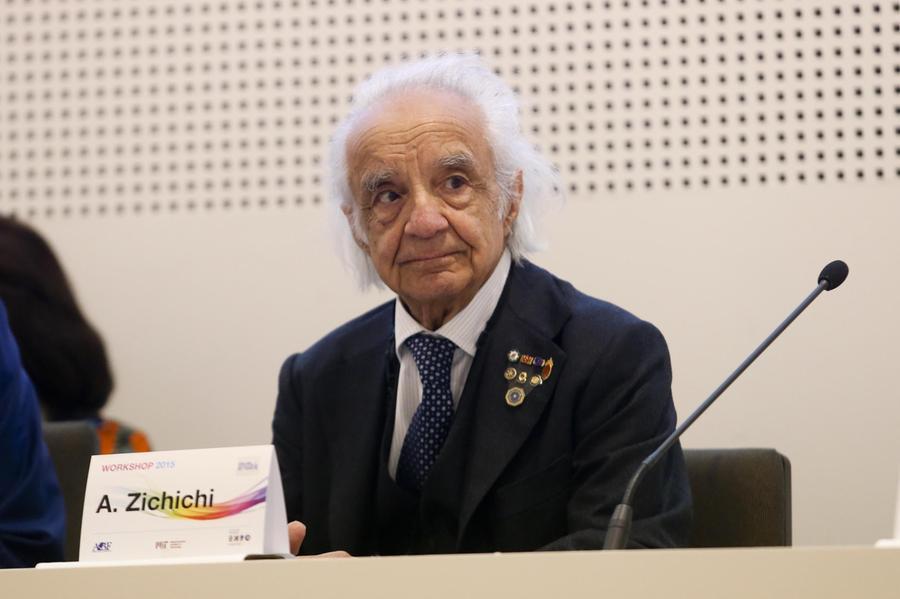



He died today at the age of 96 Antonino Zichichi, world-famous physicist and great science communicator. With him one of the most original figures of the Italian and European cultural panorama disappears: a scientist capable of moving at the highest levels of international research without ever giving up an open dialogue with faith, spirituality and the great questions of meaning.
Expert in subnuclear physics, professor emeritus of Higher Physics at the University of Bologna, Zichichi dedicated his life not only to the study of the fundamental laws of matter, but also to the diffusion of scientific culture, convinced that knowledge and moral responsibility should proceed together.
A life in science
After his university education, Zichichi soon established himself as one of the protagonists of high energy physics. He worked in the main international research centers, including CERN in Geneva, where he led leading experimental groups. In 1965 his team observed the antideuteron for the first time, a fundamental achievement in the study of antimatter. He was president of the National Institute of Nuclear Physics and of the European Physical Society, helping to strengthen Europe’s role in global scientific research. At the same time he was able to keep a careful eye on the ethical and social consequences of technological progress, in particular on the issues of energy, peace and planetary emergencies.
In 1963 he founded the “Ettore Majorana” Scientific Culture Center in Erice, which under his direction has become a meeting place between scientists, Nobel Prize winners, young researchers and scholars from all over the world. A laboratory not only of research, but also of dialogue between knowledge, cultures and visions of the world.
Science and faith, without contrasts
Zichichi has never hidden his Catholic faith, indeed he considered it an integral part of his research. In his books – including The Infinity, The irresistible charm of Time, Why I believe in the One who made the world and Between Faith and Science – he argued that science, far from denying God, can help recognize a profound logic in the universe. «Science gives everyone great intellectual dignity», he loved to repeat, «and it is the tool that makes us understand that we are made in the image and likeness of the Creator». A position that earned him criticism and misunderstanding in part of the scientific community, but also great attention and affection from the Catholic world and those seeking a non-ideological dialogue between reason and faith.
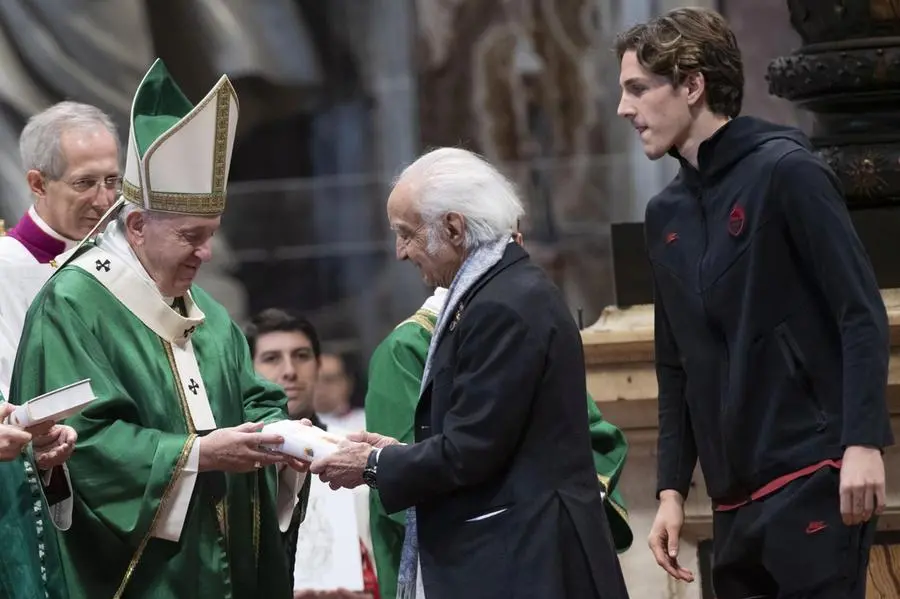
Antonino Zichichi receives the Bible from the hands of Pope Francis during the celebration in St. Peter’s Basilica on January 26, 2020
The popularizer, the television face
Zichichi was also an extraordinary popularizer. The general public remembers him for his television appearances, for that intense gaze and wide eyes that seemed to want to go beyond the screen, and for the ability to explain complex concepts with simple images and effective parables.
In recent years, faithful to his mission as a communicator, he had even chosen social networks: last year he landed on Instagram, where he spoke about science and spirituality with calm and profound words: «I wish all of you followers of scientific knowledge and spirituality – he wrote – a period of reflection and gratitude. And may it inspire us to explore the wonder of the universe with an open mind and a grateful heart.”
The affections, the pain, the memory
By the end of 2024 she was dead Maria Ludovica, the companion of a lifetime. She too was a scientist of great value, a researcher in the United States and Geneva in the field of molecular biology, daughter of the physicist Gilberto Bernardini, protagonist of the rebirth of Italian and European physics in the post-war period.
After the birth of her third child, in 1962, Maria Ludovica left research. At the table, as her son Fabrizio recalled, she often joked with her husband: “If I had continued to do research and you stayed at home to take care of your children, I would have gotten the Nobel.”
In remembering her, a year after her death, Zichichi had entrusted a thought full of science and love to social media:
«Science teaches that nothing is truly lost: every particle leaves an imprint, every form of energy continues its journey. So even love – the real one – does not fade. It transforms, it is transmitted, it becomes part of our deepest structure.”
The last few years
While continuing to travel between Switzerland and Rome, in recent years Zichichi loved to retreat to the sun of San Vito Lo Capo, in the far west of his native Sicily. His nephew Manfredi was often next to him, an open window onto the world of young people, to whom he told stories of science and life. «The important thing», he said a few months ago, «is to disseminate, to make known with enthusiasm the extraordinary stages that science achieves because they concern our lives, our tomorrow. We need to open up without fear.” He loved walking, following current events with a worried eye for a world that he saw as increasingly closed in conflict and lack of dialogue, but without giving up light things: the Sanremo Festival, television, scientific essays read in the evening.
A legacy that remains
With Antonino Zichichi goes not only a great physicist, but a cultural witness who believed in the moral responsibility of science and in the possibility of a fruitful dialogue between faith and reason.
His legacy lives on in research centres, in books, in students, but also in that profound belief that knowing the world ultimately means taking care of it.