





Electronic hacking is responsible for 94% of car thefts. To prevent your key from being cloned, forget about expensive accessories: this simple everyday object can act as a shield.
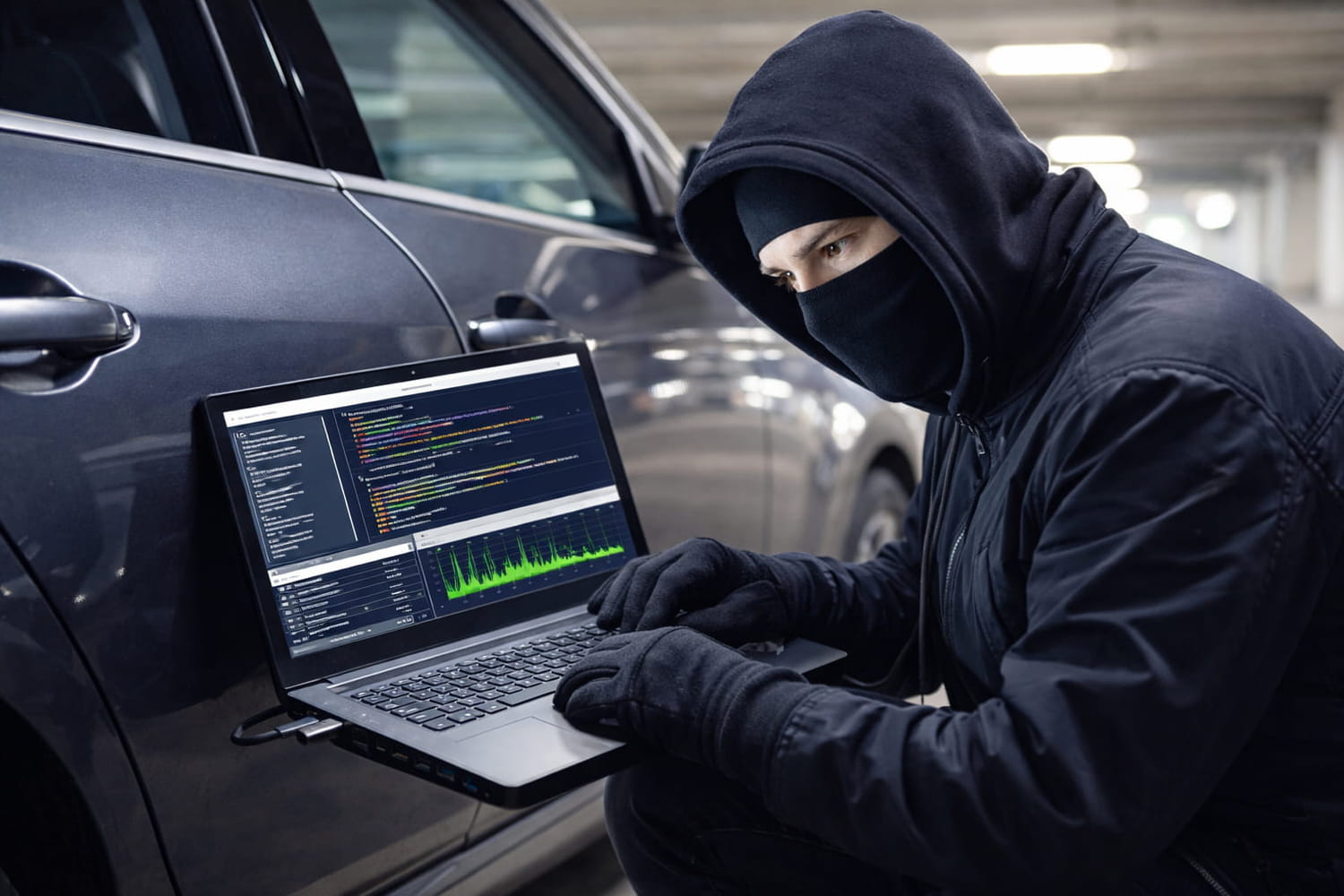
In France, a vehicle is stolen every 4 minutes. Over the year 2025, no less than 125,200 thefts were recorded by the Ministry of the Interior. But it’s not so much the number of cars stolen that surprises, but the method. We all imagine a crowbar or a broken window, and a vehicle started using wires like in the movies. However, the criminals’ new techniques are much more subtle than that. From now on, it is thefts without break-ins which represent the majority of cases. They don’t need to steal your keys either: they just need to clone them. Today, according to the Coyote Secure observatory, 94% of car thefts are committed electronically, that is to say with computer hacking techniques.
The most widespread of these is “mouse jacking”, or “mouse theft” in French. It must be said that the overwhelming majority of cars now use contactless keys: they emit an electronic signal to open the doors automatically. And it is precisely this signal that thieves intercept from a distance. With a simple relay box available on the market, for less than 100 euros, they hack the waves emitted by the key and can then send them back to the vehicle. Result: the car is opened, then started, without the need to resort to violence or even to have the key in hand. All they have to do is pass close enough to the key in question, whether it’s in your bag or in your house, and that’s it. But fortunately, there is a very simple and inexpensive solution to protect against it… and it’s in your kitchen.
To prevent hackers from “copying” your car key, simply take aluminum foil and wrap it in it. The conductive metal helps block the signal, thus acting as a sort of shielding. This is the principle of the Faraday cage, a kind of invisible barrier that prevents electromagnetic fields such as Wi-Fi or mobile networks from passing through. Thieves therefore cannot hack them. “Although it is not ideal, it is the cheapest tip to avoid this type of theft”assures Holly Huber, cybersecurity expert, to the American newspaper Detroit Free Press.
Indeed, aluminum is not completely infallible: its effectiveness depends mainly on the way the key is wrapped. If the packaging is poorly done, it will not be 100% airtight and waves may still pass through. If aluminum foil remains the easiest solution to apply, and the most financially accessible, there are also specialized products which will probably be more reliable: by typing “Faraday box” or “Faraday bag” on the internet, you will quickly find anti-wave protection at all prices.
These signal blocking accessories are also used to store smartphones, which are very prone to hacking. On the other hand, it is impossible to use said phone while it is in this armored case, and therefore few individuals use it. On the other hand, in the upper echelons of power, the Faraday cage is enjoying some success: recently, members of the Italian High Defense Council used it to protect their data during confidential meetings. At less than 15 euros per pouch, whether for your cell phone or your car keys, the invention of scientist Michael Faraday seems to be the best solution against hacking.