






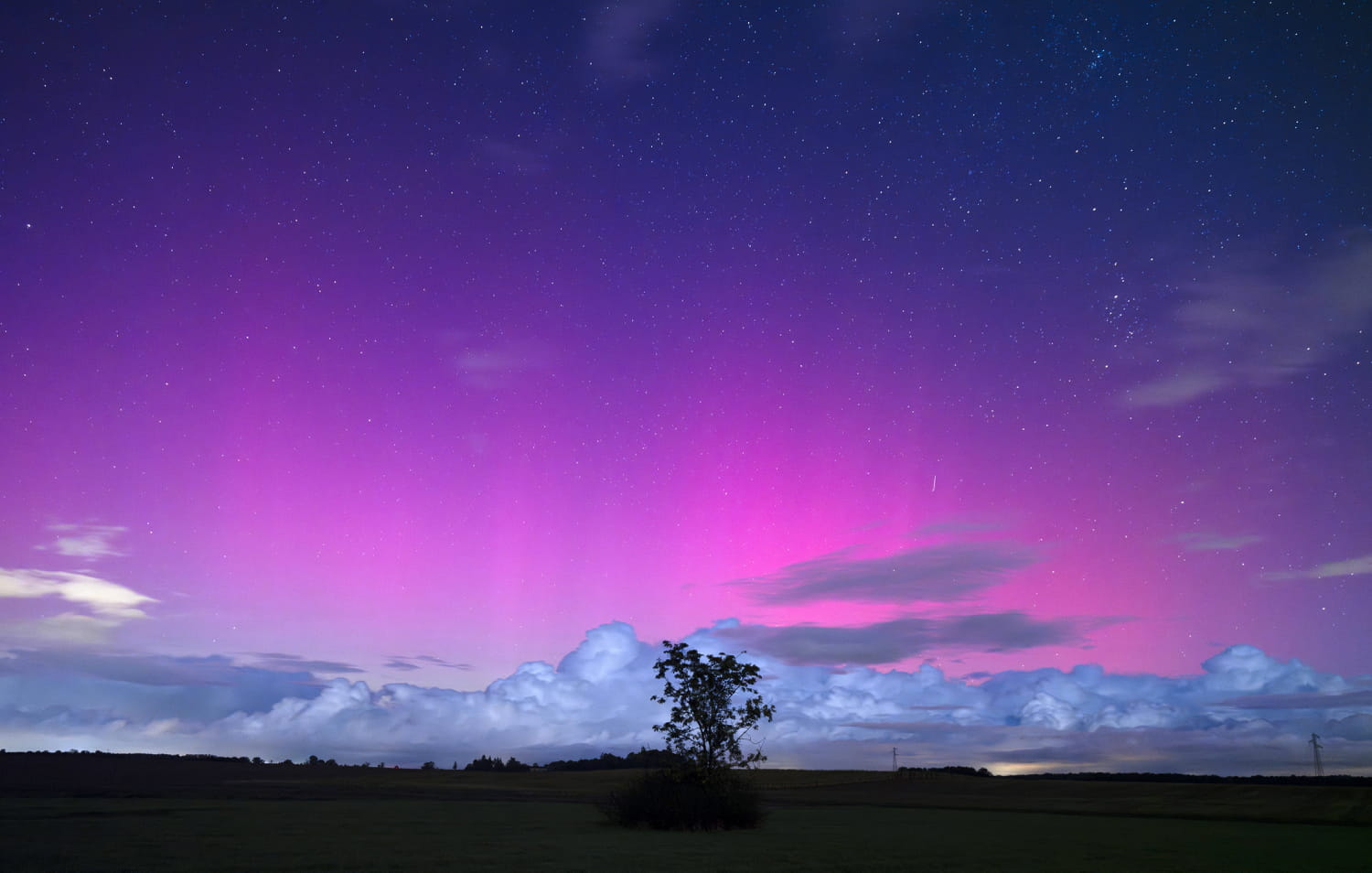
The intensification of solar storms and the magnetosphere offers this French city northern lights worthy of polar atmospheric activity.
If Lapland remains the promised land of the Northern Lights, France becomes a privileged observation site thanks to the intensification of solar cycles. This phenomenon, far from being a simple visual spectacle, is a geophysical reaction: the interaction between the solar wind and the terrestrial magnetosphere. During periods of geomagnetic storm (strong solar activity), the auroral oval stretches towards our latitudes, allowing the ionization of gases above our heads.
Contrary to popular belief, the color of the aurora depends on the physics of gases and the altitude of impact. In Norway, green dominates because the particles collide with oxygen in the lower thermosphere (between 100 and 300 km). In France, we mainly observe red glows because we only see the upper part of the phenomenon, located at an altitude of more than 300 km. At this level, the rarefaction of the air allows the oxygen atoms to emit this characteristic ruby light.
Seeing the Northern Lights in France remains an infrequent and random event. To maximize your chances, several conditions must be met simultaneously. First, and most crucial, solar activity must be extremely high. To determine it, forecasters use the Kp index: this indicator must ideally reach a level of 5 or 6 for the auroral oval to extend far enough to the south. Second, the sky must be perfectly clear, without cloud cover, so as not to obscure the faint glow of the dawn. Finally, and this is a determining factor, you must get as far away as possible from the light pollution of cities. The light from street lamps, buildings or signs is often much more intense than the aurora itself, effectively canceling it out.
The ideal is to aim for a beach or a cape that juts out into the sea, far from lighthouses or port lights, or a high point offering a panoramic, unobstructed view of the North to minimize the impact of hills or forests. Geographically, the closer you are to the magnetic pole, the greater your chances of seeing the Northern Lights. This is why the North of France is the most privileged area for seeing the Northern Lights. According to sites specializing in auroral forecasting, the French city which offers the best chances of observation is none other than Lille (with a latitude of approximately 52.0°), indicates the AuroraForecast site. Over the last 5 years, Lille has experienced 6 major episodes of northern lights, often in the form of red glows on the horizon. Other cities like Reims (latitude ~ 50.5°), Rennes (~ 50.3°), Nantes (~ 49.5°), or even Strasbourg (~ 49.3°) have also had good ones.
If observing an aurora borealis in France often remains a stroke of luck, the year 2026 offers the best chances you will have in more than ten years to try to capture this celestial spectacle from Lille, provided of course you have clear skies and get away from light pollution.