





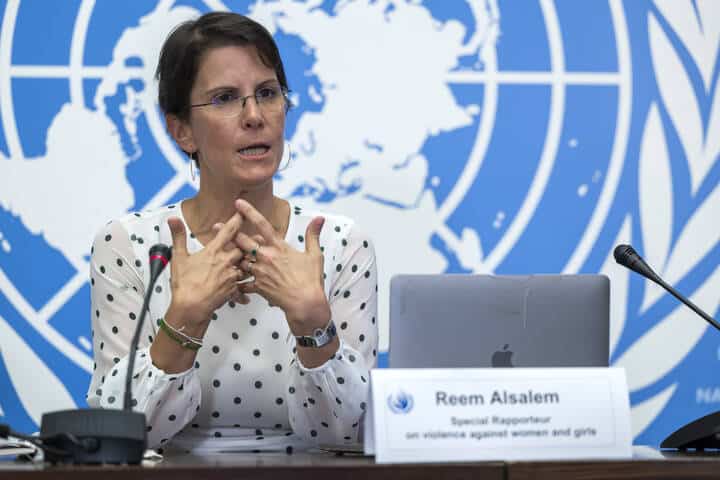
Last week’s 62 session of the United Nations Human Rights Council (UNHRC) was a major historic leap for mothers around the world, in both the developing countries and in advanced economies. Reem Alsalem, Special Rapporteur for Violence against Women and Girls, its Causes and Consequences presented an astoundingly thorough report titled Violence Against Mothers.
Working under a special UN mandate established in 1994 to investigate the root causes and resulting consequences of gender-based violence, as well as propose systemic reforms, Ms. Alsalem’s report covered the manifold forms of overlooked gender-based violence against mothers. In her public statement accompanying her report she said: “Motherhood remains largely undervalued and mischaracterized as a purely private choice rather than a public good. Mothers are subjected to multiple and intersecting forms of discrimination, yet remain unrecognized as a distinct category in law, policy and data.”
In identifying mothers facing increased risks of marginalization, subjugation, and abuse she pointed to “indigenous, migrant, refugee, stateless, adolescent, older, incarcerated, single, lesbian, surrogate and prostituted mothers, mothers with disabilities, mothers of children with disabilities, and mothers who resist harmful practices against their children.” She pointed to the known fact that “violence against mothers also profoundly affects their children, perpetuating cycles of harm across generations.”
For forty years I’ve been fighting for protective mothers who have been severely penalized for seeking redress from the family courts and child welfare agencies. When confronted with strong and compelling evidence that their children have been sexually (and/or emotionally and physically) abused, they naturally think the system will heed their concerns and protect their children from further harm. They learn quite the opposite. Their children are wrenched from their loving arms without a hearing and without evidence to warrant the drastic step of removing a child from the mother to be placed into state-run foster care or into the custody of the parent the child has accused of abuse. I had this happen to me. Rather than accept this horror and twisted, upside-down “justice,” I sought to fight the system with whatever tools I had.
As a sociologist, I studied the deeply flawed operations of the family court system and its cooperating child protective service agencies, law guardians, biased court-appointed mental health experts, and ransom-styled visitation centers (mothers having to pay huge sums to see their children who were illegally removed from them) which exacted a special form of intense, unremitting institutional violence against mothers. I co-wrote (with sociologist Ann Goetting, Ph.D.) the first quantitative study on custody outcome in protective mother cases which was published in 1999 in the Journal of Child Sexual Abuse. But my research antennae didn’t stop there. The more I probed further and deeper into the family court and child welfare system, the more I learned of systemic issues far more complex than I originally imagined. In truth, I stumbled upon a horrid revelation that I desperately wished I could unsee, unlearn, and unknow.
I learned that these same child protective agencies and foster placement agencies that were accusing protective mothers of “emotional neglect” for believing their children were sexually abused in the face of corroborative medical and psychological evidence, were likewise handily maneuvering adoptions, surrogacy, and, in some cases, concubinage and other sinister arrangements. Understanding that state and federal funds were used to feed these agencies engaged in such nefarious practices, I combed both the state and federal law enforcement offices in each state respectively where a viable investigation could ensue. The mothers were ready and willing to give testimony. But no one listened. The reason is that these crimes against motherhood did not fit into a preexisting paradigm where prosecutors could rely on prior convictions, state statutes, and case law.
So many of these crimes – forced surrogacy, forced termination of a mother’s parental rights, forced concubinage – were emblematic of the violence against mothers that had historically been overlooked, primarily because, as Ms. Alsalem aptly pointed out, motherhood remains “unrecognized as a distinct category in law, policy and data.” Last week heralded the new era where violence against mothers shall no longer be tolerated. By making this important issue part of the Human Rights Council agenda, Ms. Alsalem in essence took mothers out of bondage and placed their plight before the world stage. We must use this momentum to network with researchers, activists, and scholars across the globe so that violence against mothers shall be eradicated in our own lifetime rather than passing this scourge along to the next generation of unsuspecting mothers.
About the Author: Amy Neustein, Ph.D., co-author of From Madness to Mutiny: Why Mothers are Running from the Family Courts – and What Can Be Done about It, 2n/a Edition (Oxford University Press, 2026); please see Neustein’s citation in Reem Alsalem’s report to the UNHRC, followed by a full appendage of Neustein’s submission on protective mothers, forced surrogacy and concubinage to the UNHRC by clicking here. You can also read Amy Neustein’s response by clicking here and “Inputs Received”