





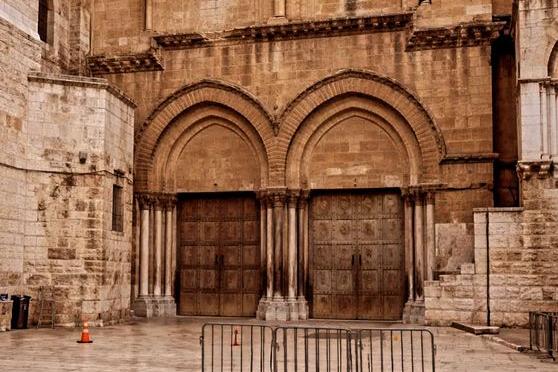
«Israel has closed the Church of the Holy Sepulcher indefinitely for the first time in the history of Christianity. Holy Week and Easter services will be prohibited. Sunday services cancelled.” This is the alarm circulating on the social networks of the Christian Churches in the Middle East. The Holy Sepulchre, which was closed on February 28, the day the bombings on Iran began, continues to remain inaccessible. It had never happened, in living memory, that Christians could not frequent the places where the passion, death and resurrection of Jesus took place for such a long period. Even during Covid, celebrations were allowed, albeit behind closed doors. During Lent, however, Israel blocked access “for security reasons” by closing the door that opens from the Christian quarter of the old city of Jerusalem onto the open space where the entrance to the Sepulcher stands. Father Ibhraim Faltas, head of the Custody’s schools, explains that the Churches are negotiating with the Israeli authorities so that at least Holy Week and Easter can be celebrated within the walls that guard Golgotha, the mountain where Jesus was crucified, and the empty tomb of Christ.
«The climate of terror in the Holy Land is reflected in the continuous fear of others and is the constant pressure of danger and insecurity to raise walls that cannot be seen, that cannot be touched but are harder than concrete and seem impossible to cross: we must unite to open them, or rather to throw them open to love for our suffering neighbors”, Father Faltas told the Vatican media. «Today, which is Friday in the season of Lent”, he tells Famiglia Cristiana, “we cannot do the Way of the Cross, we have not been able to celebrate the five Sundays of Lent, the patriarchs cannot enter. We hope that the situation will be resolved to allow us to enter for Holy Week so that the faithful who do not have access can follow the traditional rites through our broadcasts and pray with us.”
The Church of the Holy Sepulchre, commissioned by Emperor Constantine I, was destroyed by the Persian army in 614, almost demolished in 1009 and devastated by fire in the early 19th century. However, it had always remained open even during the two world wars.
Meanwhile too Muslim faithful, for the first time since 1967, were banned from entering the Temple Mount on the occasion of Eid al-Fitr, the celebration of breaking the fast which marks the end of the holy month of Ramadan for Muslims. Impossible to even try to get closer. Islamic institutions have condemned the ban, but so far without success.