



MumyMumy
  • News
  • Female Empowerment
  • Business
  • Politics
  • Career
  • Culture
  • Parenting
  • More
    • Web Stories
    • Popular
    • Pregnancy

Subscribe to Updates

Get the latest women's news and updates directly to your inbox.

Trending Now
here is the “magic dose” according to nutritionists

here is the “magic dose” according to nutritionists

11 December 2025
the well-established lie of airlines about the duration of flights

the well-established lie of airlines about the duration of flights

11 December 2025
A light of solidarity for Lucia and her family

A light of solidarity for Lucia and her family

11 December 2025
Healthy Christmas Recipes for Festive Eating

Healthy Christmas Recipes for Festive Eating

11 December 2025
Third Sunday of Advent (Year A) – 14 December 2025

Third Sunday of Advent (Year A) – 14 December 2025

11 December 2025
Facebook X (Twitter) Instagram
  • Privacy
  • Terms
  • Advertise
  • Contact
Facebook X (Twitter) Instagram Pinterest Vimeo
MumyMumy
  • News
  • Female Empowerment
  • Business
  • Politics
  • Career
  • Culture
  • Parenting
  • More
    • Web Stories
    • Popular
    • Pregnancy
Subscribe
MumyMumy
Home » how an almost invisible wave becomes a gigantic wall of water
Culture

how an almost invisible wave becomes a gigantic wall of water

By News Room9 December 20253 Mins Read
Share Facebook Twitter Pinterest LinkedIn Tumblr Reddit Telegram Email
how an almost invisible wave becomes a gigantic wall of water
Share
Facebook Twitter LinkedIn Pinterest Email

A tsunami is a geological phenomenon mainly generated by seismic ruptures or underwater landslides, linked to plate tectonics.

Tsunamis are among the most studied natural phenomena to understand how the Earth releases its energy. Beneath our feet, the ground is constantly moving even if we don’t feel it. Sometimes it starts under the sea. The word “tsunami” comes from the Japanese “tsu” which means “port” and “nami” which means “wave”. It thus defines a “port wave”. The term was coined by Japanese fishermen. When they returned from fishing, they observed significant damage in the port while the sea was calm offshore. They named these destructive waves after the place where their effects were most visible: the port. The term “tsunami” established itself in scientific vocabulary in the 1960s and 1970s. It has long been confused with that of “tidal wave” but it has no link with tides and weather conditions. But with what then?

A tsunami is the result of a sudden geological event that disturbs the ocean at rest. Most often, it is an underwater earthquake, sometimes an underwater landslide, more rarely a volcanic eruption or even a meteorite. Let’s take the most common case of an earthquake. The terrestrial crust which envelops the Earth is made up of tectonic plates, fitted one inside the other, which move. Some slide against each other; others deviate or overlap. In so-called “subduction” zones, it can happen that one plate slides under another. The crust heats up, deforms, breaks. The energy stored by the plates is suddenly released, causing the shaking characteristic of an earthquake. The water begins to move: waves first, then waves.

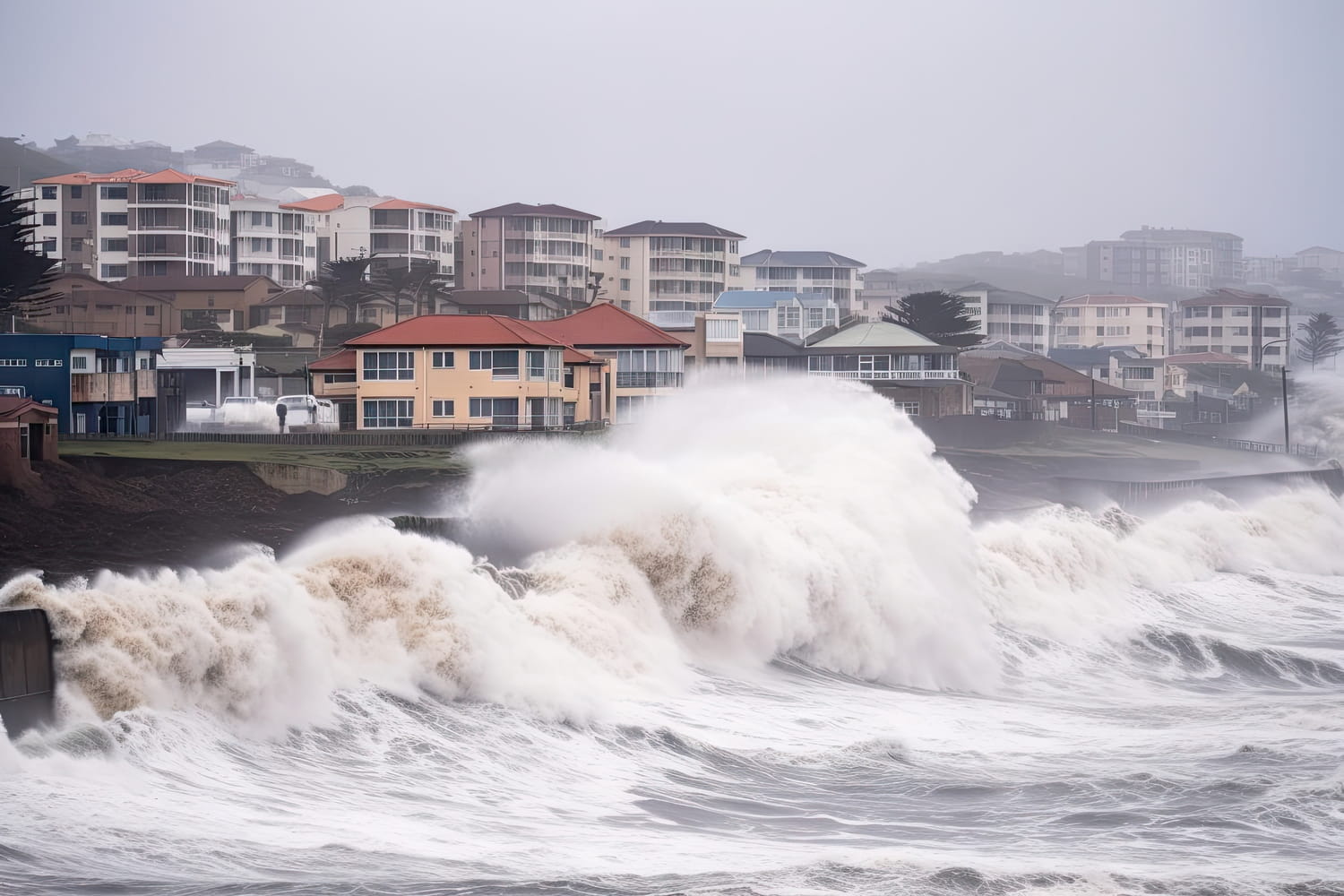
Initially, the waves are only a few centimeters but the closer they get to the coast (the speed of the waves can reach nearly 800 km/h), the less depth there is and the more the wave rises and gains height. A wave less than a meter high in the ocean can exceed several tens of meters at the shore. This is where the tsunami causes the sea to overflow and sometimes causes flooding far inland.

Diagram of the mechanism of tsunami formation © 123rf-Journal des Femmes

According to the Atomic Energy and Alternative Energies Commission (CEA), for an underwater earthquake to cause a tsunami, it must occur at a shallow depth (less than 50 or 100 km) and have a force or “magnitude” of at least 6.5. From magnitude 8, an earthquake can generate a potentially devastating tsunami at ocean level. On a daily basis, scientists observe land movements to spot tsunamis and warn countries in danger. Stations measure sea level in real time (“tide gauges” along the coast, “tsunamimeters” offshore) and can quickly identify a tsunami. On the ground, seismometers are used to measure vibrations and calculate the magnitude of earthquakes.

The Pacific area is the most exposed to tsunamis because it has many subduction zones, but there can also be some in the Mediterranean. In France, the risk exists, especially in the South. If this happens, experts recommend moving away from the sea immediately. A tsunami is not always visible before impact: ground shaking and/or a sudden retreat of the sea are warning signs. In this case, you have to flee without returning to look for anything, because the first wave is not always the strongest. You must then take refuge on the heights of the city, at least 10 meters above sea level.


Share. Facebook Twitter Pinterest LinkedIn Tumblr Email

Related Articles

here is the “magic dose” according to nutritionists
Culture

here is the “magic dose” according to nutritionists

11 December 2025
the well-established lie of airlines about the duration of flights
Culture

the well-established lie of airlines about the duration of flights

11 December 2025
It’s the most expensive city in France for couples: it’s not Paris!
Culture

It’s the most expensive city in France for couples: it’s not Paris!

11 December 2025
It was in this luxury hotel that room service was born.
Culture

It was in this luxury hotel that room service was born.

10 December 2025
here is when this phenomenon will occur and what it means
Culture

here is when this phenomenon will occur and what it means

10 December 2025
an old-fashioned entrance regains service and style
Culture

an old-fashioned entrance regains service and style

10 December 2025
Latest News
the well-established lie of airlines about the duration of flights

the well-established lie of airlines about the duration of flights

11 December 20250 Views
A light of solidarity for Lucia and her family

A light of solidarity for Lucia and her family

11 December 20250 Views
Healthy Christmas Recipes for Festive Eating

Healthy Christmas Recipes for Festive Eating

11 December 20250 Views

Subscribe to Updates

Get the latest women's news and updates directly to your inbox.

Popular Now
It’s the most expensive city in France for couples: it’s not Paris! Culture

It’s the most expensive city in France for couples: it’s not Paris!

News Room11 December 2025
Benigni, Pietro’s compelling story between beauty and entertainment Parenting

Benigni, Pietro’s compelling story between beauty and entertainment

News Room11 December 2025
It was in this luxury hotel that room service was born. Culture

It was in this luxury hotel that room service was born.

News Room10 December 2025
Most Popular
here is the “magic dose” according to nutritionists

here is the “magic dose” according to nutritionists

11 December 20250 Views
the well-established lie of airlines about the duration of flights

the well-established lie of airlines about the duration of flights

11 December 20250 Views
A light of solidarity for Lucia and her family

A light of solidarity for Lucia and her family

11 December 20250 Views
Our Picks
Healthy Christmas Recipes for Festive Eating

Healthy Christmas Recipes for Festive Eating

11 December 2025
Third Sunday of Advent (Year A) – 14 December 2025

Third Sunday of Advent (Year A) – 14 December 2025

11 December 2025
It’s the most expensive city in France for couples: it’s not Paris!

It’s the most expensive city in France for couples: it’s not Paris!

11 December 2025

Subscribe to Updates

Get the latest women's news and updates directly to your inbox.

Mumy
Facebook X (Twitter) Instagram Pinterest
  • Privacy Policy
  • Terms of use
  • Advertise
  • Contact
© 2025 Mumy. All Rights Reserved.

Type above and press Enter to search. Press Esc to cancel.