




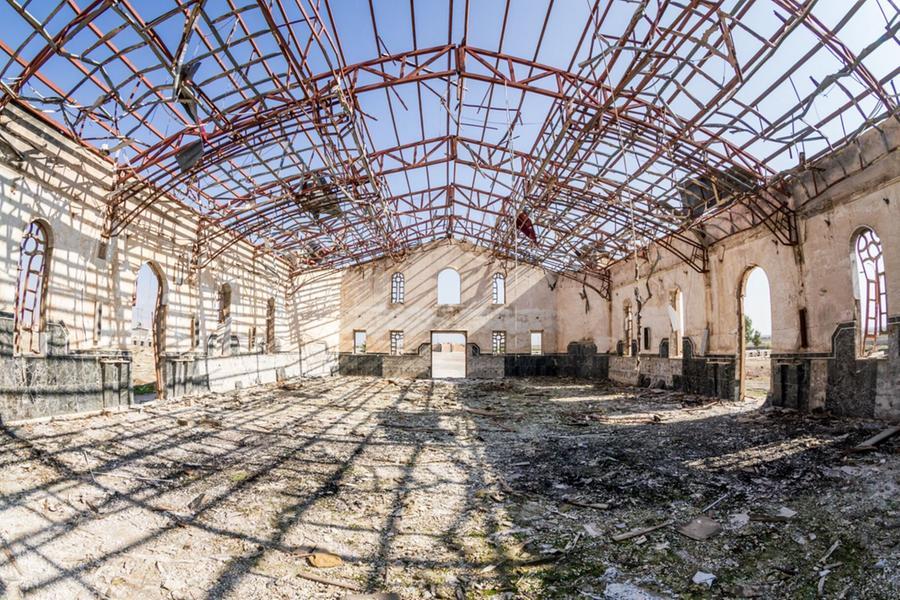
Globally, 1 in 7 Christians experience a high level of persecution and discrimination because of their faith. It means that there are over 388 million Christians persecuted.
The data is contained in World Watch Listthe annual report on the persecution of Christians in the world published by Porte Aperte/Open Doorsthe organization that has been engaged in field research into the causes and solutions to persecution since 1955, providing material support, emergency aid, literature, training and assistance to Christians who suffer because of their faith.
The 2026 Report presented today shows “the highest level of persecution since the World Watch List was published, confirming the constant increase in recent years”. From the 2021 edition, only nations with a very high and extreme level of persecution and discrimination are found in the map of the top 50 countries, thus the high level disappearing.
One Christian in every 7 is affected by this phenomenon: Dividing into macro-geographical areas they become: 1 Christian in every 5 in Africa; 2 Christians out of every 5 in Asia and 1 out of 12 in Latin America. Of these over 388 million, 201 million are women or girls (children under 15 are estimated to be around 110 million).
The countries that show a level of persecution and discrimination that can be defined as extreme rise from 13 to 15. North Korea remains stable in first place among the countries most hostile to Christians. The regime’s zero tolerance forces Christians to live their faith in secret, fueling the phenomenon of the underground or hidden Church. “Abundant evidence demonstrates how in the brutal interrogations of North Korean fugitives repatriated from China, they are expressly asked whether the fugitive has come into contact with Christians or churches on Chinese soil, confirming the regime’s dictatorial paranoia against the Christian community,” we read in the Report. It is estimated that there are between 50 and 70 thousand Christians locked up in forced labor camps.
After North Korea, the countries in which Christians are most persecuted are, in order: Somalia, Yemen and Sudan. “Here the sources of persecution”, explains the Report, “are connected to a tribal Islamic society, to active extremism and to the endemic instability of these countries: the Christian faith must be lived in secret
and, if discovered, Christians (especially if ex-Muslims) also risk death. In Sudan in particular, civil war has fragmented state authority, creating space for armed groups and areas where impunity is the norm. Churches have been occupied or destroyed, Christian leaders threatened or displaced and entire Christian families forced to flee repeatedly.”
Eritrea equates religious independence with political dissent and the World Watch List calls it the “North Korea of Africa.” The situation in Syria is worrying, where 27 Christians have been killed in one year and where political power
fragmented and disorderly “leaves space for radical actors who target Christians.”
Nigeria, bombed by Trump over Christmas with the aim of punishing the persecutors of Christians, remains stable in 7th place in the ranking, but has the sad record of being the country where the most Christians are killed in the world (3,490 in the last year). According to conservative data, from 2020 to today there have been over 25,200 victims.
Looking at global data, compared to 2025, in 2026: the number of Christians killed increased from 4,476 cases to 4,849, The number of churches or public Christian properties attacked with varying degrees of severity decreased from 7,679 cases to 3,632, the number of Christians detained and/or sentenced due to their faith remained almost unchanged from 4,744 cases to 4,712, the number of abducted Christians decreased from 3,775 to 3,302.
Faced with these data, Cristian Nani, president of Porte Aperte/Open Doors, notes that “the hidden Church is perhaps the fastest growing in the world”. For Nani “it is therefore crucial to return to talking about religious freedom in the public debate”.
“Open Doors asks the government to promote: religious freedom as a diplomatic priority, integrating it into trade negotiations; the religious literacy of its officials at various levels; collaboration with local religious actors, especially in sensitive areas such as the Sahel, to guarantee fairness in the distribution of aid, preventing discrimination”.