




Using animals to maintain links with dependent elderly people suffering from cognitive disorders. This is the animal mediation project set up at the Charpennes geriatric hospital in Villeurbanne. Meetings.
Soothe, mobilize and revalorize our elders. This is the objective of the animal mediation project launched in 2024 at the Charpennes geriatric hospital, in Villeurbanne. This establishment is part of the Institute of Aging of the Hospices Civils de Lyon and is particularly renowned for memory pathologies and Alzheimer’s diseases. It accommodates, in its long-term unit, around fifty residents, aged 70 to 100 and very dependent. “It works a bit like a nursing home, but with a greater level of medicalization”explains Alice François, facilitator and organizer of mediation in the unit. Many of them have major difficulties communicating, sometimes without the possibility of verbal expression. The idea of animal mediation is not just fun. It is a real supportive treatment in its own right to improve the well-being of these people. How does it work in practice?
“Their social role, often diminished with age, returns”
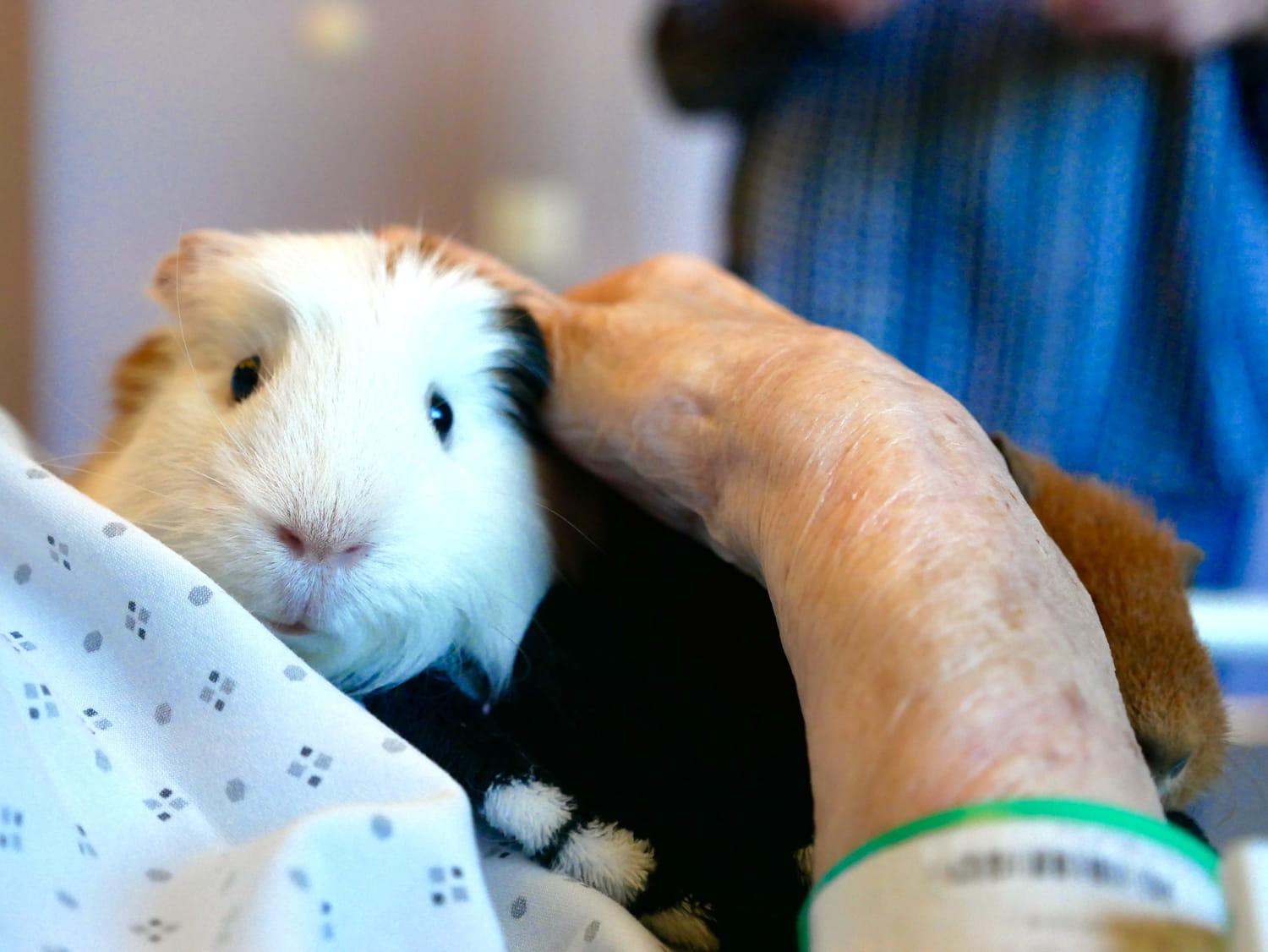
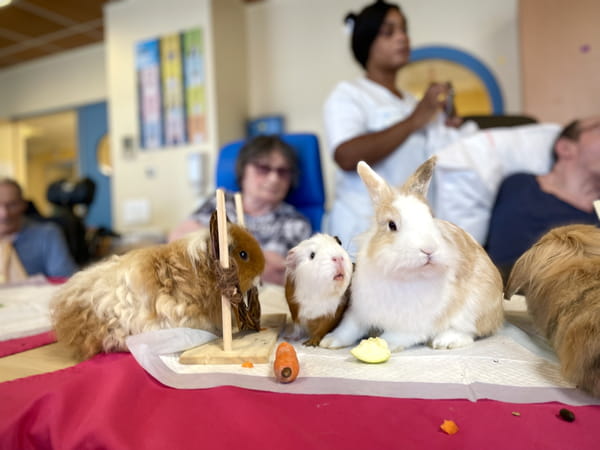
“Animals that come into the unit are not residents’ pets,” Alice François immediately tells us. These are animals offered by the Tendre Patte association, in partnership with the Charpennes hospital. “A worker from the association comes once a week to meet the residents. She offers group sessions, which allows people to connect around activities with animals, and individual sessions in rooms because we have many residents who are permanently bedridden or who cannot leave their rooms.” Residents observe the animals, caress them, feed them. “They take care of someone else, their social role, often diminished with age, returns, it gives them a mission and allows them to be revalued” deciphers Angèle Bernaudat, psychomotor therapist in Charpennes.
The animals that participate in mediation are not chosen at random. There is the dog of course, a faithful friend of man, but also rabbits, chinchillas, mice and especially the guinea pig. “It is a species that is particularly suitable for animal mediation because it is very sociable with humans and not very fearful” shares Alice François. “The guinea pig always has its effect, confirms Angèle Bernaudat. We put it on the table, it is within reach of the residents, contact is easy, it is small, soft, I have never seen a resident resistant to the guinea pig. There is a strong sensory aspect to these moments.” This is one of the benefits of animal mediation: the stimulation of the elderly person’s senses through touch. And it’s not the only one.
“Animal mediation has benefits in many different and very important spheres for the elderly: sensory but also cognitive and motor” continues the psychomotor therapist. On a cognitive level, “the animal will lead the resident to spontaneously talk about their memories with animals from their childhood or that they had at home before arriving in the unit, it brings a positive experience, it promotes spontaneous well-being, without us needing to ask them questions”. This is where the role of the animal reveals all its importance. It stimulates the resident naturally, sometimes better than humans.
“The animal appeals to something very archaic in us, it cannot be explained”
“Patients will spontaneously mobilize at the sight of the animals whereas during a rehabilitation session, bodily engagement is much less important” notes Angèle Bernaudat. As Alice François recalls “the animal appeals to something very archaic in us, it cannot be explained. For us, it’s a big victory to arouse this interest, to get the person to want to move, to move around, to get out of their room.”
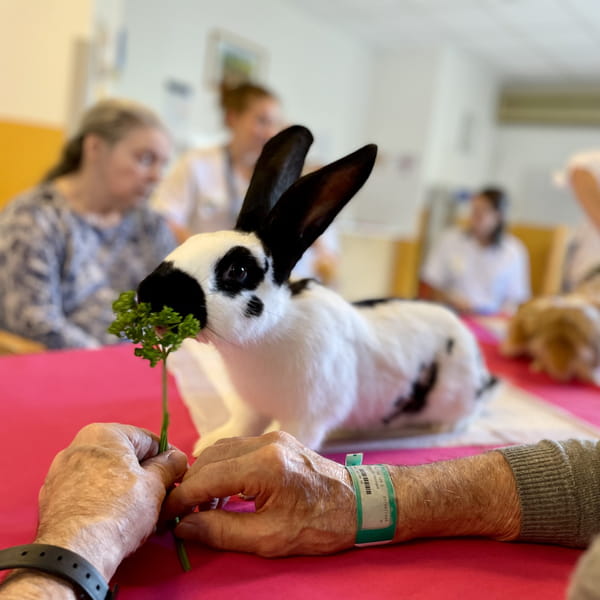
The sessions serve as a working support for caregivers: “The majority of people with cognitive disorders do not remember the sessions. We reuse the reminiscence of what they told us during the session to get in touch with them: ‘You told me that you lived on a farm with such and such an animal?'” says Angèle Bernaudat. This mediation also allows those close to them to maintain contact with the resident. As the psychomotor therapist observes, “often, with dementia and cognitive disorders, verbal communication is impaired and it is complicated for families to enter into relationships with their loved ones. Animal mediation is a different vector, it allows us to re-establish this communication, which is always non-verbal but different, it gives a tool to those around us who are sometimes deprived. When they come to the sessions, they can say for example “Do you remember when we had our cat? You scolded him because he had done…”, it brings back positive memories, it reconnects people”.
Are there any refractories? “It’s rare” our speakers respond. When this happens, it is more often for cultural reasons or fear of the animal (mice or rats, most often). In any case, there are no contraindications. Each resident, regardless of their state of health, can participate in animal mediation if they wish. And for caregivers, this project is a real joy on a daily basis: “Seeing the residents cheerful as soon as the animals arrive, seeing their faces light up, it’s spontaneous, instinctive. And it proves that love for animals continues even with cognitive disorders or dementia” concludes Angèle Bernaudat.
Thanks to Alice François and Angèle Bernaudat. Comments collected on February 16 and 17, 2026.