





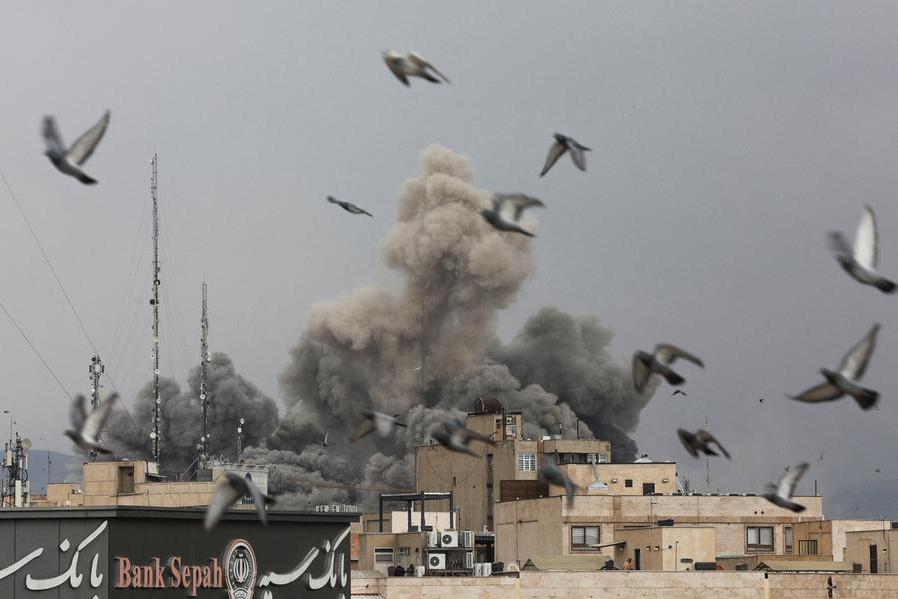
Three days after the attack by Israel and the United States against Iran, the new conflict that has broken out in the Gulf region shows no signs of abating. Tehran’s response caused the conflict to spread across the region and beyond. American military bases and civilian installations have become the target of missiles and drones launched by Iran. There are at least 9 countries targeted by Tehran, from Qatar to Bahrain, from Jordan to Iraq. Saudi Defense Ministry spokesman Major General Turki al-Maliki announced the interception and destruction of five hostile drones near Prince Sultan Air Base on Monday.
Earlier, al-Maliki confirmed that two drones attempting to strike the Ras Tanura refinery near Dammam had been successfully intercepted.
Israel is obviously also in the Iranian regime’s sights. Since Saturday, warning sirens have been pushing Israelis towards shelter, but the missile and drone interception system shows its flaws. On Sunday, 9 people were killed by a missile that hit a shelter in Beit Shemesh, not far from Jerusalem.
19 people were injured by an Iranian missile launch in the southern Israeli city of Be’er Sheva on Monday.
Meanwhile, the Israeli army has resumed military operations against Lebanon following attacks launched over the weekend by Hezbollah, a political and paramilitary force allied with Tehran. In the early afternoon of March 2, the Israeli army called on the inhabitants of several buildings in the Bourj al-Barajneh neighborhood, in the southern suburbs of Beirut, to evacuate before imminent attacks.
Israelis and Americans continue to bomb Iran, while the regime tries to organize its survival after the death of the country’s main political leaders, first and foremost Ayatollah Ali Khamenei, Supreme Leader of the theocracy that governs Iran after the Islamic revolution of 1979.
The Israeli military said it had bombed at least 600 targets in Tehran and across the country, without encountering any resistance from Iranian air defenses. According to the emergency service of the Iranian Red Crescent, more than 550 people have been killed in Iran since the start of the war.
Donald Trump multiplies his statements, often sending contradictory signals, to justify the military operation and prepare public opinion for the loss of soldiers. On Sunday, with his usual bombast, Trump said the joint US-Israeli attack was “one of the largest, most complex and most overwhelming military offensives the world has ever seen. No one has ever seen anything like it.”
Since Saturday, four US soldiers have already been killed in military operations against Iranalthough the circumstances in which their killing occurred were not specified. Meanwhile, three American jets were shot down over Kuwait during “an apparent friendly fire incident” as they participated in the campaign against Iran, the U.S. Army Central Command said in a statement Monday.
“During active combat (which included attacks by Iranian aircraft, ballistic missiles and drones) US Air Force fighter jets were shot down by Kuwaiti air defenses in error,” the Central Command statement said. All six crew members “ejected safely, have been recovered and are in stable condition,” the statement added. The episode is a major setback for a president who has often evoked the failed blitz against Iran ordered in 1980 by President Jimmy Carter to free the American hostages held by the Iranian regime.
Trump foresees a conflict lasting several weeks, but the goal remains uncertain. As he recalled New York Times“there are few, if any, examples in history of overthrowing the government of a large nation – in this case some 90 million people – by air power alone.” Trump does not seem willing to send soldiers on the ground and is inciting the Iranian people to rebel against the regime. But Trump speaks to an unarmed people, without political leadership, who have already paid a very high price, with tens of thousands of deaths, after the violent repression of recent months.