





The Covid-19 virus has not disappeared. According to the Public Health France bulletin of February 25, 2026, the virus is increasing in wastewater…
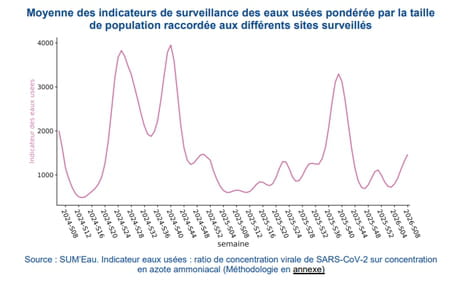
In its epidemiological bulletin of February 25, 2026, Public Health France confirms that “SARS-CoV-2 tracking indicator in wastewater is still increasing.” It is generally this indicator which confirms the circulation of the virus in the population and a probable increase in cases in the weeks to come. Santé Publique France also specifies that the circulation of the virus in wastewater at the end of February “is located at a upper level to that observed last year at the same period, reflecting a active circulation of SARS-CoV-2 in the population without visible repercussions on the use of care at this stage”.
Covid figures at the moment
The circulation of Covid remains “stable” at the end of February 2026 “and at low levels in the city and in the hospital”. But the positivity rate is lightly increase in hospital. From February 16 to 22, 2026, among patients seen in general medicine consultation for an acute respiratory infection, the incidence rate of COVID-19 cases was estimated at 4 cases per 100,000 residents.

What is the majority Covid variant at the moment?
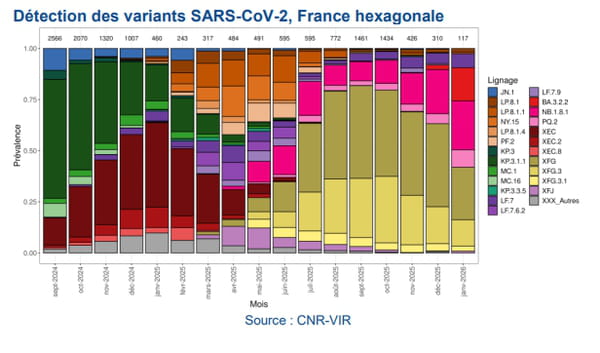
In January 2026, in France, the XFG variant remains the most common. Another variant, called BA.3.2.2, recently appeared in the territory, represents around 16% of the viruses analyzed. If we take into account all their sub-variants, XFG brings together a little more than 4 cases of Covid out of 10 and NB.1.8.1 around 3 out of 10 among the samples studied. THE variant BA.3.2 has been classified “under surveillance” by the World Health Organization in December 2025. Spotted for the first time in South Africa at the end of 2024, it presents numerous modifications to its Spike protein, the key which allows it to enter cells. In the laboratory, it seems to escape antibodies better, but there is currently no indication that it is more contagious or that it causes more serious forms. The WHO therefore estimates that the risk to the population remains low at this stage. Worldwide, 866 cases of BA.3.2 have been recorded in the international GISAID database, i.e. a very limited portion of the viruses sequenced. In France, 19 cases were identified in January.

5 anti-Covid measures (still) in force in 2026
► It is recommended to isolate yourself if you test positive for Covid-19.
► It is recommended to wear a mask if you have symptoms suggestive of Covid-19 or if you are a person at risk of developing a serious form of the disease in the event of infection, particularly in enclosed or densely populated places.
► Elderly people or those with risk factors are called upon to be (re)vaccinated against Covid-19 in the spring and fall, annually.
► It is always recommended to ventilate your home for at least 5 to 10 minutes per hour to reduce the risk of transmitting the virus. Same thing at work and in collective spaces.
► We must maintain barrier gestures, particularly in the event of a positive test and/or symptoms, in order to protect vulnerable people: regular hand washing, ventilation of enclosed spaces, wearing a mask in enclosed spaces conducive to gatherings (public transport for example).
What are the measures for Covid vaccination?
Vaccination against Covid-19 today primarily targets people at risk of serious forms (over 65 years old, pregnant women, etc.) with booster vaccinations recommended every fall (like the flu). Those over 80, immunocompromised people and residents of nursing homes and USLDs are also invited to get a booster vaccination in the spring and autumn of each year (at the same time as the flu vaccination which begins in mid-October). Anyone who wishes to be vaccinated against Covid (and who is not at risk) can do so in a pharmacy. The vaccine used for boosters is the Comirnaty® vaccine, a messenger RNA vaccine (Pfizer-BioNTech Laboratory).
What are the current measures regarding contact cases?
There is no no more official “contact case” status. Since February 1, 2023, the realization of a screening test on the second day of notification of contact status for asymptomatic contact persons no longer required. On the other hand, symptomatic people continue to have to be tested and contact people can also do so if in doubt.
What are the current measures regarding wearing a mask?
THE wearing a mask is no longer compulsory nowhere. But, in the event of a resumption of Covid circulation, there remains recommended to wear it:
- if you are positive for Covid-19
- in the event of symptoms suggestive of Covid-19
- for prevention in closed and promiscuous places and public transport (metro, train, bus, plane, etc.);
- in large gatherings, including outdoors, for vulnerable people because of their age or pathologies;
- in the presence of elderly people, immunocompromised people or people suffering from chronic illnesses;
- for vulnerable people (elderly or immunocompromised people, etc.).
What are the Covid measures in hospitals in 2026?
► Wearing a mask may be made compulsory in certain hospitals inside buildings for patients leaving their rooms in hospitalization, in day hospitals, in consultations as well as for visitors, companions and those working with patients (ex-ambulance workers).
► Wearing a mask remains compulsory for hospital staff in places where patients are located (conventional hospitalization, consultation, day hospital, circulation corridors).
Wearing a mask is no longer compulsory in offices, meeting rooms, transmission rooms, rest rooms, as well as in services and places not open to patients (laboratories, nurseries, etc.)
► Wearing a mask is compulsory, regardless of the location, for hospital staff who present symptoms suggestive of ENT or respiratory infection.