






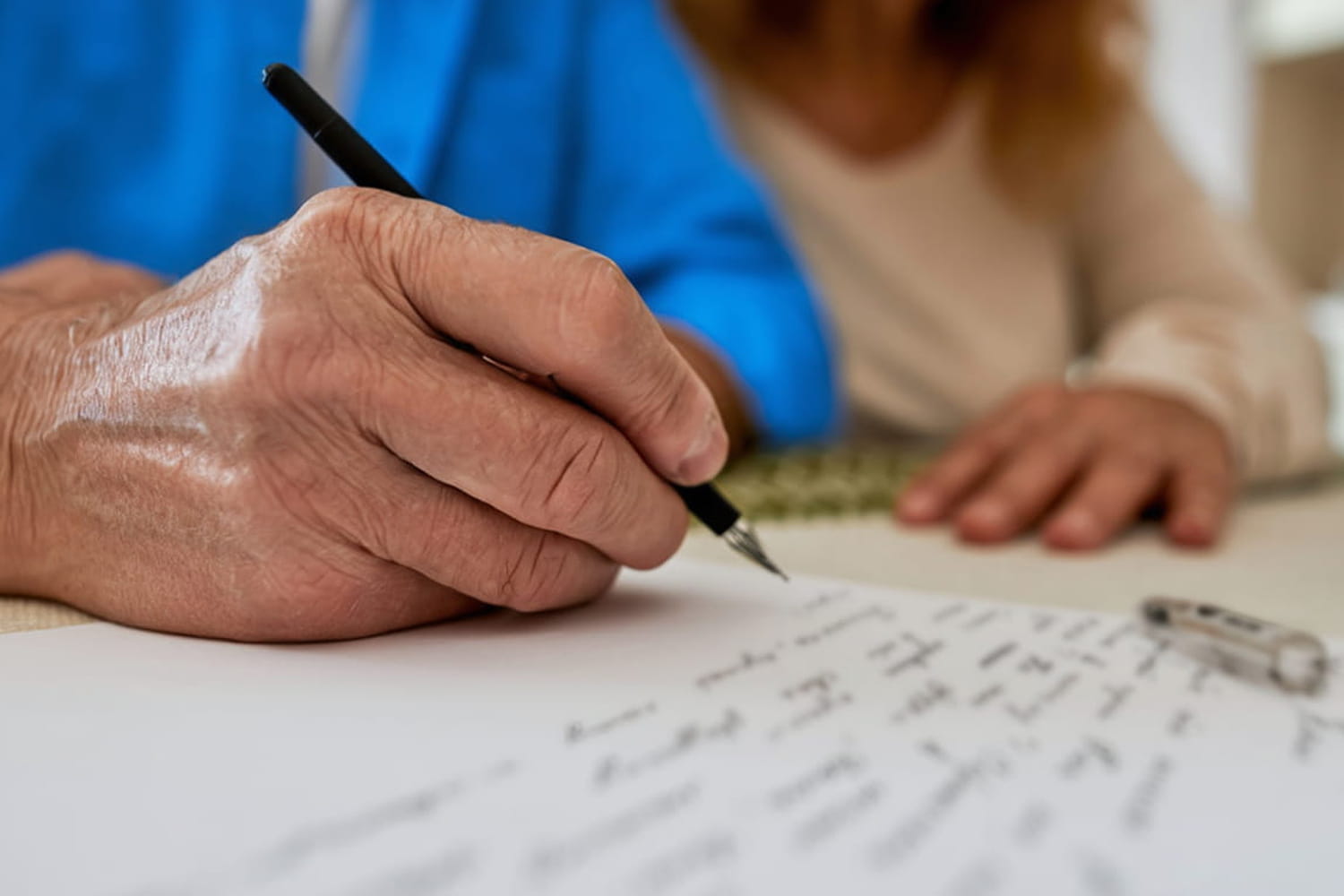
Writing disorders appear in more than 90% of people with Parkinson’s. According to experts from France Parkinson, a specific change shows that the brain is losing its automatisms. The disease progresses…
For many neurologists, observing a patient’s handwriting offers valuable clinical clues in the detection of Parkinson’s, sometimes years before the first tremors appear. It is a way to assess fine motor skills and the state of the nervous system. Because when the brain starts to tire, writing becomes a real struggle. What we often mistake for simple fatigue or a sign of aging is in fact a technical glitch: the brain loses automatic control of the hands. Writing can then lose all its naturalness and becomes increasingly difficult to train, underlines the France Parkinson Association during a press conference organized for World Disease Day on April 11.
Writing disorders appear in more than 90% of people with Parkinson’s disease at one stage or another. Even more striking, a study published in the Journal of Neurology suggests that these alterations can be detected in approximately one third of patients even before a formal diagnosis of Parkinson’s is made. Deprived of dopamine, the brain loses its natural reflexes. Writing then becomes a high-precision task that requires an exhausting effort of concentration, which slows down the speed of execution and modifies the pressure exerted on the paper.
The revealing detail in the writing, often ignored by patients themselves, has a precise medical name: micrographia. It is the fact of having a writing that manifests itself by a systematic narrowing of the letters as the sentence progresses (see the image below). While the first word of a line may appear normal, subsequent words compress and sag, sometimes ending up as a single, illegible stroke. This phenomenon is explained by a reduction in the amplitude of movement. In short, the brain sends the order to write a letter of normal size, but the signal short-circuits along the way: the hand only performs a fraction of the gesture. As a result, the letters shrivel to become tiny, often measuring less than 3 millimeters in height.
“Be careful though: shrinking handwriting does not automatically mean you have Parkinson’s. Taken alone, this detail is not enough to make a diagnosis; doctors generally look for other signals such as sleep disturbances, slowness of movements, tremors at rest, loss of smell or muscle stiffness“, explains Amandine Lagarde, general director of France Parkinson. But identifying this micrograph remains a gateway to early treatment. By detecting changes early in the patient, we can begin rehabilitation therapies before autonomy is too affected.
Even if Parkinson’s disease cannot yet be cured, we can slow down its effects on daily life. Rehabilitation exercises of “forced calligraphy” (forcing yourself to write large) or the use of large diameter pens can help stimulate the brain so that it regains its automatisms. By acting from the first visible signs on paper, we sustainably improve the quality of life and maintain control of our movements for longer.
Article produced on the occasion of the Press Conference “State of knowledge on Parkinson’s: still the most unknown of known diseases!” organized by France Parkinson on March 31, 2026.