



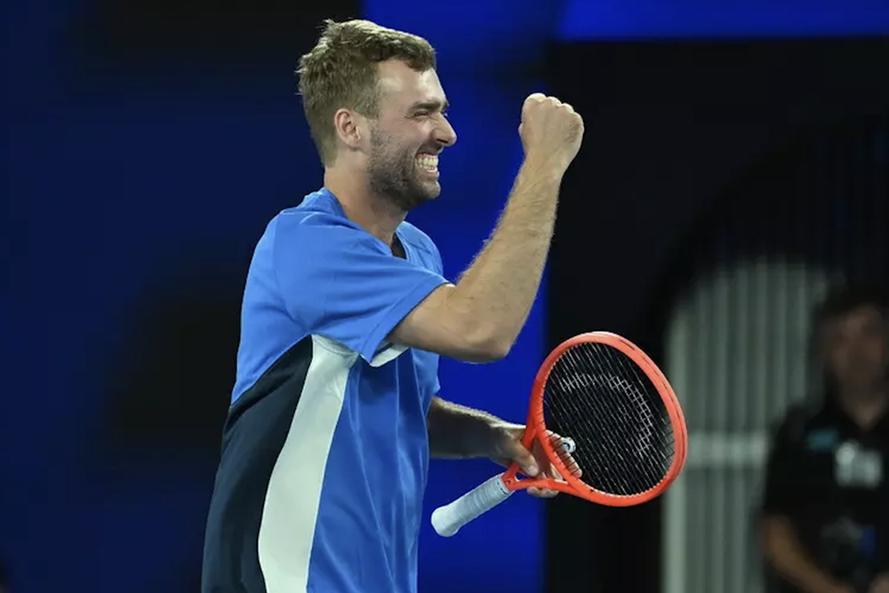
There’s something about it extraordinarily human, perhaps even touchingin what happened on Wednesday evening (Australian time) at Melbourne’s Rod Laver Arena. As world tennis prepared for its first Grand Slam of the season, as champions sharpened their weapons for battles that would span five sets and hours of battle under the Australian sun, one Sydney amateur proved that sometimes all it takes is one point. Just one point. To change lives, to rewrite hierarchies, to remind us that this sport – like life – can be unpredictable until the last moment.
Jordan Smith is thirty-two years olda racket lived by the salt of sweat and the Australian alone, and the smile of those who know that this moment will probably never return. It’s a coach at Castle Hill Tennis Academyone of those structures that dot the outskirts of big cities, where dreams are cultivated on ten synthetic pitches and are nourished by passion rather than sponsors. Tennis is in his DNA: his father Neil, a former professional who played the circuit before dedicating himself to teaching, raised him on those courts. Mother Michelle manages the administration. Brothers Cameron and Blake are also coaches. A miniature dynasty, made not of sensational victories but of that silent continuity that keeps the sport alive at the base.
As a boy, Jordan had won two junior national titles in singles and three in doubles. He had played against Cameron Norrie and – the current world No. 3 – Alexander Zverev when they were all teenagers with dreams bigger than their serve. Then the reality: not everyone becomes Sinner or Alcaraz. Some remain, teach, transmit. And perhaps this is precisely what makes his victory even more precious.
The “1 Point Slam” format is one of those ideas that on paper seems like a whim, a diversion to entertain the audience before the real battle begins. Twenty-four professionals — from Sinner to Swiatek, from Alcaraz to Gauff — against just as many amateurs and celebrities. Rock, paper, scissors to decide who is needed. Professionals with only one service available, amateurs with two. One clear point, and the loser goes home. Winner takes all: one million Australian dollars to the winner.
But tennis is strange, like life. And in this compressed, spectacular, almost playful format, without a safety net, without the possibility of recovering the deficit in the next game, luck and nerves count more than ranking. Two-time Australian Open champion Jannik Sinner found this out when he served into the net against Smith in the third round. A banal mistake, the kind that is never made in a real match. But this was different: this was theater of the absurd, where the lightness of the moment merges with the pressure of a single moment and even the best can falter. Or at least be wrong.
Smith moved on. She beat Amanda Anisimova, the women’s world number four, with that solidity that he himself defines as “being a brick wall”: making lots of balls, waiting for the opponent to make a mistake. A modest, almost humble philosophy, but effective when the margin of error is zero. In the semi-final he overcame Pedro Martinez at the end of a real exchange, perhaps the only one of the evening that recalled the tennis we know. Then the final against Joanna Garland, number 117 in the world, who had eliminated Zverev, Kyrgios, Sakkari along the way. Another outsider, another unlikely story.
Garland served wide. Smith responded profoundly. She hit an oversized forehand, and it was all over. A million dollars, in front of fifteen thousand crazy peopleunder the lights that saw Federer, Nadal and Djokovic triumph. Smith said he will use the money to buy a house. “Or maybe half a house,” he joked, “prices in Sydney are crazy.” It is the comment of a man who has not lost contact with the real world, who knows that tomorrow he will return to his students, to his synthetic fields, to normal life.
There are those who will say that it was just a game, an exhibition, that true champions are measured over five sets and not on Chinese morra. And it’s true. But that would be missing the point. Because what happened on Wednesday night in Melbourne was not a victory in the classic sense of the term. It was the demonstration that in tennis, as in life, there is space for the imponderable, for the stroke of luck that rewards those who are ready, for the moment in which David can truly beat Goliath.
Jordan Smith is not stronger than Sinner. He would probably lose 6-0, 6-0, 6-0 in a real Slam match. But at that point, at that precise moment, he was more solid, more focused, luckier. And that’s enough. It’s enough to make history, to remind us that tennis – this sport obsessed with rankings, seedings, favorites – can still surprise us. He can still give us stories like this: of an ordinary man, with a racket in his hand and an impossible dream, who became a millionaire for one evening. One point at a time.