





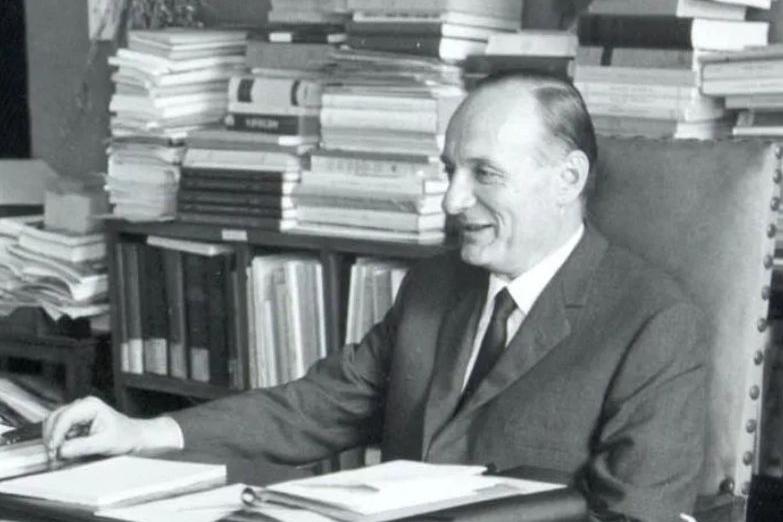
On the eve of the Ascension, the memory of Professor Giuseppe Lazzati once again filled the church of Sant’Antonio in Milan. Forty years after his death on 18 May 1986, the Ambrosian city wanted to pay homage to one of its clearest figures: an intellectual, a founding father, a tireless educator and, since 2013, a venerable member of the Catholic Church. The central event of the commemoration was the Mass presided over by the archbishop Monsignor Mario Delpini, who offered a prophetic portrait of Lazzati, defined as “a serious man who took the word of Jesus seriously”.
Taking inspiration from chapter 15 of the Gospel of John and the Lord’s invitation to “Remain in Him”, Monsignor Delpini outlined the red thread of the professor’s life: perseverance. «Lazzati listened to the word of Jesus and made it the rule of life that guided all his days and inspired all his choices». An existence lived far from passing fashions, which the Archbishop defined as “the vagabonds of caprice”, and even further from rhetoric, sentimentality and compromises.
It was precisely this evangelical seriousness that made Lazzati «exemplary in perseverance, reliable in responsibilities». And “therefore he endured the trials, the hardships, the conflicts”, added Delpini, recalling the coherence that led him to refuse to join fascism and to suffer deportation to Nazi concentration camps.
A consecrated layman, a man of great humanity and culture, he remained impressed, in his youth, by reading the biography of Pier Giorgio Frassati so much that he wanted to take him as a spiritual model. Later, in 1931 (he was born in 1909), the course of spiritual exercises led by Father Agostino Gemelli and Monsignor Francesco Olgiati convinced him to choose secular consecration. After having served in the Alpine army, he was called to collaborate at the Diocesan Catholic Action Center in Milan. In 1933, Cardinal Schuster wanted him president of the diocesan Federation of Catholic Youth. A position he held until 1943 when he was interned in a concentration camp in Stablak and then in Deblin-Irena. When he has the chance to be freed thanks to Gemelli’s interest, he prefers to stay to support the other inmates. He was transferred to three other different concentration camps until at the end of the war, in 1945, he managed to return to Italy. His experience and sensitivity made him a leading man for the civil and moral reconstruction of Italy after the fall of fascism. He was first elected city councilor in Milan, then national councilor of the Christian Democrats and, finally, member of the Constituent Assembly.
A life committed to building that “city of man” where everyone can find citizenship. An earthly society guided by democratic and evangelical values, which, while eschewing clericalism, does not deny faith. A concept, his, to which he dedicated his reflection until the last days of his life, imagining it not as a theocracy, but a place where lay believers must act as mature citizens, taking political and social responsibility for the common good.
Having fallen ill with cancer, he died in the early hours of the feast of Pentecost. The funeral was celebrated in the cathedral by Cardinal Carlo Maria Martini and the body was moved, in 1988, to the hermitage of San Salvatore in Erba, where Lazzati held vocational courses and spiritual retreats especially for young people. On 18 May 1991 the journey towards the altars desired byCristo Re Secular Institute, founded by Lazzati himself. On 5 July 2013, Pope Francis promulgated the decree recognizing the “heroic virtues” of the Servant of God, thus conferring on him the title of Venerable. A recognition that establishes the reputation for sanctity of a consecrated lay person who was able to embody the Gospel in the complexities of politics, university and ecclesial life of the twentieth century.
The commemoration of May 16th also saw the presentation of three new volumes dedicated to his thought, testifying to a reflection that never stops questioning the present. The hope launched by the Ambrosian church is that Lazzati’s example can indicate the way to “save us from contemporary shipwreck”. Forty years after his death, Giuseppe Lazzati remains a beacon for lay people and believers, a teacher for those seeking an authentic Christianity, far from shortcuts and faithful to the rock of the Gospel.
«Remaining in communion with Jesus, docile to grace», concluded Monsignor Delpini, «it produced fruits that still rejoice in those who know how to appreciate serious and true things.”