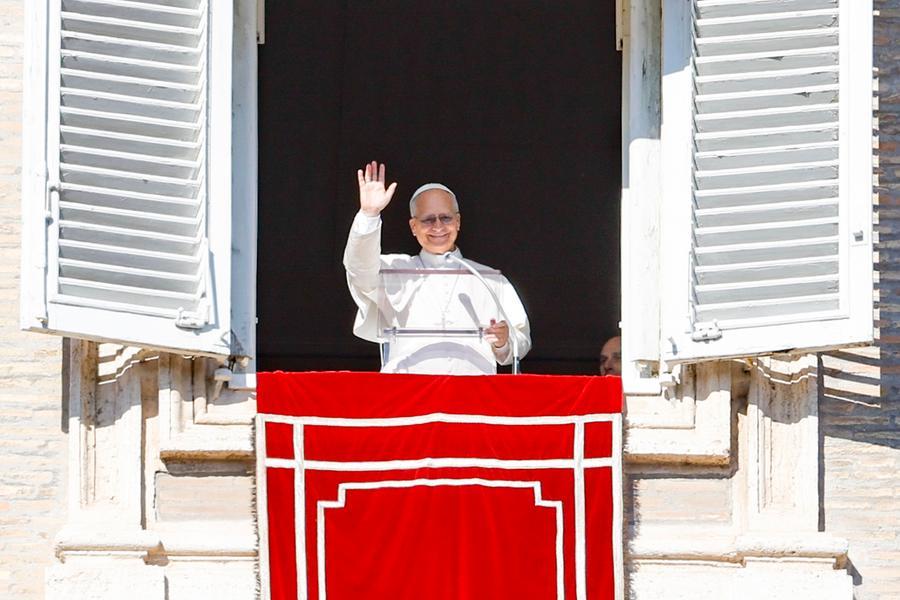


The words that make the news arrive after the Angelus. As often happens, it is there that the Pope leaves aside the liturgical commentary and looks history in the face. And this time history has the harsh face of the Middle East.
Pope Leo XIV’s thoughts turn to “what is happening in these days in the Middle East, in particular in Iran and Syria”where – he said – “persistent tensions are causing the deaths of many people”. No mincing words, no formal diplomacy: the Pontiff notes the facts and indicates the only possible path, the one that politics continues to postpone. “I hope and pray that dialogue and peace will be patiently cultivated, pursuing the common good of the entire society.”
It is an ancient, almost traditional call, but today it sounds against the grain. Because talking about patience and dialogue while weapons decide borders is unpopular. Yet this is precisely the point: without dialogue there is no future, only a self-reinforcing spiral of death.
The reference to Ukraine falls into the same vein. Leo Here the Pope insists on the concrete face of war: not strategies, but the civilian population affected, families in the dark and in the cold. The prayer is accompanied by a new appeal “to cease the violence and intensify efforts to achieve peace”.
Before these passages, the Pontiff had remembered the Baptism of some newborns, according to the tradition of the feast, extending the blessing to all children baptized in these days, especially to those born “in more difficult conditions”. It is a deliberately clear contrast: on the one hand the fragility of the life that is born, on the other the brutality of the conflicts that deny it.
Leo XIV does not invent solutions, he does not promise miracles. He tells it like it is. Peace does not arise from slogans, but from a patient and stubborn choice. And time, if not governed, becomes an accomplice to violence.
And those words, spoken before the conflict roll call, give the context and weight to everything else. Because at the Angelus Leo
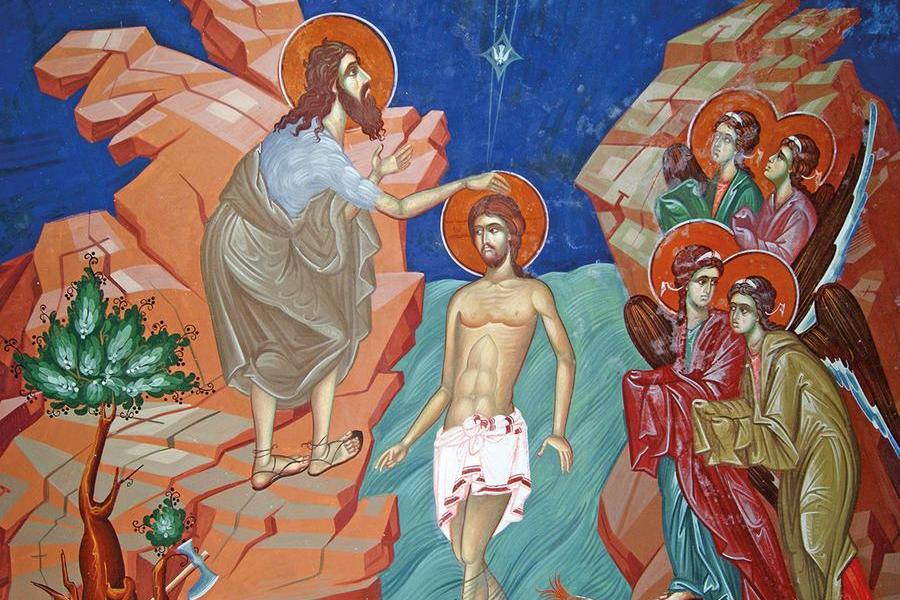
The Pope recalled that Baptism “makes us Christians, freeing us from sin and transforming us into children of God”, inserting us into a concrete story, not into an abstract devotion. Commenting on the Gospel of the Jordan, he insisted on a decisive passage: God does not remain distant, he does not look at the world “from above”. “God does not look at the world from afar, without touching our lives, our evils and our expectations,” he said. On the contrary, he enters history, gets his hands dirty, goes down into the water together with sinners.
This is the heart of the message: a God who does not dominate, but serves; which does not condemn, but saves. Jesus, the Pontiff explained, “comes to serve and not to dominate, to save and not to condemn”. Words which, read in light of the international crises mentioned after the Angelus, sound like an implicit criticism of every logic of power, of every war justified in the name of order or security.
Baptism, he continued, is not a rite of the past, but a fact that accompanies all of life: «In the dark hours, Baptism is light; in the conflicts of life, Baptism is reconciliation; at the hour of death, Baptism is the door to heaven.” It is an ancient, almost elementary, but radical vision. And for this very reason it is uncomfortable.
It is no coincidence that Leo XIV invited the faithful to remember the gift received, testifying to it “with joy and coherence”. A challenging word, coherence, especially when the world seems to be going in a completely different direction. Yet it is from there that the Pope starts again: from personal and collective responsibility, from the Church as a people of men and women of every culture, regenerated by the same Spirit.
Then, without interruption, the gaze broadened to the wounded history of the present: Iran, Syria, Ukraine. From the source of Baptism to the battlefields. As if to say that faith, if it doesn’t reach that point, remains a harmless exercise. And that peace, today more than ever, is not a slogan: it is a demanding, slow, counter-current choice. But it is the only one that opens up a future.