




We are publishing the full text of Pope Leo’s Message for the next World Day of the Sick scheduled for February 11th.
Dear brothers and sisters!
The XXXIV World Day of the Sick will be solemnly celebrated in Chiclayo, Peru, on 11 February 2026. For this occasion I wanted to re-propose the image of the Good Samaritan, always current and necessary to rediscover the beauty of charity and the social dimension of compassion, to focus attention on the needy and the suffering, such as the sick.
We have all heard and read this moving text by Saint Luke (see Luke 10:25-37). To a doctor of the law who asks him who the neighbor to love is, Jesus responds by telling a story: a man traveling from Jerusalem to Jericho was attacked by thieves and left half dead; a priest and a Levite passed by, but a Samaritan had compassion on him, bandaged his wounds, took him to an inn and paid for him to be treated. I wanted to propose reflection on this biblical passage, with the hermeneutic key of the Encyclical Brothers all, of my beloved predecessor Pope Francis, where compassion and mercy towards the needy are not reduced to a mere individual effort, but are realized in relationships: with the brother in need, with those who care for him and, ultimately, with God who gives us his love.
The gift of meeting: the joy of giving closeness and presence
We live immersed in the culture of speed, immediacy, haste, but also of waste and indifference, which prevents us from approaching and stopping along the way to look at the needs and suffering that surround us. The parable tells that the Samaritan, seeing the wounded man, did not “pass on”, but had an open and attentive gaze on him, the gaze of Jesus, which brought him to a human and supportive closeness. The Samaritan “stopped, gave him closeness, cared for him with his own hands, paid out of his own pocket and took care of him. Above all he gave him (…) his time.” Jesus does not teach who our neighbor is, but how to become neighbor, that is, how to become neighbor ourselves. In this regard, we can affirm with Saint Augustine that the Lord did not want to teach who that man’s neighbor was, but to whom he should become neighbor. In fact, no one is a neighbor to another until he approaches him voluntarily. Therefore he who had mercy became a neighbor.
Love is not passive, it goes towards the other; being close does not depend on physical or social closeness, but on the decision to love. For this reason the Christian becomes a neighbor to those who suffer, following the example of Christ, the true divine Samaritan who approached wounded humanity. These are not simple gestures of philanthropy, but signs in which one can perceive that personal participation in the suffering of others implies giving oneself, it means going beyond the satisfaction of needs, to ensure that our person is part of the gift. This charity is necessarily nourished by the encounter with Christ, who gave himself for us out of love. Saint Francis explained it very well when, speaking of his encounter with the lepers, he said: “The Lord himself led me among them”, because through them he had discovered the sweet joy of loving.
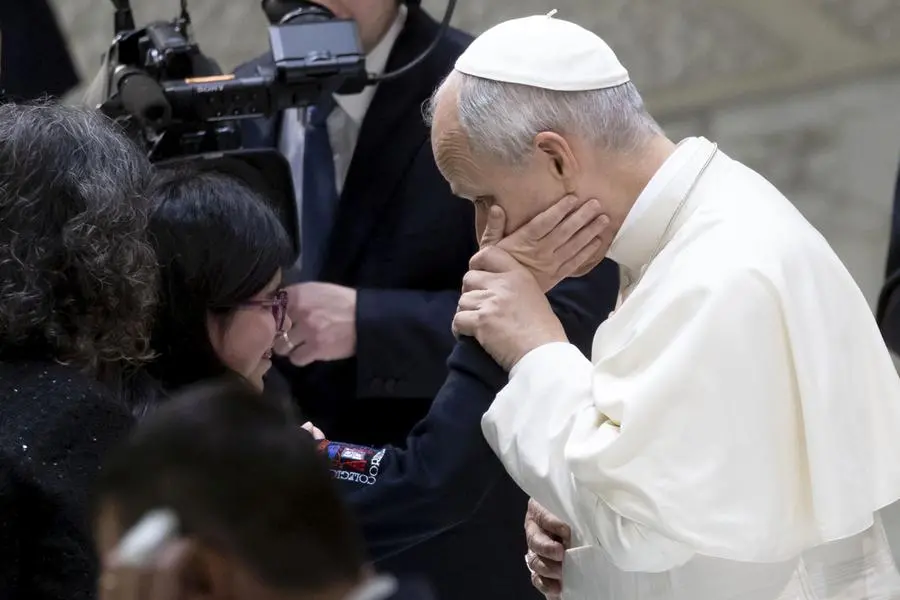
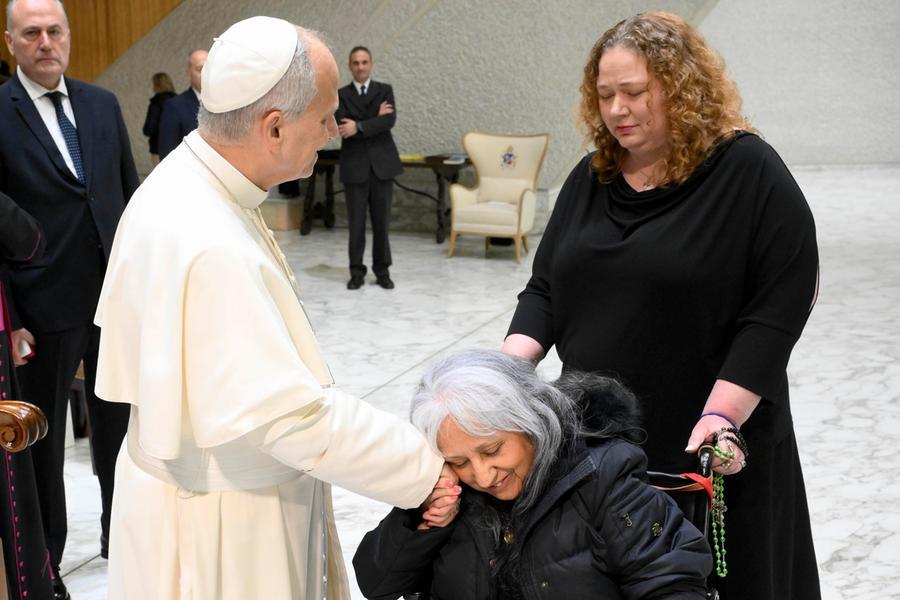
Pope Leo XIV in the Paul VI Hall for the general audience
(HANDLE)
The gift of the encounter arises from the bond with Jesus Christ, who we identify as the good Samaritan who brought us eternal health and who we make present when we bow before our wounded brother. Saint Ambrose said: «Therefore, since no one is closer to us than he who healed our wounds, let us love him as Lord, and let us also love him as a neighbor: in fact, nothing is so close as the head to the members. We also love him who is an imitator of Christ: we love him who suffers for the poverty of others, for the sake of the unity of the body.” Being one in the One, in the closeness, in the presence, in the love received and shared, and enjoy, like Saint Francis, the sweetness of having met him.
The shared mission in caring for the sick
St. Luke goes on to say that the Samaritan “felt compassion.” Having compassion implies a deep emotion, which drives action. It is a feeling that comes from within and leads to commitment to the suffering of others. In this parable, compassion is the hallmark of active love. It is neither theoretical nor sentimental, it translates into concrete gestures: the Samaritan approaches, heals the wounds, takes charge and takes care. But be careful, he doesn’t do it alone, individually, «the Samaritan looked for a guest house who could take care of that man, as we are called to invite and meet in an “us” that is stronger than the sum of small individualities». I myself have seen, in my experience as a missionary and bishop in Peru, how many people share mercy and compassion in the manner of the Samaritan and the innkeeper. Family members, neighbors, healthcare workers, people involved in healthcare pastoral care and many others who stop, approach, care, bring, accompany and offer what they have, give compassion a social dimension. This experience, which takes place in a network of relationships, goes beyond mere individual commitment. In this way, in the Apostolic Exhortation Dilexi you not only did I refer to the care of the sick as an “important part” of the Church’s mission, but as an authentic “ecclesial action”. In it I quoted Saint Cyprian to show how in that dimension we can verify the health of our society: «This epidemic, this plague, which seems horrible and fatal, puts everyone’s justice to the test, and examines the feelings of the human race: whether the healthy serve the sick, whether relatives love their relatives with respect, whether masters have compassion for servants who are ill, whether doctors do not abandon the sick who ask for help».
Being one in the One means feeling that we are truly members of a body in which we bring, according to our vocation, the Lord’s compassion for the suffering of all men. Furthermore, the pain that moves us is not a foreign pain, it is the pain of a member of our own body which our Head commands us to take care of for the good of all. In this sense it identifies with the pain of Christ and, offered in a Christian way, hastenes the fulfillment of the prayer of the Savior himself for the unity of all.
Always driven by love for God, to meet with ourselves and with our brother
In the double commandment: “You shall love the Lord your God with all your heart, and with all your soul, and with all your strength, and with all your mind, and your neighbor as yourself” (Luke 10:27)we can recognize the primacy of love for God and its direct consequence on man’s way of loving and relating in all its dimensions. “Love for one’s neighbor represents tangible proof of the authenticity of love for God, as the apostle John attests: “No one has ever seen God; if we love one another, God remains in us and his love is perfect in us. (…) God is love; whoever remains in love remains in God and God remains in him” (1 John 4:12.16)”. Although the object of this love is different: God, one’s neighbor and oneself, and in this sense we can understand them as distinct loves, they are always inseparable. The primacy of divine love implies that man’s action is carried out without personal interest or reward, but rather as a manifestation of a love that transcends ritual norms and translates into authentic worship: serving others is loving God in fact.
This dimension also allows us to detect what it means to love oneself. It means moving away from us the interest in basing our self-esteem or sense of our dignity on stereotypes of success, career, position or descent and recovering our place before God and our brother. Benedict XVI said that «the human creature, being of a spiritual nature, is realized in interpersonal relationships. The more authentically he experiences them, the more his personal identity matures. It is not by isolating himself that man values himself, but by placing himself in relationship with others and with God.”
Dear brothers and sisters, “the true remedy for humanity’s wounds is a lifestyle based on fraternal love, which has its root in the love of God”. I sincerely desire that this fraternal, “Samaritan”, inclusive, courageous, committed and supportive dimension is never missing from our Christian lifestyle, which has its most intimate root in our union with God, in faith in Jesus Christ. Inflamed by this divine love, we will truly be able to give ourselves for the good of all those who suffer, especially our sick, elderly and afflicted brothers.
Let us raise our prayer to the Blessed Virgin Mary, Health of the sick; we ask for his help for all those who suffer, who need compassion, listening and comfort, and we beg his intercession with this ancient prayer, which was recited in the family for those who live in illness and pain:
Sweet Mother, do not turn away,
do not take your gaze away from me.
Come with me everywhere
and never leave me alone.
You who always protect me
like my true Mother,
let the Father bless me,
the Son and the Holy Spirit.
I cordially impart my apostolic blessing to all the sick, their families and those who assist them, to healthcare workers, to people involved in health pastoral care and in a special way to those who participate in this World Day of the Sick.