



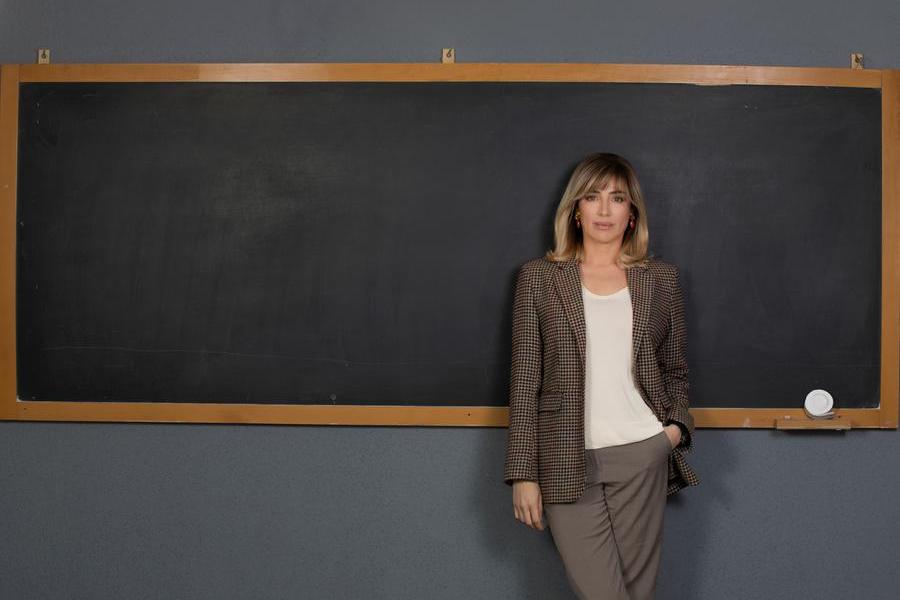
The head teacher of the Morano di Caivano Institute, Eugenia Carfora, transforms into Eugenia Liguori in the series “La Preside”, made up of four episodes broadcast on Rai 1 from today, 12 January. To step into the shoes of this woman who through school has challenged and continues to challenge a place marked by degradation and organized crime is Luisa Ranieriwhich these days we can also see on Prime Video in the film “Christmas without Father” and find in bookstores with “At the table with the Food Wizards”, a book of recipes, stories and games for children. But let’s go back to “The Principal”: «I play a woman with great energy, a very high sense of legality. She is also a mother and knows how to relate to her kids”, explains Ranieri, the actress who returns to show off her Neapolitan roots in this series.
Did you meet the “real” principal Eugenia Carfora?
«Yes, because a documentary was made about her before, as part of the program Che ci fa qui by Domenico Iannacone. We met her with my husband Luca Zingaretti. He came up with the idea of making “La Preside”. We spent time together. He is a person who knows well what goals he wants to achieve, but he is also sweet. He never backs down from his students.”

It is no coincidence that the series opens with one of his phrases: “There is no time to waste, if I waste a minute, I lose a boy.”
«Exactly, it’s a phrase he often repeats. Eugenia rings at the homes of those who don’t show up in court, talks to the families. It doesn’t stop at bureaucracy. She is also loved and respected by her teaching staff, but at the same time she is also feared. He doesn’t grant holidays beyond those required by the regulations because he wants to set a good example. It has an incredible rigidity, which we are no longer used to. Teachers today are underpaid, they are not motivated, the children’s parents often mistreat them. We have a wrong conception of school. High school is the most important time in the formation of a future adult. It is not enough to set a good example, we must also recognize the strength of the institution. And this is precisely what Eugenia Carfora does.”
Have you been to Caivano, to the Morano Institute?
“Certain. Now, after all the work that has been done recently, it is so beautiful, efficient, clean, cutting-edge, that we had to shoot somewhere else (laughs, ed.), in another neighborhood. Caivano is an incredible reality for the area. There are motivational phrases written around everywhere, quotes that serve to encourage not to give up. For example, on the chairs in the teachers’ lounge we read: “Come to school and your life will change.” It is a technological place, in the afternoon there are music and theater courses. The goal is to cultivate the passions of the kids, taking them off the streets. I spoke to some of those teenagers, and I realized that there is a great educational absence. The head teacher therefore becomes a point of reference to turn to in times of difficulty. I witnessed a scene: a student was angry with the Italian teacher and no longer wanted to talk to her. So Principal Carfora told him: “Today you’re with me.” This means taking care, not abandoning.”
As a parent, how do you feel the school world is evolving?
«I perceive a lack of movement: we are standing still while the society around us changes. The arrogance of mothers and fathers towards teachers hurts young people and makes them overprotected. Frustrations are important in the growth journey. In class, instead of studying the Sumerians several times, we should introduce more modern history, which we almost never manage to address. We need greater updating, adding sexual education. My generation knew the emotional dimension, the first crushes, in high school: today, however, everything is anticipated. Violence against women starts from social media, and must be combated already in the classroom. We need to re-educate empathy and families can’t do it alone.”
What was Luisa Ranieri like as a student?
«I was very diligent and studious. I had a lot of self-respect, I don’t think I ever got a bad grade. It bothered me, the idea mortified me, so I was always prepared. I was a girl with a head on her shoulders.”

What is it like to collaborate with your husband Luca Zingaretti?
“Very nice. We know how to divide roles, respect spaces. Dialogue is fundamental, as well as in the private dimension. Sharing is the basis. He takes care of getting the project to take its first steps and dedicates himself to the writing phase. I’ll get to the end (laughs, ed.). The exchange between us is natural, there are no fears, we know how to tell each other when we don’t like something or when it doesn’t work.”