




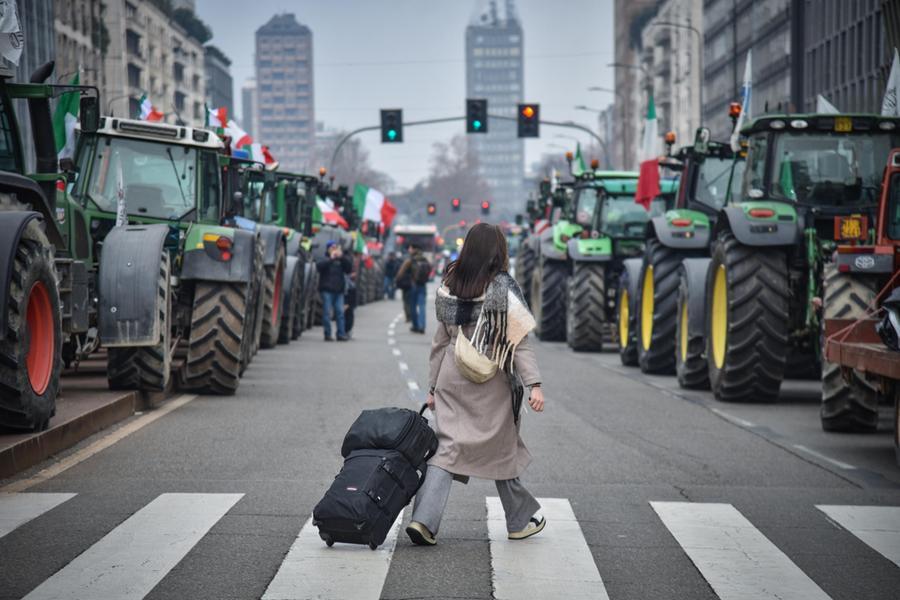
Tractors in the square, as in Milan, firecrackers, potatoes and manure thrown by thousands of demonstrators in front of the headquarters of the main European institutions in Brussels. It was only the latest act of the waves of protests by farmers across half of Europe to postpone the signing of the EU-Mercosur trade agreement initially scheduled for December 20th, but now postponed to January 17th, in Paraguay, following the riots recorded and the firm opposition of important countries such as France.
The agreement between the European Union and the Mercosur countries, an area that includes Argentina, Brazil, Paraguay and Uruguay, provides for the possibility of creating the largest free trade area in the world, a common market of 700 million people which, based on the contents of the bill, provides for the liberalization of 90 percent of imports of European industrial goods and 93 percent of agricultural products. The barriers between the two vast areas of the planet will progressively be reduced, which today see tariffs of 15 to 35 percent on auto parts, machinery, chemical products, pharmaceuticals, spirits and wines.
But the agreement divides. While on the one hand it would allow EU companies to save around four billion euros in duties per year and would encourage exports with simpler customs procedures, on the agricultural front they would instead have to face competition from South American products, in particular sugar, beef, poultry and corn which for farmers would be put on the market with few guarantees compared to the standards set by the European Union. The European Commission has specified that all imported products, now easily traceable through the use of technology, will have to strictly comply with European standards on food safety, but fear in the agri-food sector remains and reassurances when a piece of bread and health are involved are not enough. Among the countries in favor of the agreement, Germany is in the front row, followed by Spain and the countries of Northern Europe, opposed as well as France and also Poland, Hungary, Austria and Ireland (Belgium, divided between Flemings and Walloons, abstained). An insufficient number to be able to block everything as to reach any type of trade agreement in the Council of the EU it is necessary to reach a qualified majority. In fact, more than 15 member states voted in favor, exceeding 65 percent of the European population. The veto, however, is obtained when it exceeds 35 percent of the votes.
The position expressed by Prime Minister Giorgia Meloni on the need to sign the Mercosur agreement, also reiterated in yesterday’s press conference, is clear. Italy requests that the agreement include guarantees for the agricultural sector, for businesses and for the health of consumers. For farmers these guarantees do not seem to exist. The benefits for Italy could however concern the industrial sector, in particular the mechanical, technological and chemical-pharmaceutical sectors. According to an analysis by the Foreign Ministry in 2021 to evaluate the effects of the agreement, by 2036, the EU’s total exports of goods and services would increase by around $25 billion and Italy would be the largest beneficiary among the 27 member countries, with a share of 14 percent. Confindustria estimates a benefit for Italy of around 14 billion euros.
For Coldiretti the postponement of the signature was a collective victory. But Europe signed, including Italy. The main organization that supports Italian farmers has pointed out that the agreement in question ignores the discrepancies between European production standards and those of the Mercosur countries. In South American fields, substances banned in Europe for years are still used, such as fungicides, insecticides, herbicides in a context of total absence of workers’ rights. In the first 10 months of 2025, according to Coldiretti’s estimate, imports from Mercosur into Italy rose by 17 percent compared to 2024, almost reaching 3 billion euros (equal to the entire previous year), while Italian exports fell by 3 percent. «In recent months we have carried out work at all levels, Italian and community, to denounce the enormous risks associated with the signing of an agreement without guarantees for agricultural companies and for the very health of consumer citizens. In the absence of equal conditions, guaranteed by the principle of reciprocity of rules, the way opens up to unfair competition which penalizes European farmers, sacrificed in favor of other commercial interests, and also increases the potential threats to the health of consumer citizens. The agreement completely ignores the gap between European production standards and those in force in the Mercosur countries, where molecules that have been banned in the European Union for years continue to be used to a large extent in the fields”, reads a statement from Coldiretti.