





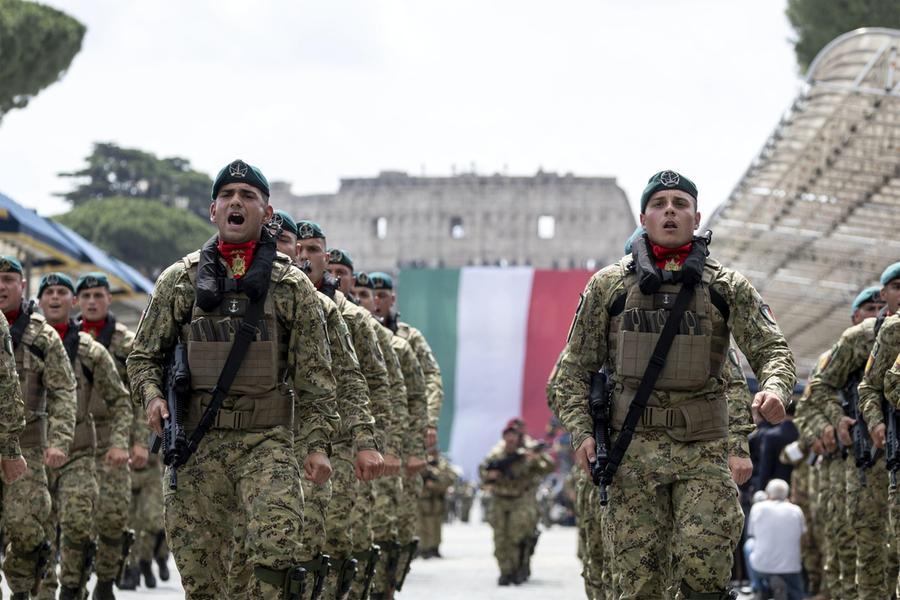
Tuesday in Rome at the parade June 2nd, Republic Dayfor the first time a representation of the military chaplains. A performance which, in the intentions of the military Ordinariate (the diocese without territory which has jurisdiction over all military chaplains, ed.), was intended to be a public recognition of their pastoral service in the Armed Forces but which in just a few hours turned into a case reopening a question which has been debated for some time: what relationship should the Church have with the military apparatus? The chaplains participated in the parade with “cassock with stars, sash, black beret with military Ordinariate frieze and black gloves”.
A presence that divides
The choice sparked immediate reactions in the ecclesial and Catholic world, especially in those realities that have been critically reflecting on the relationship between faith and war for years. Among the clearest dissenting voices is that of Pax Christi, who expressed «dismay and strong indignation» at this participation: «A careless and profoundly anti-evangelical choice», they write, «not only because it contradicts Pope Leo For movement, «the participation of the chaplains in the parade marks, however, an even more marked integration of the priests within the military apparatus, in his logic and his mentality.”
And the judgment ends with a very clear evangelical reminder: “It is a worrying signal, which must be urgently reversed if we want to remain credible in the evangelical announcement of peace: ‘Peace I leave with you, my peace I give to you. Not as the world gives, do I give to you’ (Jn 14:27)”.
Criticism too WeekNewsthe online magazine of the Dehonians, which entrusts the reflection to Luigi Mariano Guzzo, professor of Canon Law at the University of Pisa: «The choice of the military Ordinariate to ask a representation of the priests incardinated in it to parade in a military parade wearing the “cassock
with stars”, the sash and the “black beret” not only have the flavor of regurgitations of ecclesiastical traditionalism in forms that should have been completely overcome after the Second Vatican Council”, he writes, “even more, represents the plastic, visual metaphor of an unsustainable and irreconcilable compromise, that between the Gospel and weapons. The Church cannot be
exploited in the vortex of a patriotic-military message that undermines the very credibility of the Christian message”.

The symbolic knot according to Msgr. Savino
Among the most significant reactions in the episcopal world is that of Monsignor Francesco Savinobishop of Cassano all’Jonio and vice-president of the CEI, who addressed the issue without questioning the people, but questioning the ecclesial meaning of the gesture. “I evaluate the participation of military chaplains in the parade with respect for the people and with concern for the sign,” he said in an interview with Republic, «I would like to be very clear: the dedication of many military chaplains, priests who accompany men and women often exposed to loneliness, fear, distance from families, sometimes even to the moral laceration that arises in the face of violence and death, is not in question. Their mission, when lived evangelically, is not to bless weapons, but to guard consciences; it is not to sacralize the military apparatus, but to remember, even in difficult contexts, that every human life remains inviolable». The critical point, however, for Savino concerns the context of the parade: «The language of symbols must be taken seriously. A military parade belongs to a precise public register: uniform, order, force, apparatus, power of the State. Inserting chaplains there risks producing an ambiguity: making the priestly ministry appear as part of the religious ornamentation of the armed force. The Church”, he added, “it must be close to the people, not within the aesthetics of war. The priest is not the chaplain of power, but the defenseless servant of the Gospel. Don Primo Mazzolari and Don Lorenzo Milani come to mind: both, in different ways, remembered that Christian obedience can never become silent complicity with violence.” Savino also recalls the theme of conscience and peace: «Personally, I continue to feel very current the uncomfortable and prophetic words that Don Lorenzo Milani delivers in the writing Obedience is no longer a virtue. To the fear of others or to the slower and more demanding effort of democracy?
The reflection of the Italian Church
The story is part of the process of reflection of the Italian Church. The recent pastoral note of the CEI Educate for an unarmed and disarming peace (2025) has in fact explicitly opened up to possibility of rethinking the forms of presence of military chaplains, speaking of methods “less directly linked to belonging to the military structure”, to guarantee greater freedom in the evangelical proclamation of peace.
An indication that is intertwined with the synodal path of the Churches in Italy, which called for a reflection on the spiritual assistance service to the Armed Forces and the Police, underlining the need for shared and non-ideological paths of discernment.