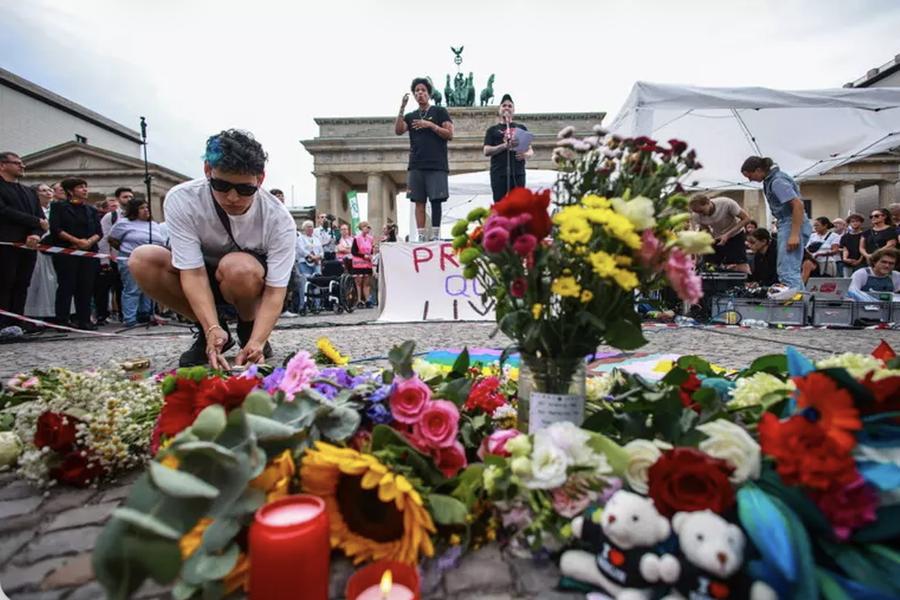
The manhunt that kept Berlin and Germany in suspense for almost 24 hours ended on Sunday evening with an intervention by the SEK special intervention units (Spezialeinsatzkommando) of the Berlin police in the Spandau district, among the greenery of the community gardens. Abdul Ballout, 21, was killed there, the suspected perpetrator of Saturday evening’s attack against Christopher Street Day, the large annual LGBTQ+ Pride demonstration and parade held every year in Berlin.
Driving a van, Ballout had knocked down passers-by near the Tiergarten, the large park around which the events of the demonstration took place. A Polish woman who was in Berlin with her daughter died in the attack and 29 other people were injured, some also hit with a sharp weapon. No injuries are life-threatening.
The German capital has emerged from the nightmare of the killer on the run, perhaps ready to strike again, but the anguish of a city and a country that once again finds itself having to deal with jihadist violence remains. Abdul Ballout had already been reported as a radical Islamist, linked to ISIS. Born in Germany, a German citizen, a mother of Lebanese origins, he was known to the authorities for his radicalization. Yet it escaped all control and managed to hit one of the most important and crowded public events in Berlin.
“I consider it politically relevant how Islamist homophobia is systematically underestimated and downplayed. In recent years, there have been numerous attacks by Islamists against queer people across Europe, including several murders. Pride parades are regularly targeted by Islamists,” he tells the Berlin newspaper Tagesspiegel the political scientist Hendrik Hansen.
The extremism expert Hans-Jakob Schindler he declared to the same newspaper that the danger posed by Islamism in Germany today is far greater than the resources available to the police.
“The problem is that the Islamist environment in Berlin,” says Schindler, “is relatively large. We are talking about a considerable number of individuals. Monitoring all Islamists in the same way is not resource-efficient for the police. This is also true if one wanted to monitor only so-called ‘potential terrorists’, i.e. those who the security authorities believe could commit or support acts of violence at any time.”
The report of the Federal Office for the Protection of the Constitution (Verfassungsschutzbericht) noted in 2015 the presence of over 9,000 violence-oriented Islamists in Germany. Among them, 1,940 would be in Berlin, where it is estimated that the Islamist environment has 2,590 militants.
The most serious attack in the capital so far occurred ten years ago. On 19 December 2016, a Tunisian asylum seeker, Anis Amri, whose application had been rejected, drove a hijacked truck into a Christmas market in the German capital, killing 13 people and injuring dozens. The perpetrator of the attack was killed a few days later in a firefight in Italy. The militant group “Islamic State” claimed responsibility for the attack.
But Germany has been the victim of terrorist attacks several times. On May 4, two people were killed and 20 others injured when a car hit a crowd in Leipzig. The suspect was described as a 33-year-old German citizen living locally, already known to the police, although not for crimes related to the case.
On March 3, 2025, at least two people were killed and several others injured in Mannheim when a driver intentionally ran his car into a crowd of people. Authorities identified the suspect as a 40-year-old German man. Law enforcement at the time ruled out a political motive, although the man had paid a fine under German hate crime laws for a comment he posted on a social media platform in 2018.
A 37-year-old woman and her two-year-old daughter were killed in Munich on February 13, 2025, when a car plowed into a demonstration organized by the Verdi trade union. A 25-year-old Afghan man was later tried for their murder, as well as the attempted murder of the dozens of other people injured in the attack.
On December 20, 2024, six people died and more than 300 were injured when a man drove a rented BMW SUV into a Christmas market in Magdeburg. The suspect, arrested on the spot, was a 50-year-old doctor from Saudi Arabia who had expressed anti-Muslim views and support for the far-right AfD party. In June 2026 he was sentenced to life imprisonment; the court underlined the seriousness of the crime, which effectively excludes the possibility of early release.
This coming September, between the 6th and the 20th, several key elections are scheduled in various German states (including the city state of Berlin), and the far-right Alternative for Germany (AfD) party is leading in the polls. Saturday’s deadly attack risks intensifying the debate over immigration and security, two issues on which the AfD stands out for its nationalist and anti-immigrant positions.