She is the all-round woman who, together with her sister Mary in Bethany near Jerusalem, welcomed the Lord Jesus into her home and, upon the death of her brother Lazarus, resurrected by Christ, professed: “You are the Christ, the Son of God, the one who comes into the world”. Her name means “lady”. She is the protector of housewives, maids, hoteliers, innkeepers and cooks. The first to dedicate a liturgical celebration to it were the Franciscans in 1262.
«Lord, tell my sister to help me»
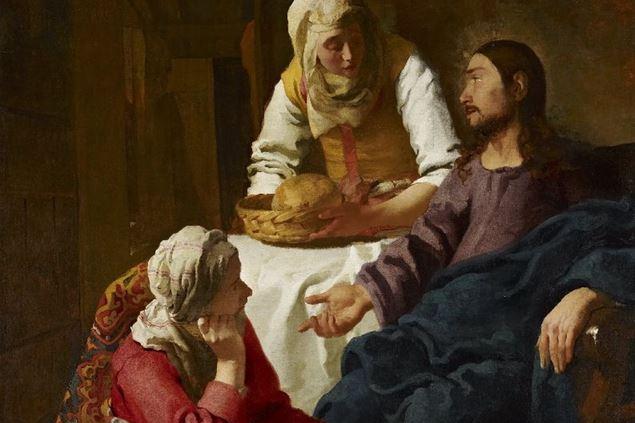
Marta is the sister of Mary and Lazarus of Bethanya village about three kilometers from Jerusalem. Jesus loved to stay in their hospitable home while preaching in Judea. On the occasion of one of these visits Marta appears for the first time. The Gospel presents her to us as the woman of the house, attentive and busy to worthily welcome the welcome guest, while her sister Mary prefers to remain quiet listening to the Master’s words. We are therefore not surprised by the reproach that Martha makes to Mary: «Lord, don’t you care that my sister left me alone to serve? So tell her to help me.” Jesus’ response may sound like a reproach to the active housewife: «Martha, Martha, you are worried and worried about many things; only one is necessary: Mary instead chose the best part, which will not be taken away from her.” But it is not a reproach, as Saint Augustine commented: «Martha, you did not choose evil; However, Maria chose better than you».
Nonetheless, Mary is considered the evangelical model of contemplative souls already by Saint Basil and Saint Gregory the Great and the sanctity of this sweet figure of a woman is beyond question, since it was confirmed to her by the very words of Christ.
The profession of faith
The dejected and misunderstood profession of housewife is redeemed by this active saint named Marta, which simply means “lady”. Martha reappears in the Gospel in the dramatic episode of the resurrection of Lazarus, where she implicitly asks for the miracle with a simple and stupendous profession of faith in the omnipotence of the Savior, in the resurrection of the dead and in the divinity of Christ and during a banquet in which Lazarus himself, recently resurrected, participates, and this time too she presents herself as a woman of all trades. The lesson given to her by the Master evidently did not concern her commendable industriousness but her excessive concern for material things to the detriment of her interior life.. We have no historically verifiable information about the saint’s subsequent years, although legendary tales abound. The first to dedicate a liturgical celebration to Santa Marta were the Franciscans, in 1262, on 29 July, that is, eight days after the feast of Santa Maria Maddalena, improperly identified with her sister Mary.
On July 29th, Martha’s brothers are also remembered: Mary and Lazarus
From 2021, July 29th appears in the General Roman Calendar as the memory of the saints Martha, Mary and Lazarus. He arranged it Pope Francis accepting the proposal of the Congregation for Divine Worship and the Discipline of the Sacraments which published the relevant decree. Until that moment, only the memory of Martha appeared in the General Roman Calendar. Motivating the decision, the decree, signed by the then prefect of the Dicastery, Cardinal Robert Sarah, and the secretary, Archbishop Arthur Roche, underlines «the important evangelical testimony» offered by the three brothers «in hosting the Lord Jesus in their home, in listening to him cordially, in believing that he is the resurrection and the life. In the house of Bethany – we read – the Lord Jesus experienced the family spirit and friendship of Martha, Mary and Lazarus, and for this reason the Gospel of John states that he loved them. Martha generously offered him hospitality, Mary listened to his words docilely and Lazarus promptly left the tomb at the command of Him who humiliated death.”

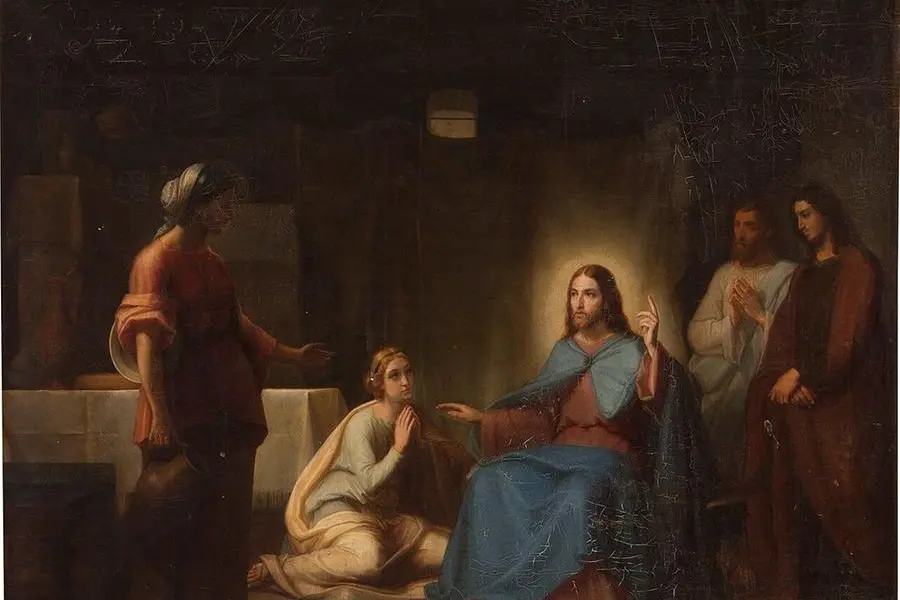
Juan Antonio Vera Calvo, Jesus in the house of Martha and Mary (circa 1858), oil on canvas, preserved in the Prado Museum. The work represents the evangelical episode of the welcome of Jesus into the house of Lazarus’ sisters, staging the contrast between Martha, dedicated to domestic duties, and Mary, collected in listening to the word of Christ
The decree explains that «the traditional uncertainty of the Latin Church regarding the identity of Mary – the Magdalene to whom Christ appeared after his resurrection, the sister of Martha, the sinner whose sins the Lord forgave – which decided the inscription of Martha alone on 29 July in the Roman Calendar, has found a solution in recent studies and times, as attested by today’s Roman Martyrology which also commemorates Mary and Lazarus on that same day. Furthermore, in some particular Calendars the three brothers are celebrated together on that day. With this denomination – concludes the decree – the memorial must therefore appear in all Calendars and liturgical books for the celebration of the Mass and the Liturgy of the Hours; the variations and additions to be adopted in the liturgical texts, attached to this decree, must be translated, approved and, after confirmation by this Dicastery, published by the Episcopal Conferences”.