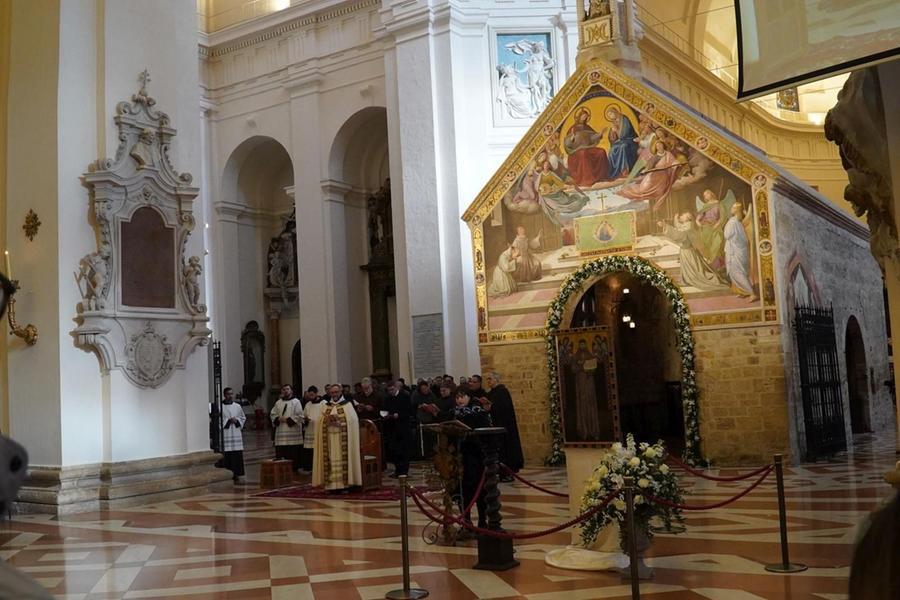
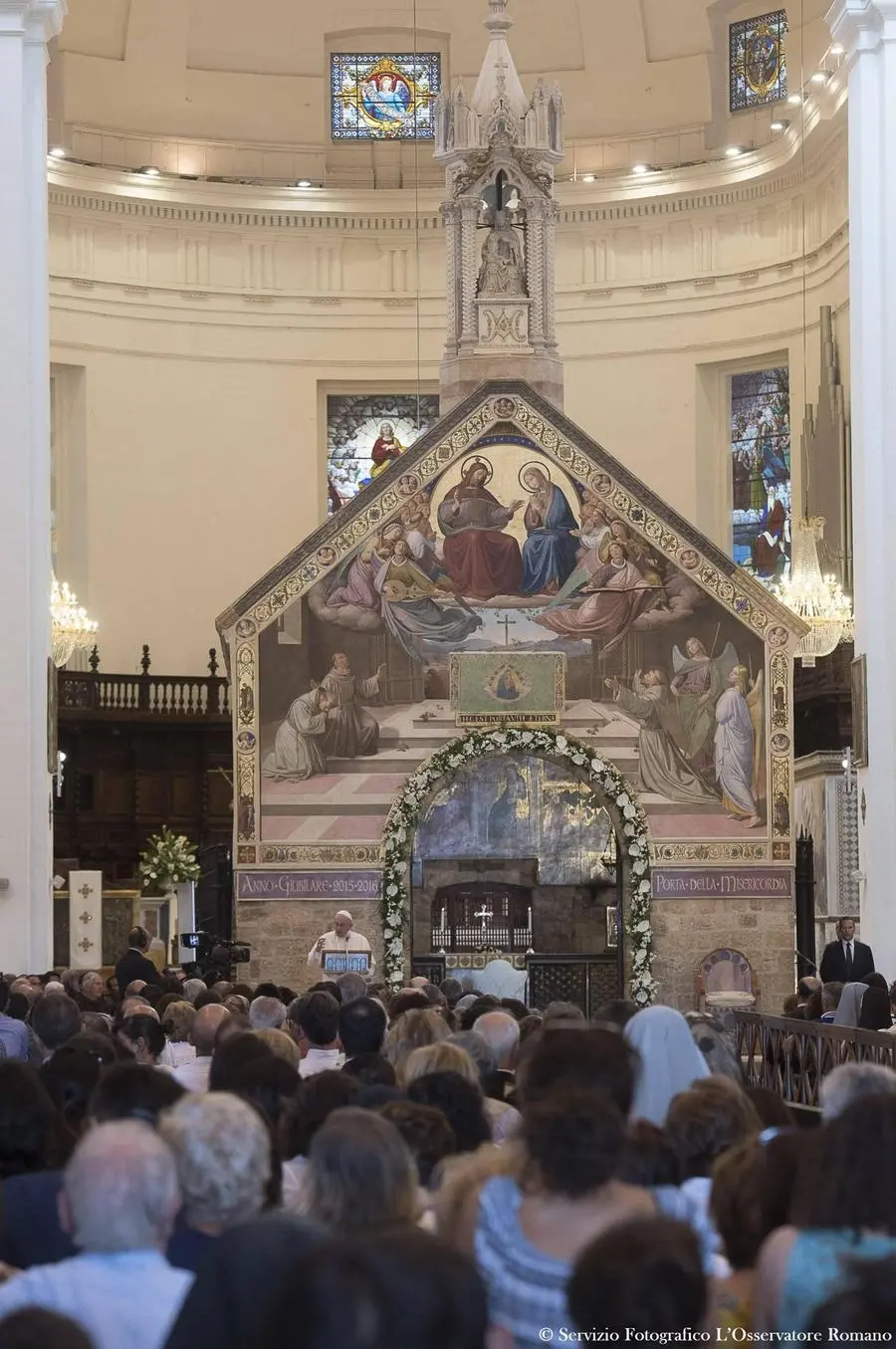
The majestic Basilica of Santa Maria degli Angeli in Porziuncola, built on the interest of Saint Pius V starting from 1569 and which is located about four kilometers from Assisicontains within its walls the ancient chapel of the Porziuncola, linked to the memory of Saint Francis of Assisi. Today on its facade there is a fresco depicting the institution of Pardon of Assisithe work of GF Overbek of Lübeck (1829-1830), who thus wanted to decorate that distinguished place.
How was the Pardon of Assisi born?
Precisely at the Porziuncola Francis had the divine inspiration to ask the Pope for the indulgence which was then said, precisely, “of the Porziuncola or Great Forgiveness“, whose feast is celebrated on August 2. It is the diploma of Brother Teobaldo, bishop of Assisi, one of the most widespread documents, which reports this. Saint Francis, on an unspecified night in July 1216, while he was kneeling in front of the small altar of the Porziuncola, immersed in prayer, suddenly saw a dazzling light illuminate the walls of the humble church. Seated on the throne, surrounded by a crowd of angels, Jesus and Mary appeared in a dazzling light. The Redeemer asked his Servant what grace he desired for the good of men. Saint Francis humbly replied: «Since he is a miserable sinner who speaks to you, O merciful God, he asks you for mercy for his sinner brothers; and all those who, repentant, cross the threshold of this place, may receive from you, O Lord, who sees their torments, forgiveness for the sins they have committed.».
«What you ask for, Brother Francis, is great», the Lord told him, «but you are worthy of greater things and you will have greater things. I therefore welcome your prayer, but on the condition that you ask my vicar on earth for this indulgence on my behalf.”

The request to Pope Honorius III
At the first light of dawn, therefore, Francis, taking with him only Brother Masseo of Marignano, headed towards Perugia, where the Pope was then. He sat on the throne of Peter, after the death of the great Innocent III, Pope Honorius IIIan elderly but very good and pious man, who had given what he had to the poor. The Pontiff, having listened to the story of the vision from the mouth of the Poor Man of Assisi, asked how many years he would ask for this indulgence.
Francis replied that he was asking for “not years, but souls” and that he wanted “that whoever comes to this church confessed and contrite, will be absolved from all his sins, guilt and punishment, in heaven and on earth, from the day of baptism until the day and hour he enters the said church”. This was an unusual request, given that such an indulgence was usually granted only to those who took the Cross for the liberation of the Holy Sepulchre, becoming crusaders.
The Pope, in fact, pointed out to the Poverello that “It is not the custom of the Roman court to grant such an indulgence.” Francis replied: «What I ask is not from me, but from Him who sent me, that is, our Lord Jesus Christ.». Therefore, despite the opposition of the Curia, the pontiff granted him what he requested (“It pleases us that you have it”). On the point of saying goodbye, the Pontiff asked Francis – happy with the concession obtained – where he was going “without a document” certifying what he had obtained. «Holy Father», replied the Saint, «your word is enough for me! If this indulgence is the work of God, He will think about manifesting his work; I don’t need any document, this paper must be the Holy Virgin Mary, Christ the notary and the Angels the witnesses”. The indulgence was obtained, therefore, “vivae vocis oraculo”».

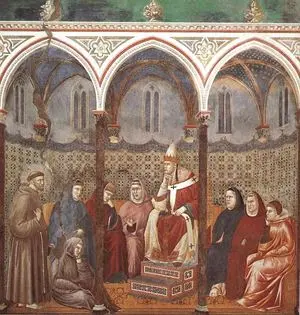
Giotto, Saint Francis preaches before Pope Honorius IIIfresco of the cycle of Stories of Saint Franciscirca 1297-1299, Upper Basilica of San Francesco, Assisi. The scene depicts the Saint while addressing the pontiff, to whom tradition attributes the granting of the indulgence of the Porziuncola, known as the Pardon of Assisi
When was it officially established?
The 2 August 1216in front of a large crowd, Saint Francis, in the presence of the bishops of Umbria with a soul full of joy, promulgated the Great Forgiveness, for each year, on that date, for anyone, pilgrim and repentant, who had crossed the threshold of the Franciscan temple. In 1279, friar Pietro di Giovanni Olivi wrote that “this indulgence is of great use to the people who are thus driven to confession, contrition and amendment of sins, precisely in the place where, through Saint Francis and Saint Clare, the state of evangelical life suitable for these times was revealed”.
Under what conditions can indulgence be obtained?
Receive absolution for one’s sins in sacramental Confession, celebrated in the period that includes the eight days before and after the visit to the Porziuncola church, to return to God’s grace; participate in Mass and Eucharistic Communion in the same period of time indicated for Confession; visit the church of Porziuncola where the profession of faith must be renewed, through the recitation of the Creed, to reaffirm one’s Christian identity, and recite the Our Fatherto reaffirm one’s dignity as children of God, received in Baptism; recite a prayer according to the Pope’s intentions, to reaffirm one’s belonging to the Church, whose foundation and visible center of unity is the Roman Pontiff. Normally one recites a Our FatheraHail Mary and a Glory to the Father; However, individual faithful are given the right to recite any other prayer according to their piety and devotion towards the Pope.
On which days can the “Pardon of Assisi” be obtained?
In the sanctuary of the Porziuncola, in Assisi, thanks also to a special decree of the Apostolic Penitentiary dated 15 July 1988 (Portiuncolae sacrae aedes) you can gain an indulgence, for yourself or for your deceased, under the same conditions, throughout the yearonly once a day. While in all the parish churches and Franciscan churches scattered around the world you can make money from midday on August 1st to midnight on August 2nd of each year.
What is indulgence?
In the Catechism of the Catholic Church (nos. 1478-9) we read: «The indulgence is obtained through the Church which, by virtue of the power to bind and loose granted to it by Jesus Christ, intervenes on behalf of a Christian and opens up to him the treasure of the merits of Christ and the saints so that he can obtain from the Father of mercies the remission of the temporal punishments due for his sins. Thus the Church not only wants to come to the aid of this Christian, but also to push him to perform works of piety, penance and charity (See Paul VI, Apostolic Constitution. Indulgentiarum doctrina8; Council of Trent: DS 1835). Since the faithful deceased in the process of purification are also members of the same communion of saints, we can help them, among other things, by obtaining indulgences for them, so that they are relieved of the temporal punishments due for their sins. Through indulgences the faithful can obtain for themselves, and also for the souls in Purgatory, the remission of temporal punishments, consequences of sins. (CCC 1498)”.