





On 8 February 1951 it debuted in Italian cinemas Miracle in Milana masterpiece by Vittorio De Sica born from the pen of Cesare Zavattini. Despite the artistic value, the reception was anything but benevolent: the following day the critics lashed out against the film with “ferocious, offensive and poisonous” tones, as recalled by Zavattini himself. What intensified the judgment was the harsh climate of the Cold War, which forced the film into an ideological grip: conservatives read in it a dangerous pro-Soviet populism, while the orthodox left did not accept the betrayal of Neorealism in favor of the fantastic fairy tale.
Yet, it is precisely this ability to place a distance from reality to question it through the fantastic that makes the work still vibrant. A current event that the Small Theatre chose to celebrate the 75th anniversary of the film by entrusting a theatrical rewrite to Paolo Di Paolo with the direction of Claudio Longhi.
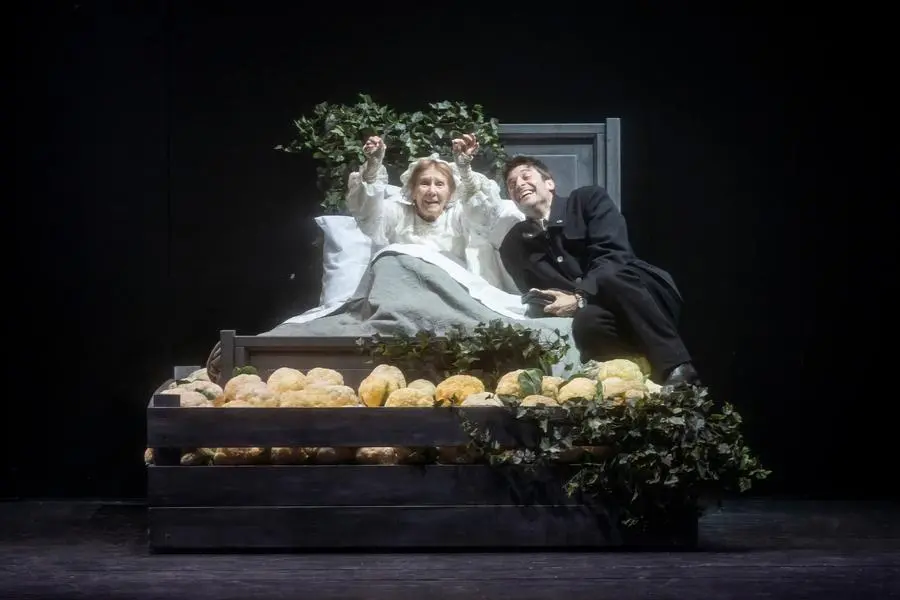
Lino Guanciale and Giulia Lazzarini in a scene, world premiere at the Piccolo Teatro Strehler from 4 March.
The setting of the press conference could only be symbolic: the Fountain room of the Museo del Novecento, with the silhouette of the Cathedral acting as a natural scenography. During the conference, President Marchetti underlined how the Piccolo’s objective has always been to «represent a strong link of continuity with tradition». For Marchetti, rediscover today Miracle in Milan it is not a nostalgic or “archaeological” operation, but rather a necessary act that it touches the vital issues of modernity, configuring itself as a true “commitment to civil militancy”.
Longhi defines the show as «a Brechtian opera», since uses estrangement and temporal and spatial distance to reflect on a reality that reflects current events in Milan. The antithetical poles of “poor vs rich” thus become the pretext for a social reflection that looks to the future, even before the past.
Linen Pillowwho in addition to playing the protagonist Totò, worked as dramaturg at the show, he highlighted the complexity of the original material, explaining that a radical part of the work has its roots in the variety registers and in that “Totoian” horizon (understood as the poetic and surreal legacy of the character of Totò) which should not be underestimated. The show is therefore configured as a musical drama capable of combining cultured and popular references, looking for a perfect synthesis between the literary matrix of the film and the new theatrical dimension.
The project marks a significant return to the roots of the Milanese tradition, rereading the work of De Sica and Zavattini in the light of the new critical issues of modernity. The debut is set for March 4th at the Strehler Theater, where the show will remain scheduled until April 1st.