
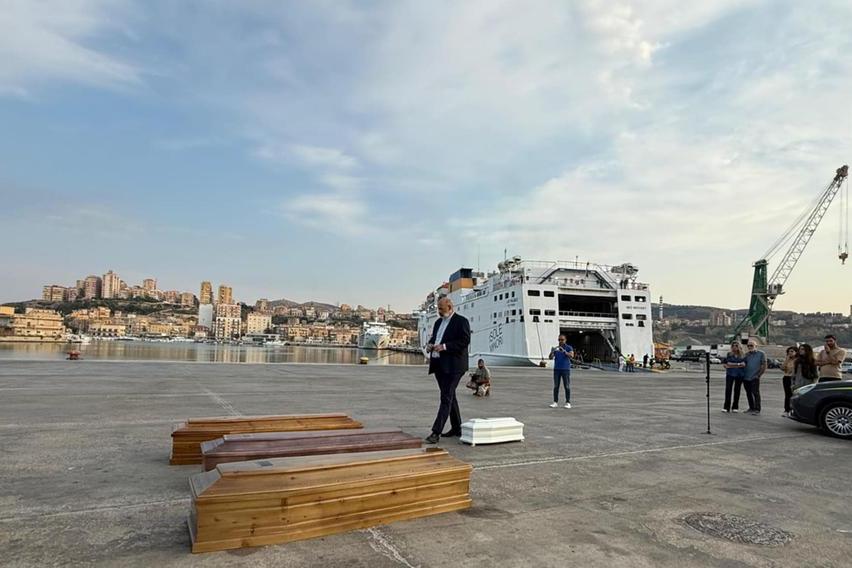


Submerged by insults, but also by a wave of solidarity that moved him. Monsignor Corrado Lorefice, archbishop of Palermo, after the letter sent to Mediterranea Saving human, he had been overwhelmed by hateful messages against his words. «I am sincerely sorry», wrote the prelate, «that I cannot go out into the open sea with you to caress the tormented waters of our Sea still shaken and scandalized by yet another massacre – it is not a tragedy! – which took place in the most absolute silence shouted out by precise political choices – of yesterday and today –, guiltily forgetful of the inalienable rights of the human being, in violation of international law and rescue conventions.” And again, he added: «Yours today – following the shipwrecks that occurred in the Strait of Sicily during and after cyclone “Harry”, which left around a thousand missing – is a strong and precious sign, a clear call to upset the silence and wake up the sleep of the eyes of all of us, narcotized by political choices that plan the oblivion of those who continue to cross the sea in search of life, freedom, peace, strengthened by the right of every man and every woman to mobility. These victims – these erased faces and bodies of the poor – are yet another fruit of the inhuman choices of Europe and Italy capable only of legislating containment and abandonment and of blaming as criminals those who set out to sea as “fishermen of men and women” at the mercy of the waves. These human bodies that the sea has returned are a clear denunciation of those who, for mere populist propaganda, claim the result of the reduction in landings”.
Monsignor, how does it feel, from a personal point of view, to be the object of insults?
«We men stand out for our ability to speak, speech is a relationship so I believe it is important to also recover the true meaning of what characterizes us as human beings: speech. Every form of word that dominates, that insults, that hits, is already a betrayal of human relationships, even more so on a topic like that of migrants.”
Why even more so on migrants?
«Because this topic requires dialogue skills. It cannot be addressed in emergency terms. We have lost sight of the fact that behind the reality of human mobility there are faces, there are people. Every being who dies in the Mediterranean while trying to cross it is a human story, it is a relationship, a family, friends, a language, a culture, expectations, desires. We cannot dehumanize this. Mobility is a human factor that has always existed, even more so today because the vast majority of the human family lives in conditions of poverty, cannot achieve fulfillment, and is often the victim of wars. And poverty is also often dictated by how we Westerners have set up the economy, by capitalism which is based on the law of profit, by climate change which is increasing, by the advancing desertification.”
He talked about wars.
“Certain. We are fleeing from violence and wars and a good part of these conflicts originate in the interests that are in the hands of the world’s large financial companies or of the few who hold economic power, think of Congo. It is clear that the problem cannot be tackled head-on, much less can it become a reason for propaganda which risks distracting from the real problems of Italy, Europe and the entire world.”
Let’s go back to hatred on social media. It seems that today we should be ashamed of being good. Is that so?
«We are accused of being do-gooders, but this isn’t about being do-gooders. The question is that what characterizes the human being is the relationship. And the caring relationship arises from the fact that we recognize the dignity of every human person. When this recognition fails we lose our humanity. Caritas, NGOs and volunteers are not do-gooders, but are those who help to safeguard humanism, to safeguard the high human value of the dignity of every person. It is human people who cross the sea, not migrants. What happens on social media, the violent reactions, are the sign of a dehumanization, of a sclerotization of our hearts. It is not a sentimental term, but when I speak from the heart I say that when faced with a human being who is in difficulty I must have the feeling of pity. What amazes me is that those who use such aggressive language are also self-styled religious people, self-styled Christians who allow themselves to be able to say, even in the name of their self-styled religiosity, that these are people who deserve to die. But is this the religion that Jesus Christ gave us? “Love one another”, “I was hungry and thirsty, I was a refugee and a stranger and you quenched my thirst and welcomed me” I didn’t say it, Jesus said it. I am just a bishop who reminds everyone, and not just Christians but mostly them, that we must remain human. The heart of Christianity, of a Christ who gave his life even for those who took it from him, is to make the suffering of others his own, to have compassion for them. The problem is that we have now made religion a label, but we do not draw on the logic of Jesus Christ. Indeed, we can even allow ourselves, in the name of a so-called religion, that migrants are aggressors and that we can therefore leave them to die in the Mediterranean.”
Faced with all this hatred, is it better to withdraw from social media?
«Meanwhile, we know that today social media is largely controlled and that behind all this clamor there are also organizations, trolls rather than anything else, that try to guide public opinion. Then there is also a desertification of the heart that leads to these very violent languages. However, I would also like to say that, through social media, I have also received great solidarity and indignation for the violent language used towards me. A lot of solidarity was generated for having expressed clear and decisive words giving an interpretation that is not propagandistic and biased. So yes, you shouldn’t be afraid of social media.”
So would he say exactly the same words again?
«Yes and certainly not out of pride. I make the suffering of every human being my own because I am a human being and I want to remain that way. Secondly, I am a Christian and disciple of Jesus who said. “Love one another. Greater love has no one than to lay down one’s life for others.” Third, I am even a Christian who has been called by the Lord to be a bishop, to announce the Gospel. So I can only announce the Gospel. I don’t announce an ideology. I am not a communist bishop. I am a bishop who announces the Gospel and repeats the words of Jesus Christ, who was not a communist, who said he loved everyone, especially those who suffer.”
What do you want to say to those who addressed hateful words to you?
«I want to say that no city, no common home – which is the world – will be able to find serenity and peace if we foment acts and words of violence. On our lips the words solidarity, care, dignity must shine again. And with these words we also address problems of a certain complexity. Violence can only generate violence, injustice, wars. It is clear to everyone that the common home, precisely thanks to the fact that we are no longer safeguarding the greatest words of humanity which then also correspond to those of the Gospel, is in danger of burning. As Pope Francis reminded us and as Pope Leo is also reminding us, the world really risks the explosion of a third world war. We see world leaders pushing towards such a heinous event. And then we have only one way to save ourselves: that of making the fact that we are against violence and every form of war resonate throughout our common home. On the positive side, we are for peace, for brotherhood and for dialogue, the only tool for solving problems. We must look ourselves in the face, present our reasons, guard a human and honest heart.”
What moved you most about the messages of solidarity?
«The most beautiful thing is that dozens and dozens of messages have arrived from the simplest people to organizations, from the ecclesial and secular world, from the Holy See and from the bishops of other dioceses, from religious, lay people, young people, elderly people. And then the fallout of those violent words was a flowering of good, the coming to light of many people who say that their hearts have not hardened and that they still have the ability to use the words that can lead us to a more authentic and peaceful human coexistence.”