

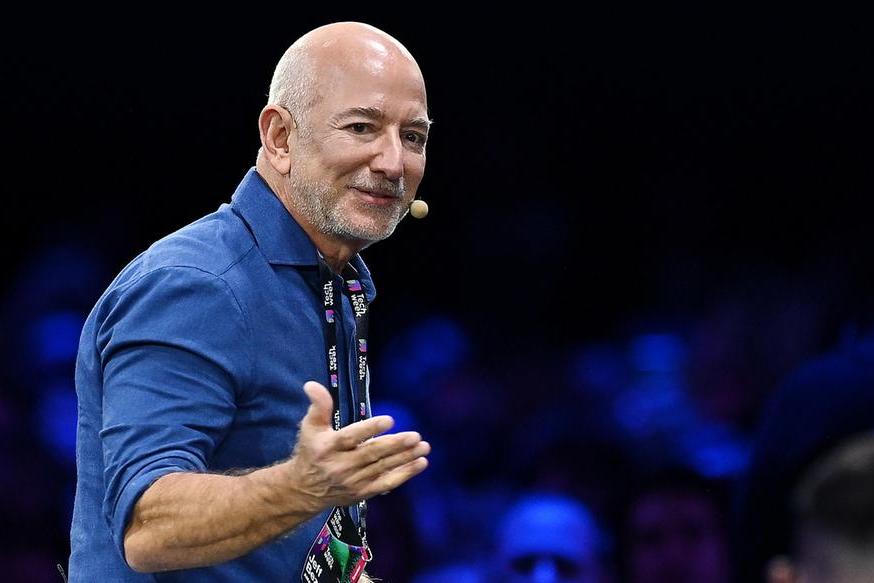
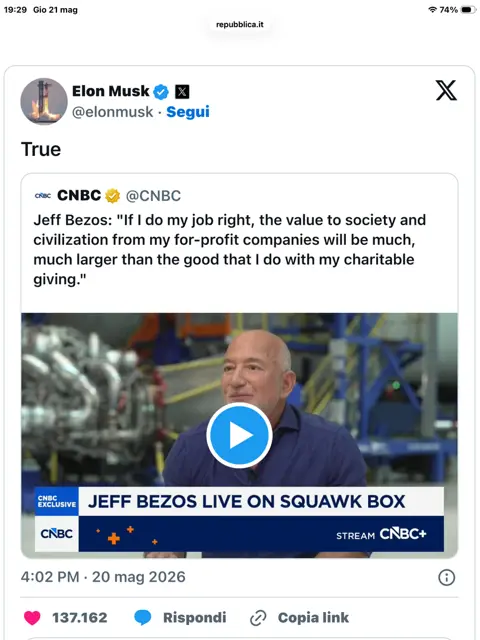
“If I do my job well, the value for society generated by my companies will be much, much greater than the good I do through charitable donations” is what he declared Jeff Bezosthe founder of Amazon (to whom Forbes attributes a personal wealth of 224 billion dollars) in an interview with CNBC (the financial television network). Elon Musk (an estimated asset of 839 billion dollars) responded by posting these words on X and writing “true”. The provocation, shared on social media, says that the most important contribution of businesses to society would be the creation of jobs and wealth rather than philanthropy and has sparked a strong debate. A discussion that goes far beyond the case of the two tycoons and touches on a decisive issue: the relationship between profit, common good and corporate social responsibility. Is the market really still capable of automatically producing collective well-being, left to act?
For the economist Luigino Brunithe topic of philanthropy is only the tip of the iceberg. Behind the controversy lies a much deeper question: is the model of capitalism that has guided the modern economy showing signs of crisis?
Musk and Bezos argue that the real contribution of businesses is to create jobs and wealth, rather than giving to charity. What do you think of this position?
«It touches on a decisive theme of the market economy, which is somewhat at the heart of capitalism: the company creates value primarily by creating quality products, jobs and paying taxes. If we put together all the wealth created by a company, charity, however much it can be done, always concerns a part of the profits which in any case do not necessarily represent the most important part of the company.”
So the topic they pose is not new?
«I would ignore the specific case of these two entrepreneurs who are talked about for many other reasons and who, as we also read on social media, are considered not very generous, not always examples of fair salaries in their businesses and do not have large charitable foundations. However, the theme they pose is nothing new: it is the theme of Milton Friedman, one of the main economists of the twentieth century. Capitalism creates wealth, but profits are only the tip of the iceberg.”
Yet the reactions on social media were very strong. What do they tell us?
«These impressive and important reactions that come from the world of social media, as can be seen from these articles, evidently say something. They say there is a growing perception that the system by which capitalism has advanced the common good as an almost indirect effect — Adam Smith’s “invisible hand” — is showing limits. The entrepreneur seeks his earnings, his advantages, his profits and, without wanting or intending it, he also creates salaries, creates value, creates products. The aim is profit and the indirect effects are the salaries of workers, the payment of various stakeholders and taxes, when they can and when they want to pay them.”
You argue that this idea of capitalism that has governed the world until today is entering a crisis. Why?
«Because people, after the environmental crisis, the issue of inequalities, of wars, realize more and more that there is something obsolete in this idea: “think about earning, let us work and then everything else, including the common good, comes as a consequence”. The idea that the common good, in classical capitalism, is a collateral effect of the private good is less and less convincing today.”
What should change?
«Today we are in a period in which we need to work in two directions: the first is that companies, in important areas such as the environment, justice and evident poverty, make intentional choices for the common good, not just thinking about getting rich. It is no longer enough to say: I look after my interests and then the market does its own, because the world has become too complex.”
And the second direction?
«We must evolve towards a different, more cooperative and more participatory form of capitalism. Which calls into question property rights. It doesn’t mean being communist, as some say “out of season”, but it means moving from political democracy alone to economic democracy.”
How do you imagine this change?
«I imagine, perhaps in a utopian, perhaps prophetic way, that in a few decades there will be large companies with millions of shareholders, where the citizen is also the owner of some piece, even a small one: companies in which one can intervene and feel like citizens, and not just subjects. Beyond the specific case, the theme of philanthropy concerns the nature of capitalism which is proving obsolete and incapable of safeguarding common goods and the common good.”