





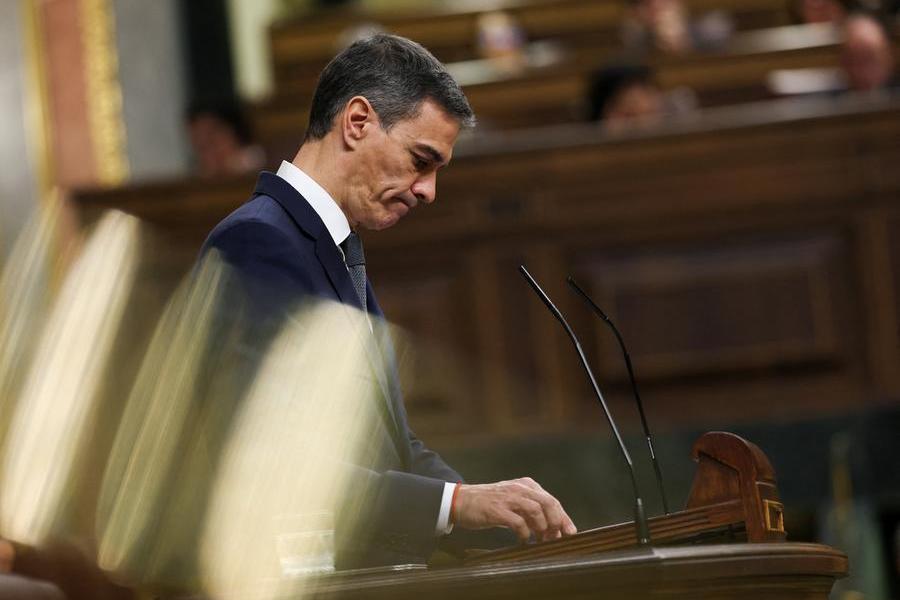
«No to war». A firm, clear, very clear position: it is the one taken by the Spanish Prime Minister Pedro Sánchez against the decision of the Governments of the United States and Israel to attack Iran, starting a conflict which, in a very short time, spread to the entire region, with a military escalation with alarming and unpredictable developments. «Spain’s position is the same as that on Ukraine and Gaza. No to the failure of an international law that protects us all. No to resolving conflicts with bombs”, declared Sánchez in his institutional speech at Moncloa, the seat of the Presidency of the Government in Madrid, responding – without ever citing him directly – to Donald Trump, who was furious with Madrid for its refusal to allow the US to use its military bases in Andalusia for the war against Iran.
Europe, once again, has been sidelined by the United States, neither consulted nor warned by Washington regarding its international military actions. And, even in this situation, EU countries have not managed, at least so far, to find a common line in foreign policy. France, Germany and the United Kingdom joined in a joint statement in which they said they were ready to defend their interests and those of their allies in the Gulf, if necessary, by taking “defensive actions” against Iran. And British Prime Minister Keir Stamer, under pressure from Trump who had also harshly criticized London, agreed to grant the military bases to the USA, but confirmed that the United Kingdom will remain out of the war and will not participate in direct interventions.
In the European context, Pedro Sánchez’s voice stands out for its determination and coherence. No giving in before Washington, no hesitation in the face of Trump’s roar.
In his speech at Moncloa, the Spanish prime minister recalled the precedent of the war in Iraq, in 2003. «Twenty-three years ago, another United States administration brought us into an unjust war. The war in Iraq generated a drastic increase in terrorism, a serious migratory and economic crisis.” At the time, the People’s Party was in government, with Prime Minister José Maria Aznar. On 11 March 2004, three days before the general elections, Madrid was hit by a series of terrible terrorist attacks which caused 192 victims and more than 2 thousand injuries. The Aznar government immediately accused the Basque independence activists of ETA. But over the days it became increasingly clear that the attacks had an Islamist origin. The vote on March 14 represented a heavy blow for the People’s Party and led José Zapatero’s PSOE to victory.
Sánchez strongly underlined that the Government rejects the regime of the ayatollahs. But he added: “The question is whether we are on the side of international legality and peace.” He made it clear that he will work to arrive at a consensual position within the EU, but making it clear that Spain will not have a subordinate position to the United States.
It is not the first time that Sánchez has gone into direct confrontation with Trump. It had already happened in 2025: when NATO allies meeting in The Hague agreed to raise annual defense spending to 5 percent of GDP by 2035, the Spanish prime minister said no, stating that 2.1 percent is sufficient and refusing to remove funds from welfare and other priorities to allocate them to NATO.
Furthermore, Madrid formally recognized the State of Palestine on May 28, 2024, along with Ireland and Norway. “This is a historic decision with a single objective: to make our contribution so that Israelis and Palestinians achieve peace,” declared Prime Minister Sánchez.