





If the journey is a progressive stripping away of the superfluous, the segment that connects the upper Val di Chiascio to Assisi represents the moment in which the steps become liturgy. It is a stage with significant differences in altitude, approximately 22 kilometers between woods and ridges.
We start from the Hermitage of San Pietro in Vigneto and, after the church of Caprignone, the road rises towards the Castello di Giomici (www.castello-giomici.it), a medieval fortress that dominates the valley. Here I meet the owner, Andrea Longo, a fifty-two-year-old former hotel manager in Rome who has chosen a welcome opposite to “hit and run” tourism: «Here travelers are not customers, but guests in the purest sense. The first contact turns them into friends”.
Longo tells me the legend of the bellicose Count Suppolino di Giomici, indicated as the instigator of the beating suffered by Saint Francis which forced him to recover for a week at the Benedictine Abbey of Valfabbrica (www.comune.valfabbrica.pg.it), a historic nucleus still dominated today by its severe Civic Tower.

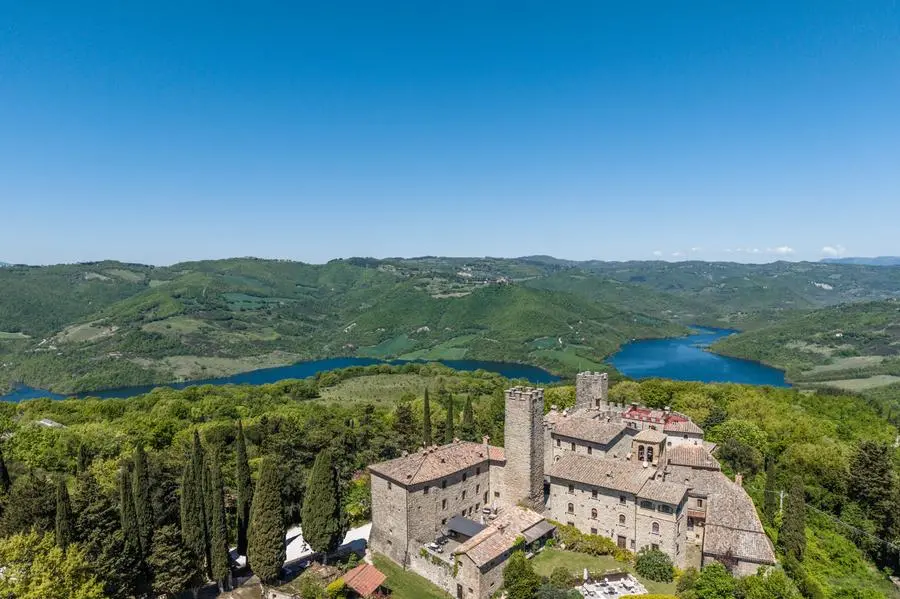
From Giomici the landscape slopes towards the Valfabbrica valley (www.umbriatourism.it), where the sun forces a choice at a crossroads: the main road deviates towards the ancient Pieve di Coccorano, offering glimpses of the Chiascio; the alternative is a short variant along the dam. Whatever the choice, the village of Valfabbrica appears on the horizon like a Franciscan Monte do Gozo, where you can meditate on the journey that will take place the next day.
The next 13.5 kilometers towards Assisi unwind through the woods and olive groves of Pieve San Niccolò. Suddenly you can see the imposing ensemble of the Sacred Convent (www.sanfrancescoassisi.org). Once you reach Ponte de Galli, you go up through the paths of the Bosco del Fai, to enter Assisi (www.visit-assisi.it) from Porta San Giacomo. Before immersing myself in the sanctuaries, I treat myself to a coffee at Bar Mario. Behind the counter are Debora Caporicci (59 years old), originally from the village, and her partner Gennaro Cignarelli (60 years old), a truly Neapolitan bartender: two generous souls who offer a human prelude to the solemnity of the city.
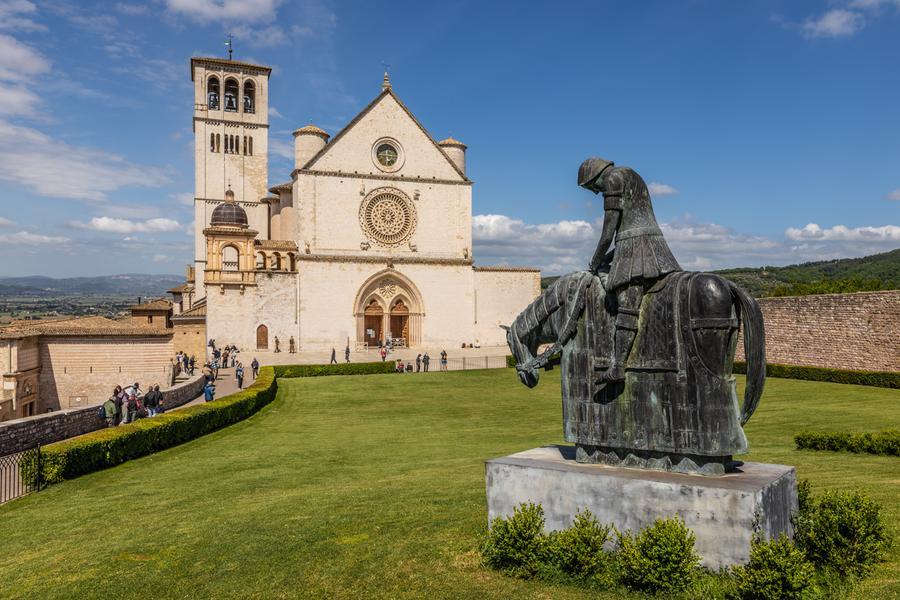
In the churchyard of the upper Basilica, between the vegetal Tau and the writing “PAX”, I meet Brother Elías (66 years old), a renewed minor religious of Colombian origin, who with the Sicilian Brother Stefano (40 years old) testifies to the universal strength of the Poverello. A little further on, the statue of Norberto Proietti captures the drama of Francesco bent over his steed on his return from Perugia.

The spiritual experience takes place in the doubling of the Basilica. Below, the lower Basilica welcomes the pilgrim like a crypt carved into the rock. It is here that Father Giulio Cesareo, conventual friar minor and director of communications of the Sacred Convent, guides us in front of Cimabue’s Majesty: a very powerful fresco that restores the real and shy features of the saint, with the protruding ear so profoundly human. Next to it, Giotto’s Vele celebrate the allegories of the Franciscan virtues. Above, the upper Basilica opens up like a hymn of Gothic light, where Giotto’s revolutionary cycle of the Stories of Saint Francis and Cimabue’s negative apocalyptic paintings unfold.
On this year of extraordinary celebrations and visitors coming from everywhere, Father Giulio contemplates «with wonder and renewed awareness how much people love Saint FrancisIndeed, it is even more extraordinary to see how much he inspires them and speaks to the hearts and minds of so many men and women, believers and non-believers, inviting them to cherish life by taking care of relationships.”
The well-known poet and writer Davide Rondoni (62 years old), president of the National Committee for the celebrations of the eighth centenary of the death of Saint Francis of Assisi (www.sanfrancesco800.cultura.gov.it), summarizes the meaning of this anniversary thus: «Saint Francis is an explosion of life, an exceptional friend who makes us dare. With all the strength of poetry we are working to ensure that they are moving and essential celebrations, capable of bringing his gaze and his heart to the world.”

From the town of Assisi the path then descends to the plain below to gather in the places of the first fraternity. We first pass by the Sacred Hovel of Rivotorto, the primordial shelter of mud and stone, and then reach the Porziuncola (www.porziuncola.org), enclosed in the basilica of Santa Maria degli Angeli. Here, Brother Emanuele Gelmi (45 years old), now bursar of the sanctuary, talks about his conversion, which began in 1999 as an engineering student in Brescia when he fell into a strong addiction to an online role-playing game that isolated him from the world: «In 2004 a friar in Assisi sensed my block and told me to turn off the virtual world to find real things again. I entered the convent in 2007. What attracted me most was the dimension of fraternity and the simple style of interacting with people”.
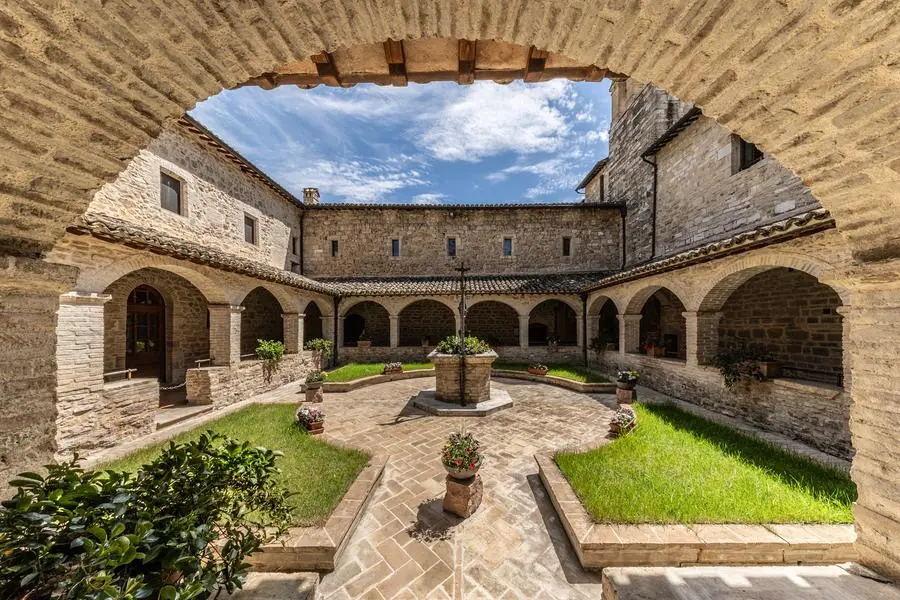
From the plain you go up slightly towards the sanctuary of San Damiano (www.santuariosandamiano.org), a key place where the Crucifix spoke to the young Francis and where Clare of Assisi later founded her community, leaving the intimate and bare atmosphere of the first medieval cloister intact.
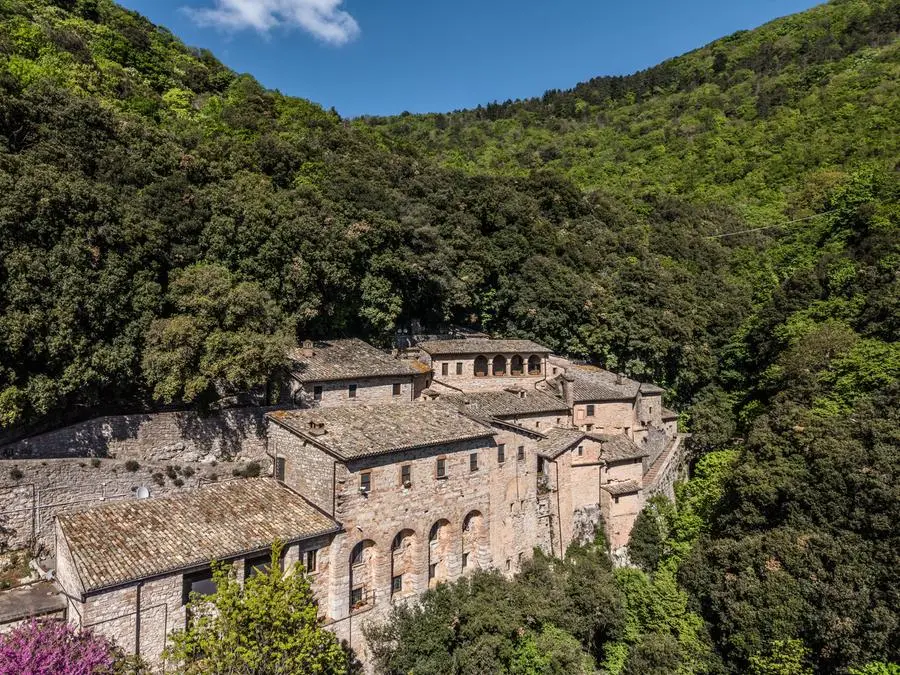
Finally, this stage culminates with the ascent to the Eremo delle Carceri (www.santuarioeremodellecarceri.org), perched on Mount Subasio. The path welcomes us with the majesty of monumental holm oaks that stand tall, embracing the traveler. This place preserves the essence of Franciscan isolation, a space saturated with silence in which the primordial elements manifest themselves with vigor: the water of the rocks, the wind among the branches, the filtered light and the fire understood as the ardor of conversion. The experience turns out to be memorable. Francis still speaks through the breath of the wind and the rustling of the leaves of these sacred woods, revealing his living and perennial presence.