





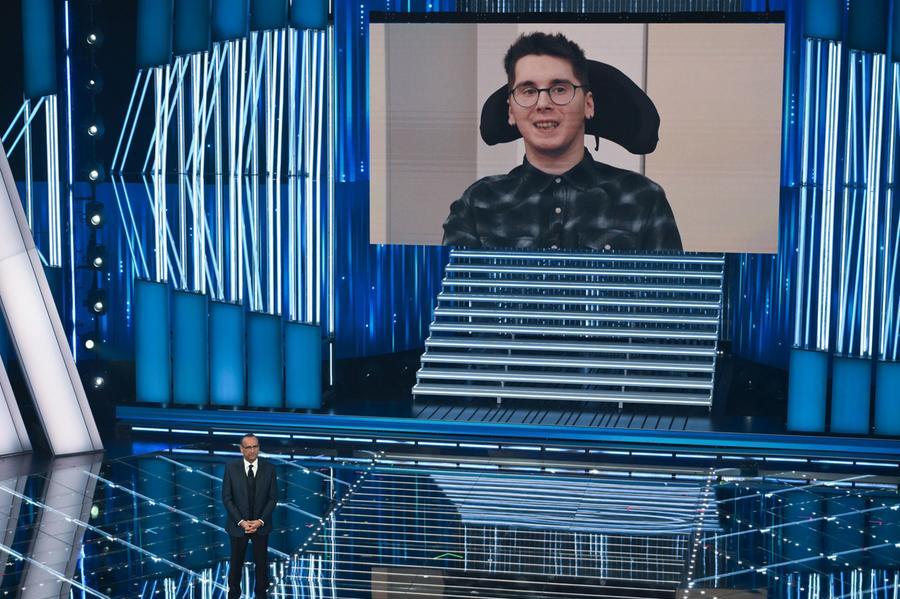
The Sanremo Festival is not just a singing competition. The Ariston stage has always become a sounding board for the country’s wounds and hopes. On the third evening of Thursday 26 February, the host Carlo Conti wanted to shine a spotlight on one of those wounds that question the collective conscience: violence among very young people. He did it by giving voice to the story of Paolo Sarullo, 25 years old, from Albenga, survived a brutal attack that changed his life forever.
In connection with the Ariston Theatre, Paolo spoke with disarming simplicity: «I’m happy to be here. Stop violence against young people.” Words pronounced with difficulty, but filled with a strength that comes from having gone through the deepest pain.
The night that changed everything
Paolo’s life fell apart – and then slowly put itself back together – on the night of May 19, 2024. He was returning home with a friend after an evening in a nightclub in the Savona area. As they left the venue, a group of boys approached them with the intention of taking possession of Paolo’s electric scooter. A banal, apparently futile gesture. But in an attempt to defend what was his, Paolo was hit with a violent punch that knocked him to the ground. The impact of his head on the asphalt was devastating. Urgently transported to the Santa Corona hospital in Pietra Ligure, he underwent two very delicate neurosurgical operations, which lasted a total of thirty hours. He remained in a coma for three months, suspended between life and death, while his family and an entire community prayed and waited for a sign of hope. That sign came with the awakening. But from that moment on, the road proved to be uphill.
The sentences and compensation that do not erase the pain
The investigations quickly identified those responsible: four young people between 18 and 20 years old and a minor. Arrests and very serious charges were brought against them. One year after the events, the Court of Appeal confirmed the sentences for the perpetrator of the punch and his accomplices.
In addition to the prison sentence, the judges ordered provisional compensation of 1 million and 270 thousand euros for Paolo and 200 thousand euros for his mother. A figure that testifies to the seriousness of the biological and moral damage suffered. But, as the family has repeatedly underlined, no amount of money will be able to restore Paolo to full health and the light-heartedness of that spring evening.
Rehabilitation and the choice of forgiveness
Upon awakening from a coma, Paolo had to deal with a very harsh reality: the use of his arms and legs was seriously compromised. Thus began a long and tiring rehabilitation journey, punctuated by daily work with physiotherapists and speech therapists. Small steps, minimal achievements which for those who experience them become immense goals. In recent days, he said, he has begun to make new progress. Every recovered movement is a victory against resignation. But the passage that most struck the Sanremo audience was another. When asked if he had forgiven his attackers, Paul responded without hesitation: “Yes. I would like to tell them that this must never happen to anyone again. You don’t give up on shit.” Strong, raw, true words. Inside that sentence there is the anger of someone who has seen death up close, but also the determination not to let hatred become the last word.
A message for young people (and adults)
Paolo’s presence at the Ariston was not just a testimony. It was a call to responsibility. The violence that arises for a futile reason, the logic of the herd, the inability to stop for a moment before the irreparable act: all this challenges not only the children, but also the families, the school, the Christian and civil community.
The story of Paolo Sarullo is not just a news story. It is the story of a possible rebirth. It is the sign that, even after the deepest darkness, a light can turn on again. And that forgiveness – while not erasing justice or pain – can become the first step to breaking the chain of violence.