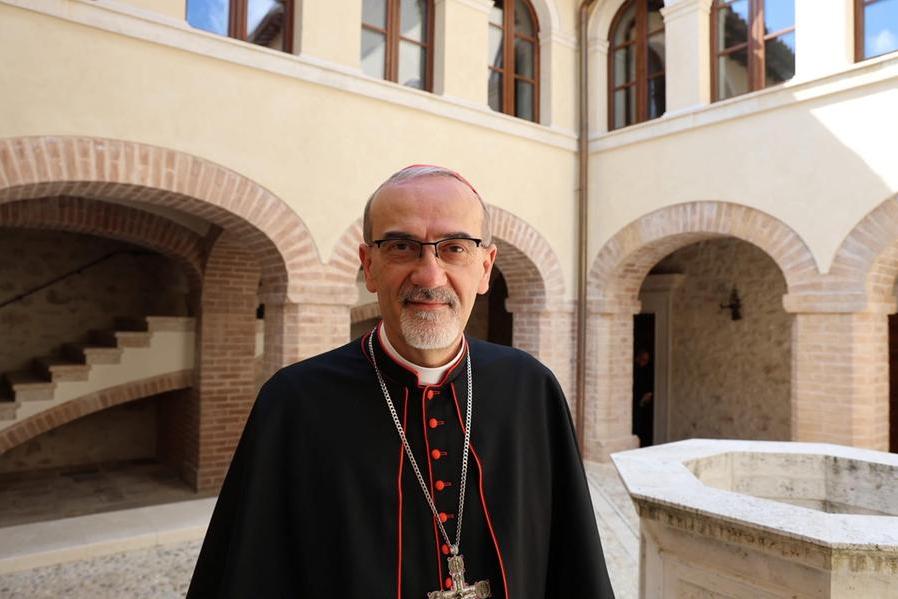
«There’s no way out of the crisis in the Middle East, it’s a quagmire. Always has been and always will be.” With these words, pronounced on Saturday at Norciathe cardinal Pierbattista Pizzaballa, Latin Patriarch of Jerusalem, he described the dramatic situation in the region which for years has been at the center of wars, tensions and instability.
Pizzaballa spoke on the sidelines of the ceremony with which he was awarded the San Benedetto International Awardguest of the Abbey of San Benedetto in Monte, where he also participated in the celebration of Vespers of the feast of San Benedetto with the Benedictine monks.
The Patriarch, who observes the consequences of the conflict daily from Jerusalem, explained how the Middle East is going through “a very hard, difficult moment”, characterized by tensions that have “now exploded” after years of war. But, he warned, a lesson emerges from this experience that does not only concern that region of the world: «What we must learn in the Middle East is to overcome the idea that new balances can be formed only with the use of force and violence». For the cardinal, in fact, “the balance of the future cannot be founded solely on the criterion of force and violence”.
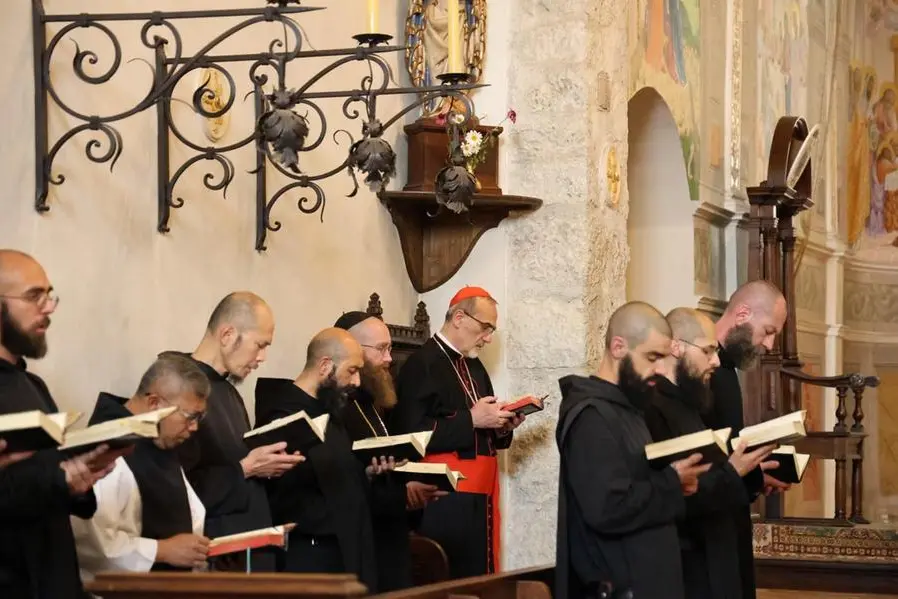
Cardinal Pierbattista Pizzaballa, patriarch of Jerusalem, recites Vespers in the Abbey of San Benedetto in Monte in Norcia
(HANDLE)
«There is a lack of leadership capable of building peace»
The Patriarch of Jerusalem then broadened his gaze to the root causes of the international crisis, indicating the fragility of the institutions as one of the most worrying elements: «The lack of local and international leadership, the weakness of political, cultural and even religious institutions, they are one of the elements of today’s crisis.” According to Pizzaballa, the problem does not only concern international politics, but also affects “local, cultural and religious institutions”, in a context marked by widespread conflicts and the weakening of the culture of peace.
Saint Benedict’s message for today’s world
Receiving the international San Benedetto Award, the cardinal underlined how the figure of the Patron Saint of Europe still has a lot to say in our time: «The message of San Benedetto is very current, because even today, as in his time, we are living in an era marked by the end of political, social, economic and cultural balances, without knowing yet what will happen.” The comparison with the 6th century is not accidental: “Saint Benedict lived through a long period of transition, of the end and decline of an empire and of lack of clarity about what was about to happen.”
For this reason, according to the Patriarch, the Saint of Norcia continues to indicate a path: “He shows us a method”, that of «not just watching the news, but knowing how to interpret events» and to «build the future of the next generations also on cultural foundations and not only on purely social economic aspects». Pizzaballa recalled that at the center of the Benedictine vision there were “faith and the religious element”, which today “do not seem to me to be central, at least in the Western world”. Yet, he added, the message remains alive because it recalls “the need to build a humanity taking into account spirituality, the spirit, which is part of the life of all men, believers or not”.
«Peace is also a culture»
Finally, the cardinal reflected on why appeals for peace, in the Holy Land but not only, seem to remain unheard today: «Peace is also a culture. And the culture of peace is not as widespread as it seems”, he observed, inviting us not to limit our gaze to the Middle East alone but to analyze “the general dynamics”. For the Patriarch, in fact, today «the individualistic culture prevails, me, therefore what are my interests, my convenience”.
A logic that runs through all areas of public and private life. “The violence we are witnessing and the wars are a consequence of this.” And the reason why appeals for peace are not heard is as simple as it is disturbing: “The heart and attention are directed elsewhere.”