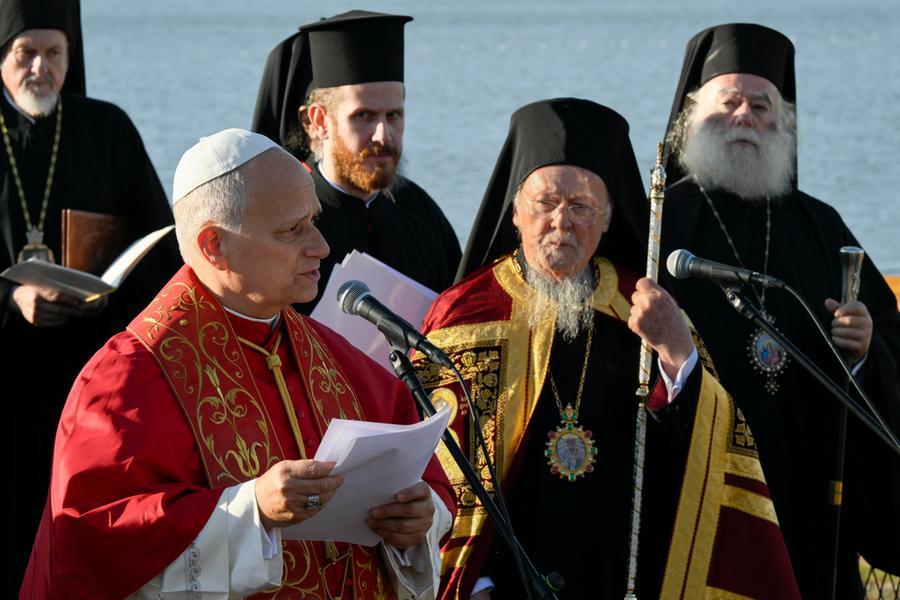




«I believe in God, the almighty Father…. And in Jesus Christ, his only Son, … I believe in the Holy Spirit.” Those who recited these words, which all Christians of all latitudes – not only Catholics, but also Orthodox and Protestants – proclaim every Sunday, were not ordinary believers but Pope Leo XIV and the Orthodox Patriarch Bartholomew, together with other representatives of the Christian Churches, last November 27, near the excavations of the ancient one basilica of Saint Neophytus in Iznik, ancient Nicaea, the city where in the year 325 the bishops were brought together by the emperor Constantine and shaped the first profession of Christian faith.
An event that wants to be a historical memory – the 1,700 years of that Council – and which reminds us that Christians, before any differences, are linked by a common creed, recognized by all. This ecumenical meeting and the joint recitation of the Creed by a Roman Pontiff together with the ecumenical patriarch of Constantinople – signs of great hope on the path towards Christian unity – would not have been possible even just 60 years ago, due to the mutual excommunications dating back to the Great Schism between East and West in 1054.
And this brings us back to another anniversary and another historical event, which happened exactly 60 years ago: the Vatican Council II, that Pietro Pisarra tells us in the Zoom that Don Severino Dianich recalls for Credere (interview on page 37). In fact, it was Vatican II that officially inaugurated the season of ecumenical dialogue and mutual recognition with the other Christian Churches. A new direction made visible by the historic embrace between Pope Paul VI and the Orthodox Patriarch Athenagoras on 5 January 1964: a gesture that opened the way to reconciliation after a millennium of mutual condemnations and hostility.
These two epochal events – Nicaea, year 325, and the Second Vatican Council, which ended on 8 December 1965 – remind us that our faith has distant but still vital rootsis shaped by what other Christians before us have developed and handed over to us. The Church, in other words, is determined by one Living traditionfrom the handing over from one generation to another of a faith that over time is enriched, deepened, reshaped, maintaining the link with the origins but also opening up to the stresses of history (the “signs of the times”) to learn to repeat the words of the Gospel in our times.
Tradition is not a static deposit, a casket of truth closed in mothballs. We live determined by a memory rooted in the Good News of Jesus Christ, who “was born of the Virgin Mary”, but we are also on a journey through history. We must be grateful for the faith that has been transmitted to us, which frees us, at least in part, from the effort of rethinking Christianity from scratch every time, having solid references. But we don’t have to fear, on the other hand, the necessary “updating”, which forces us to find the words to express our faith, to be ever more faithful to Christ and his Gospel.