



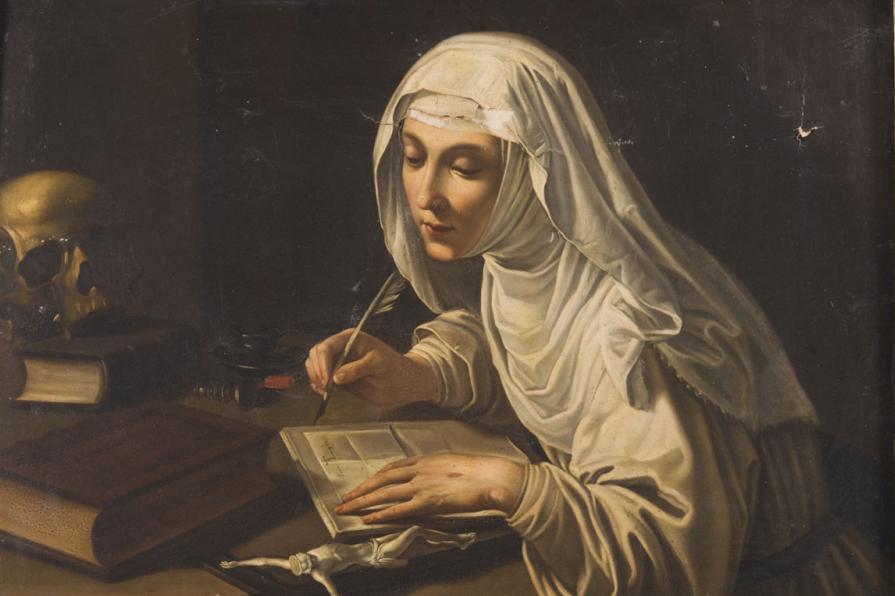
Semi-literate, she doesn’t go to school and has no private teachers, her parents want to marry her off at the age of 12 but she says no. She will become mystic, spiritual advisor to powerful and high dignitaries and patron saint of Italy and co-patron of Europe. Thanks to the work The Dialogue of Divine Providence (that is to say Book of Divine Doctrine), a masterpiece of spiritual literature, the exceptional Epistolary and the collection of PrayersSaint Catherine of Siena was proclaimed Doctor of the Church on 4 October 1970 at the behest of Pope Paul VI, seven days after that of Saint Teresa of Avila (1515–1582).
Caterina (from the Greek: “pure woman”) lives in a historical moment and in a land, Tuscany, of enterprising spiritual and cultural richness, whose artistic and literary scene is dominated by figures such as Giotto (1267–1337) e Dante (1265–1321).

Pompeo Batoni, Ecstasy of Saint Catherine of Siena1743
Born in Siena, in 1347, into a very large family, she died in Rome, in 1380. At the age of 16, driven by a vision of Saint Dominicentered the Dominican Third Order, in the female branch known as the Mantellate. Remaining in her family, she confirmed the vow of virginity she had made privately when she was still a teenager, and dedicated herself to prayer, penance, and works of charity, especially for the benefit of the sick. Caterina approached sacred readings despite being illiterate: on her own she learned to read and also to write, but she still and often used the dictation method.
The mystical language
The letters that the mystic wrote to the Pope in the name of God are fiery, documents of a reality that engages heaven and earth. The Catherine style flows from itself, out of internal necessity. She is defined as «Very delicate woman, this giant of will; very sweet daughter and sister, this rude admonisher of Popes and kings; the reproaches and threats that she dares to make are imbued with inexhaustible affection” (G. Papasogli, Catherine of SienaFabbri Editori RCS, Milan 2001). She uses thunderous expressions, inviting virility in choices and actions, but she knows how to be equally tender, as only a female spirit is capable of doing.

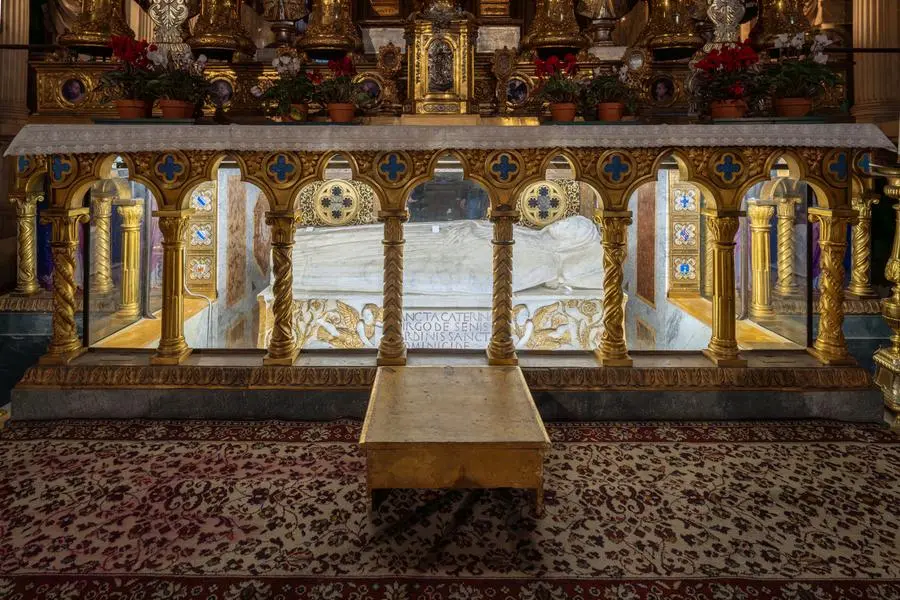
The mortal remains of Saint Catherine of Siena kept in the Basilica of Santa Maria Sopra Minerva in Rome
Advisor to princes and popes
«When the fame of her holiness spread», explained Pope Benedict XVI in the audience dedicated to her on 24 November 2010, «she was the protagonist of an intense activity of spiritual advice towards every category of people: nobles and politicians, artists and common people, consecrated people, ecclesiastics, including Pope Gregory who was residing in Avignon at that time and who Caterina energetically and effectively urged to return to Rome. She traveled extensively to urge the internal reform of the Church and to promote peace between states: also for this reason John Paul II wanted to declare her Co-Patroness of Europe: the Old Continent must never forget the Christian roots that are the basis of its path and continue to draw from the Gospel the fundamental values that ensure justice and harmony”.