





A devotion that spread very quickly: already in 384 Saint Ursus dedicated a church to her in Ravenna, Pope Honorius I shortly after another in Rome. Today, relics of the Syracusan martyr and works of art inspired by her can be found all over the world.
December 13th, the shortest day of the year, is a holiday in many cities. And everywhere his cult has inspired traditions and legends. One of the most widespread, linked to Christmas, is found in Northern Italy where there is a tradition linked to the “gifts of Saint Lucia”, almost a feminine “colleague” of the various Saints Nicholas, Santa Claus and Befana who bring gifts to the little oneswho write a letter to the Saint, listing the gifts they would like to receive and declaring that they deserve them, having been good and obedient during the year.

Food to “thank” Saint Lucia
To increase the children’s anticipation, it is traditional for the older children, in the evenings before, to walk the streets ringing a mass bell and reminding the little ones of their duty to go to bed immediately, to avoid the saint seeing them. To thank Saint Lucia we leave some food; usually oranges, biscuits, coffee, half a glass of red wine and hay, or yellow flour and salt or hay, for the donkey carrying the gifts. On the morning of December 13th, when they woke up, the children found a plate with the oranges and biscuits they had consumed, enriched with sweets and chocolate coins. Furthermore, sometimes hidden in the house, the gifts that they had requested and which are dispensed totally or partially, depending on the behaviour.
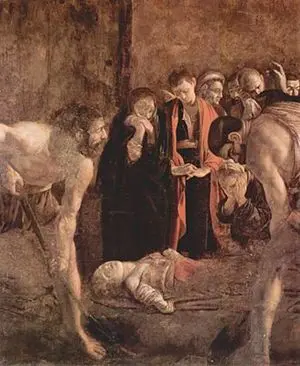
She is one of the seven women mentioned in the Roman Canon. Having lived in Syracuse, she died as a martyr under Diocletian’s persecution around the year 304. The acts of her martyrdom tell of atrocious tortures inflicted on her by the prefect Paschasiuswho did not want to bow to the extraordinary signs that God was showing through her. She is the protector of the blind and is invoked against eye diseases.
The journey of the remains
The saint’s remains are kept in Venice in the parish church of Saints Geremia and Lucia, near the railway station, where, before the construction of the railway yard, a church entirely dedicated to her stood. And one of the oldest Venetian traditions tells that the remains of the Syracusan saint passed through Verona during their journey to Germany around the 10th century, a fact which would also explain the spread of the cult of the saint both in Verona and in northern Europe.
According to another tradition, the cult of Saint Lucia in Verona dates back to the period of dominion of the Serenissima over Verona with Venice which already in 1204 transported the saint’s remains to the lagoon city.
Uncertainty over the exact date of martyrdom
It seems that Lucia suffered martyrdom in 304 under Diocletian but there are scholars who favor other datings: 303, 307 and 310. They are motivated by the fact that Lucia’s prophecy contains divergent chronological elements which often do not coincide with each other: for the peace of the church this prophecy should refer to the first edict of tolerance towards Christianity and therefore it should be ascribed to 311, connectable, that is, to Constantine’s edict of 313; Diocletian’s abdication occurred around 305; Maximian’s death occurred in 310.
However, the date relating to his is accepted by the majority of sources Christmas Day: December 13th. Yet, the Hieronimian Martyrology remembers Lucia of Syracuse on two different dates: 6 February and 13 December. The last date occurs in all subsequent Byzantine and Western liturgical texts, except in the Mozarabic calendar, which instead celebrates it on 12 December.
In the mysterious Latin calendar of Sinai the dies natalis of Lucia falls on February 8: it was drawn up in North Africa and there is an ancient document of the local liturgy that is overall autonomous from both the Church of Constantinople and that of Rome, while revealing sources common to the Hieronymian calendar.
When and how did the cult of Lucia as the patron saint of the eyes arise?
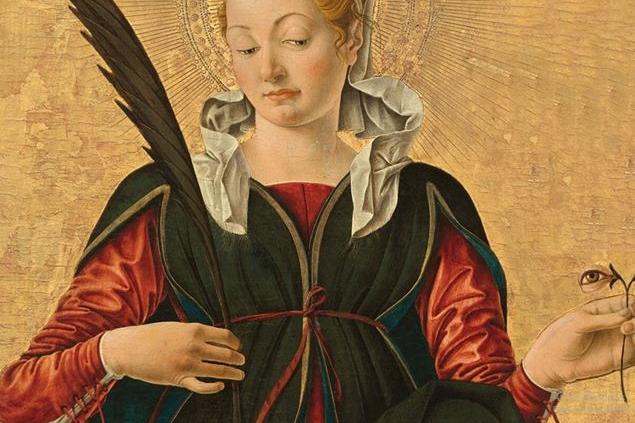
The celebration of the cult of Lucia as the patron saint of the eyes is still very widespread today. This also seems to be supported by the vast iconographic representation, which, however, is very varied, as over the centuries and in various places it has been enriched with new symbols and various values. But has it always been like this? When did this patronage actually arise and why? Since the Middle Ages, Lucia’s thaumaturgy as the patron saint of sight has been increasingly consolidated. XIV-XV an innovation in iconography makes its way: the depiction holding a saucer (or a cup) where his own eyes are placed. How can this theme be explained?
Has it perhaps moved from the oral text to iconography? Or from iconography to oral elaboration? What is the origin of such patronage? It is probably to be found in the etymological connection of Lucia a lux, very widespread especially in Byzantine and Western Middle Ages hagiographic texts. But what are the limits of the documentation and what are the causes of the proliferation of the tradition relating to the iconography of Lucia, protector of sight? Can we talk about the expansion of the act of reading in the iconographic imagination, as well as in the literary one? And is this expansion in religious phenomena an act of devotion and faith? It is also true that the esoteric semantics given to the name of the v. and m. of Syracuse is the characteristic that the figure and cult of Lucia has, lighting it with intense poetry, which becomes, over the centuries and in various places, a promise of light, both material and spiritual.
And precisely for this purpose the iconography, already starting from the century. XIV, interprets and disseminates this legend, depicting the saint with specific and at the same time connotative symbols: the eyeswhich Lucia holds in her hand (or on a plate or on a tray), which are often accompanied by the palm, the lamp (which is also one of the most widespread and beautiful evangelical symbols, perhaps derived from sepulchral art) and, less frequently, also by other elements of her martyrdom, such as for example. the book, the chalice, the sword, the dagger and the flames.
It is also true that religious images can be understood both as portraits and as imitations but we must not forget that before the modern age there was a lack of references to its physiognomic data, so artists used to resort to hagiographic literature whose example par excellence is the Legenda Aurea by Iacopo da Varazze, which represents the reference text and source of much of the religious iconography. In this work, Lucia’s hagiographic dossier – which is presented as a text of approximately three pages in length – is preceded by a preamble on the various etymological and semantic values relating to the Lucia/light combination: Lucia is a derivative of light also extended to the symbolic value via Lucisthat is, path of light.