


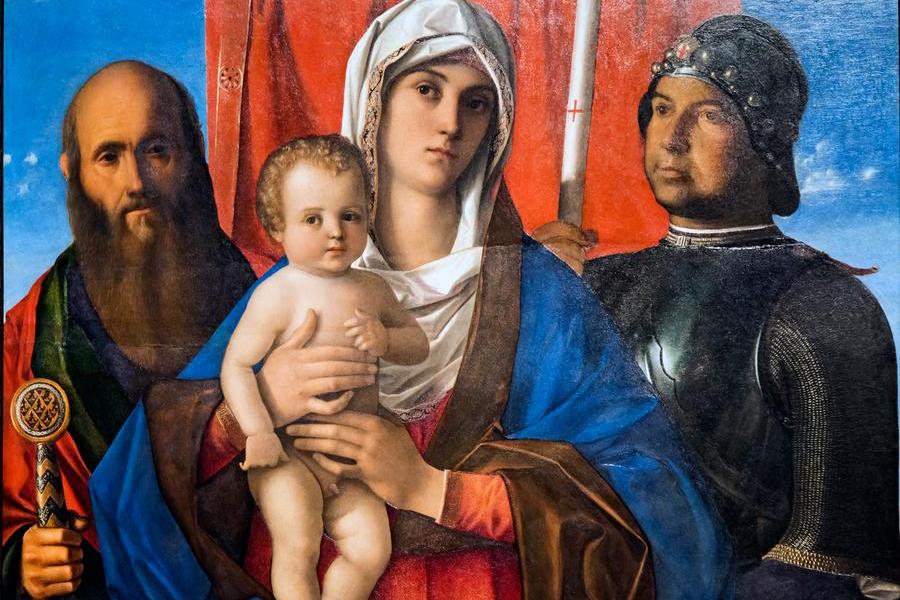



Why does Paul of Tarsus never explicitly mention the Madonna, neither as “Mary” nor as “Mother of Jesus”, in any of his letters?
Roberto Catanuto
The first and only occasion on which Paul refers to Mary is in Galatians 4:4: “But when the fullness of time had come, God sent forth his Son, born of a woman.” Furthermore, it is only an implicit reference to the Mother of the Lord, given that the Apostle (a great expert of the Old Testament!) here takes up two verses from the Book of Job (14,1-2), in which the extreme fragility of the human condition is expressed: «Man, born of woman, has a short life and full of restlessness. Like a flower it sprouts and withers.” “Born of a woman” therefore indicates that Jesus was fully in solidarity (except for sin) with the condition of weakness of all men.
Why, then, does Paul make this choice? Because he writes his letters – except the one to the Romans – to specific communities, in response to particular questions and with a pastoral spirit. And he always does so by recalling some aspect of his “gospel”, that is, the heart of his announcement. That it is Christ and He alone, the true center of faith, what really matters and its only concern. The rest appears peripheral to him.
Therefore, it is true: there is no explicit and articulated Mariological reflection in Paul. But even Peter in his letters does not speak of Mary and neither does John, who is the disciple to whom Jesus, dying on the cross, had entrusted his Mother (and he to her, cf. John 19:26-27). This tells us that the New Testament must be read as a whole and that we cannot focus on just one entry.
However, the fact remains that Paul mentions Mary, in an indirect but still clear way. And this is no small thing, since Paul wrote in the 50s, well in advance of the first theological reflections on her, which date back to the writing of the Gospel of Luke (and his Acts of the Apostles), that is, in the 80s and 90s. The very formulation of the Mariological dogmas (Perpetual Virginity, Divine Maternity, Immaculate Conception and Assumption into heaven) are the result of theological reflections that occurred centuries later. Just like the development of Marian devotion, which came much later.