


Thomas, or the courage of doubt
The scene with which the Gospel story opens is easy to imagine: a closed room, a few people gathered together, many words left unsaid and the feeling that everything that was promised has suddenly stopped. Closed doors tell a story a tense communitywho protects himself and seeks security, but who precisely in this closure discovers the space into which the Resurrection can enter. It is there, in this ordinary and almost domestic situation, that Jesus appears and gets in the way, creating a space in which others can find the courage to live, showing that new life does not need grand gestures, but authentic presence.
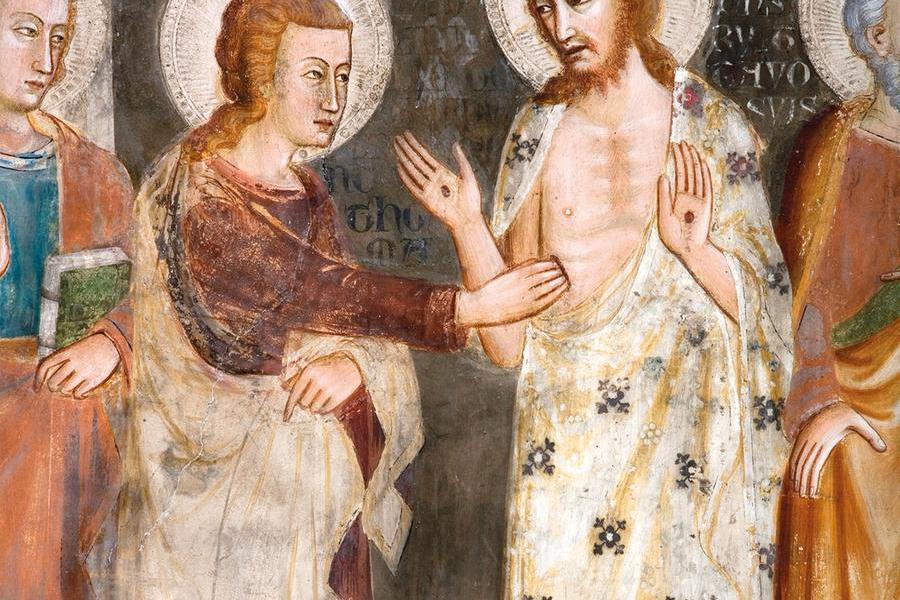
His greeting, «Peace be with you», it’s like a deep breath that brings calm and orientation, similar to when someone enters a tense room with just presence restores serenity. Jesus shows his hands and his side, reminding his disciples that new life does not erase what has been difficult: the wounds remain visible, just as the traces of the trials that everyone goes through remain visible. Joy comes from the awareness that one’s own that wounded story can continuetransforming itself into an opportunity for growth and openness, in a space where even painful experiences find a new meaning.
From here the sending of disciples takes shape, not as a task to be organized immediately, but as a lifestyle that is rooted in the presence and mutual support. Entering blocked situations without forcing them, putting firm relationships back into motion, restoring trust where it seemed dull: all this is made possible by the gift of the Spirit, the breath that opens paths, renew the heart and makes possible what we would not be able to do alone. It is the Spirit who transforms gestures and words into life, who accompanies every step of believers, replacing fear with courage, closure with openness, doubt with possibility. The figure of Thomas, known as Didymus, i.e. Twin, adds another dimension to the scene. His doubt is not rejection, but sincere research: he wants to touch with his own hands, verify with his own senses, understand at his own pace. This shows that faith grows through encounter and patience, and that doubt is not an obstacle, but a door through which trust can come in and take root. Jesus meets him in his request, returns precisely for him and does not judge him, showing that the loving presence welcomes questions and hesitations. The confession “My Lord and my God” arises from this relationship, but it is also the fruit of a community that supports and accompaniesand becomes the expression of a living faith, formed over time, in listening and in the willingness to open up. In this sense, Thomas is not only the doubter of the story, but the symbol of those looking for authenticityand his experience teaches us that doubt, when accepted, does not weaken faith, but makes it deeper and more aware.
The last word of the text is addressed to the reader: the bliss for those who believe without having seen invites them to travel faith as a path of trustsupported by the gift of the Spirit, capable of accepting their own questions and opening their lives to others. The Resurrection takes shape in concrete gestures, in the willingness to listen to those who are afraid, in the courage to offer forgiveness and trust, and in the ability to build authentic relationships. Believing means letting yourself be transformed, allowing the Spirit to guide the stepsand discover that every small gesture of openness, every word said with sincerity, every act of closeness can become a seed of new life, making our daily life a place where Easter continues to flourish.