



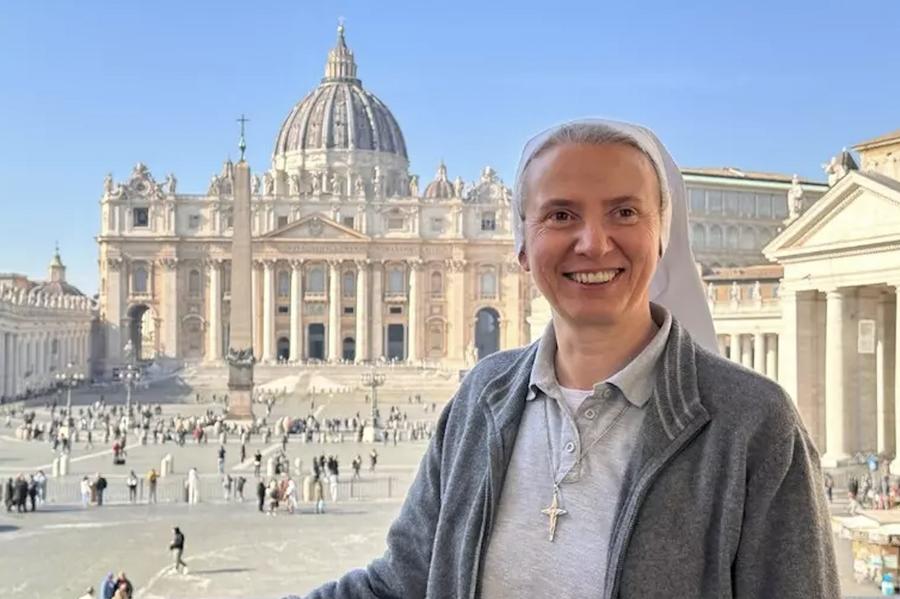
When history accelerates, it often does so in silence. Without proclamations, without dramatic outbursts, but through decisions which, over time, prove to be watersheds. The appointment, on January 6, 2025 by Pope Francis, of Sister Simona Brambilla head of the Dicastery for Institutes of Consecrated Life and Societies of Apostolic Life belongs to this category of events: a passage that marks a before and after in the recent history of the Catholic Church, especially regarding the role of women in decision-making places.
For the first time a woman, a religious woman, takes on the leadership of a Vatican Dicastery with the role of Prefect. The second to hold a high-level position in the Roman Curia following the appointment in 2021 of Sister Alessandra Smerilli as secretary of the Dicastery for the service of integral human development. Not a symbolic position, not an ancillary role, but a full responsibility on one of the most complex and delicate areas of ecclesial life: that of consecrated life, which involves hundreds of thousands of religious men and women throughout the world. A universe crossed by great transformations: the decrease in vocations in Europe, the growth in Africa and Asia, the struggle to reread ancient charisms in new cultural contexts, the demand for a credible evangelical presence in a world marked by inequalities and conflicts.
A missionary before a manager
Sister Simona Brambilla, Consolata missionary, born in 1965, is not a figure who grew up in Roman palaces. Trained as a nurse, she has had a long missionary experience in Mozambiquealongside the sick, the poor, the communities wounded by war and precariousness. It is there that a leadership style matures that does not coincide with command, but with proximity, listening, the ability to stay within contradictions without simplifying them.
Having returned to Italy, she combined professional competence and theological reflection, until she was called to Rome to collaborate with the Dicastery for Consecrated Life. In 2023 she becomes its secretary: a first turning point, which breaks an all-male custom in managing top roles. Today, with the appointment as prefect, that path finds a fulfillment that goes far beyond her person and takes on a far-reaching ecclesial and symbolic value.
His personal story tells a Church that never separates thought from experience. A Church that entrusts responsibility not through belonging, but through competence and credibility. This is one of the most significant traits of the choice made by the Pope: recognizing that authority arises from service and discernment, not from gender or clerical status.
The ecclesial significance of a historic appointment
The appointment of Sister Simona Brambilla by Pope Francis was not an isolated gesture, nor a belated concession to external requests. It fits in an ecclesial journey that in recent years has put key words such as synodality at the centerco-responsibility, listening to the People of God. In this horizon, the mandate received takes on a scope that is both pastoral and prophetic.
Entrusting the leadership of a Dicastery to a woman means recognizing that the Church can no longer afford to ignore or marginalize half of its energies. For decades, religious women have represented the most widespread and concrete presence of the Church in the world: in schools, hospitals, in urban suburbs and in the poorest areas of the planet. Yet, they have rarely had a voice in the places where pastoral lines and strategic choices are decided. This nomination broke an implicit, but not evangelical, balance by introducing a new and at the same time ancient principle: in the Gospel, authority is not domination but service. And service, when authentic, generates shared responsibility. Sister Simona Brambilla’s guidance makes this possibility visible, makes it concrete, practicable, embodied.
Women, power and conversion of gaze
This is not an ideological revolution, nor an identity flag. The strength of this choice lies precisely in its normality. Sister Simona does not represent “women” in the abstract, but a concrete story, a lived vocation, a recognized competence. Its authority does not arise from claim, but from experience. This passage forces the Church to question itself on the language of power. Governing, in the evangelical logic, means taking care, guarding, accompanying. It is a conversion of gaze that concerns men and women, lay and consecrated. But seeing a woman exercise a top role in the Curia helps to undermine sedimented images and make credible a change often evoked but rarely achieved.
For many believing women, this nomination is a sign of confidence. It does not resolve the issue of equality in the Church in one fell swoop, which remains open and complex, but it indicates a direction. It shows that change is not only desirable, but possible. And that can happen without distorting the ecclesial identity, indeed making it more faithful to the Gospel.
An open road for the future
In a time in which the Church is called to counteract centrifugal forces, especially in the eyes of the new generations, choices like this are centripetal: they speak more than many documents. They tell of a Church that is not afraid to trust, to open spaces, to recognize charisms where they mature. A Church that does not fear difference, but considers it a resource.
Sister Simona Brambilla is not “the first woman” just because of a statistical question. And for this reason it was chosen three women of the year 2025 by Christian family. It is the first because it opens a path. And every new path, in the Church as in society, is always an act of hope. A concrete, embodied hope that now asks to be explored to the full.