


Throat cancer usually affects the larynx and pharynx. They represent around 8,000 to 10,000 cases per year in France, especially after the age of 50.
In France, throat cancers (which mainly include the larynx and oropharynx) are part of all ENT cancers. They represent approximately 8,000 to 10,000 cases per year out of 15,000 in total for ENT cancers. They affect men more than women and are most often diagnosed from 50 years old. What symptoms spot? Can we heal throat cancer? What are the treatments ?
Definition: what is throat cancer?
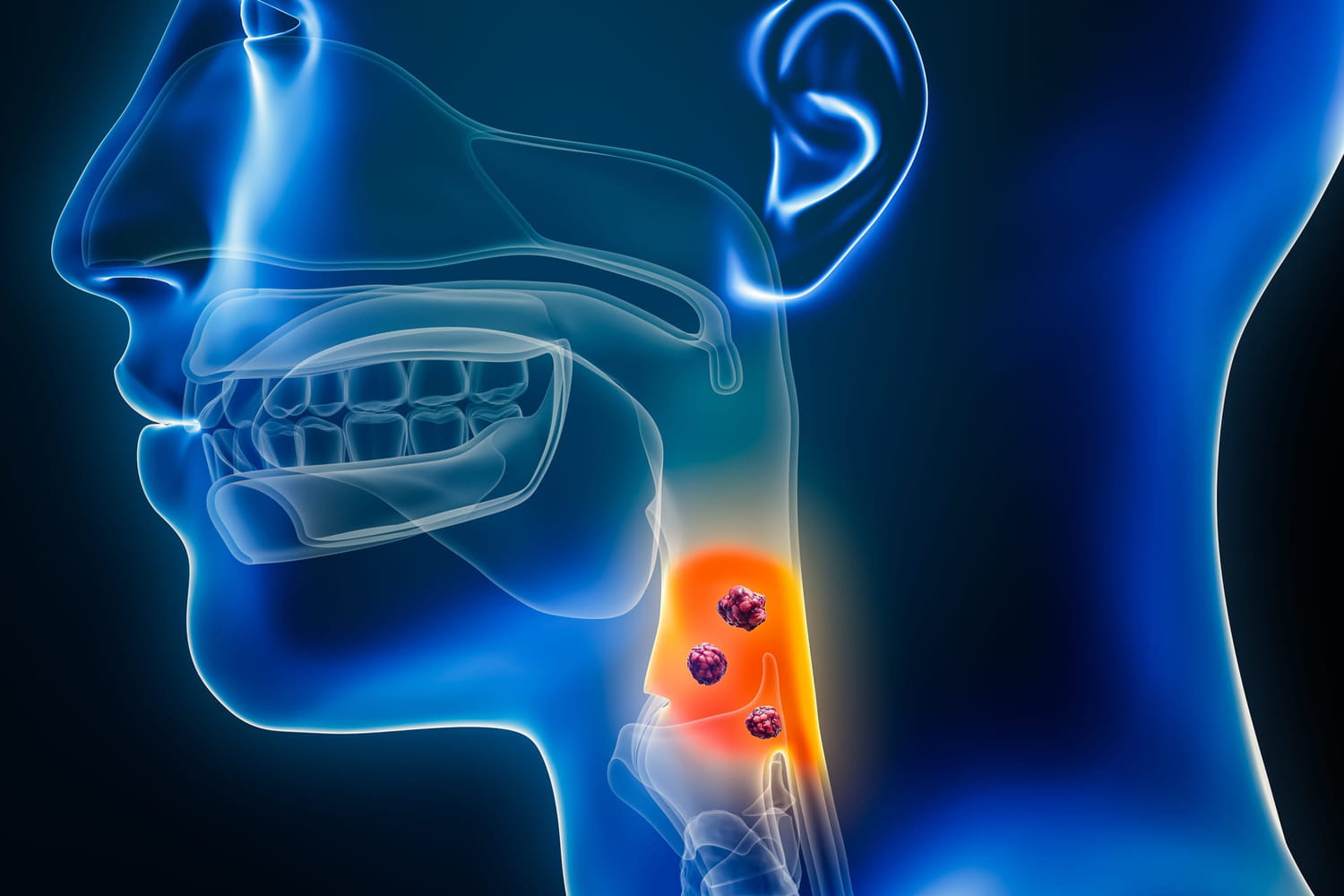
Throat cancer is more commonly referred to in medicine as “upper aerodigestive tract cancer“. It generally affects the larynx and pharynx and can develop in the nasal passagesof the oral cavity (language, palace, gum, lips), of the tonsilsvocal cords (otherwise called larynx or glottis) and epiglottis. This cancer causes symptoms at the level of the voice or the swallowing.
What are the symptoms of throat cancer?
Most throat cancers develop from precancerous lesions that have not been detected. The difficulty in detecting cancer of these lesions early lies in the fact that the process remains long time asymptomatic. This cancer, however, has consequences on swallowing, speaking and breathing. “It’s the unusual persistence over time (more than 3 weeks) of these classic symptoms which should, in patients at risk, raise the suspicion of cancer”explains Dr Antoine Moya-Plana, ENT surgeon at Gustave Roussy. Among the symptoms that may suggest throat cancer:
- change in tone of voice,
- cough,
- difficult breathing,
- painful swallowing,
- ear pain,
- sore throat,
- lymphadenopathy
► nodule in the throat. A nodule is a small rounded mass that usually forms just under the skin, sometimes referred to as a “lump” or “lump”. The nodules can be located on the thyroid or on the vocal cords. In this case, we often speak of “singer’s nodules“, because they frequently affect professional interpreters. This is also the case in other professions where the voice is in high demand, such as teachers, lawyers, market gardeners, etc. In the vast majority of cases, the nodule is completely benign.
What are the stages of throat cancer?
Staging of throat and larynx cancers is based on the TNM classification. Like any cancer, throat cancer can be diagnosed at a more or less advanced stage. The more the cancer spreads, the greater the stage and the lower the chances of survival.
► Stage I is a localized and small cancer. Whether it is a subglottic or supraglottic throat tumor, it does not affect the lymph nodes in the neck or other areas of the body.
► At stage II, the tumor involves more than one area.
► At stage III, the vocal cords have lost some of their mobility or the tumor has spread to surrounding tissues.
► At stage IVthe lymph nodes are affected, the cancer is extensive and metastases have appeared.
Life expectancy: can throat cancer be cured?
Overall, for throat cancer (larynx, pharynx), around 55% to 60% of patients are still alive 5 years after diagnosis according to figures from Santé Publique France. But it also depends on the stage of the disease. At the early stage (stage 1), 5-year survival is estimated between 80 and 90%; at the intermediate stage (stage 2 or 3), around 40 to 50% and at the advanced stage (with metastases), it is 20 to 30%. These cancers are often diagnosed late. The figures also show that not all throat cancers are equal: some (related to HPV) have a better prognosis while those linked to tobacco and alcohol are often more severe.
What are the risk factors for throat cancer?
THE smoking is the main risk factor for throat cancer. In association with excessive consumption alcoholtobacco is particularly dangerous for the upper airways. However, other external factors may be responsible for the proliferation of cancer cells. This is particularly the case of thepapillomavirus infection (HPV). “This virus, which is sexually transmitted, can induce oropharyngeal cancers (amygdala, soft palate, base of tongue)”specifies the doctor. We can also cite theprolonged exposure to toxic substancesTHE gastroesophageal reflux and nutritional deficiency.
If cancer of the upper aero-digestive tract is suspected, a endoscopy of this area of the body is performed under general anesthesia. We inserts a rigid tube into the throat to explore the air and digestive tracts and sample suspicious tissues to analyze them (biopsy). “The diagnosis of cancer is established if cancer cells are found in the samples, continues the specialist. In the event of proven cancer, other examinations are necessary to assess the extent of the disease: head and neck scan, chest scan, MRI, PET scan.”
What are the treatments for throat cancer?
The management of throat cancer will be decided by a multidisciplinary medical team (ENT surgeon, anesthesiologist, radiotherapist, radiologist, oncologist) depending on the nature of the pathology and its stage of development. Several possible surgeries:
► Removal of the tumor by endoscopic surgery. (only for the vocal cords). If the cancer is still in its early stages, the doctor can destroy the cancer cells with or without a laser.
► There partial laryngectomy consists of removing the part of the larynx affected by the tumor. This intervention can affect speech and breathing, but there are larynx reconstruction techniques that can limit the after-effects.
► There cordectomy consists of removing only part of the affected vocal cord.
► There pharyngectomy involves removing part of the pharynx. We can then reconstruct the organ in order to limit the after-effects and ensure normal swallowing.
► There total laryngectomy. If the cancer is advanced, it is sometimes necessary to remove the entire larynx and make an opening in the neck connected to the trachea to ensure air entry to the lungs (a tracheostomy). After such an intervention, the operated person must learn to speak again with the help of a speech therapist.
► THE lymph node dissection. If the lymph nodes are affected or in certain forms of cancer at risk, it is necessary to remove the lymph nodes during the same operation as the removal of the pharyngo-laryngeal tumor.
A complementary radiotherapy to destroy any residual cancer cells may be indicated. If surgery is contraindicated, radiotherapy is generally used. Some drugs targeted drugs act directly on specific mechanisms of cancer cells to slow down their development. THE cetuximab (Erbitux®) is one of the treatments still used, particularly in combination with radiotherapy when conventional chemotherapy is not possible. But in recent years, the arrival of immunotherapy has profoundly changed care, with new treatments becoming central in certain situations. In the event of surgery, rehabilitation with a speech therapist is often necessary to regain basic functions such as speaking or swallowing. During radiotherapy, particular attention to oral hygiene and regular follow-up with the dentist remain essential.
Produced in collaboration with Dr Antoine Moya-Plana, ENT surgeon at Gustave Roussy.