
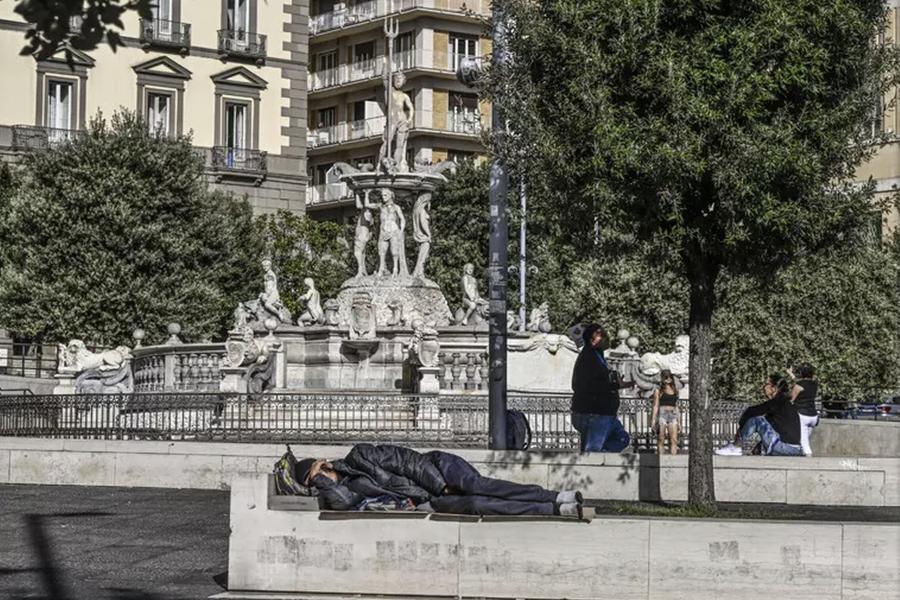




It was the small hours of January 26, 2026. Outside, winter held the cities in its usual grip. In the streets of Rome, Milan, Naples, Genoa, hundreds of volunteers moved in silence between porticoes, underpasses, railway stations, frozen benches. They had an unprecedented and necessary task: counting the invisible. Those women and men who have nowhere to go at night, who sleep curled up under makeshift blankets, who have lost, often through tortuous ways, never because of a single day, the thread that kept them anchored to the civil assembly.
The result of that night is a number that challenges consciences: 10,037 homeless people in the fourteen Italian metropolitan municipalities. Ten thousand. A small city within the big cities. A census that Istat, in collaboration with the Italian Federation of organizations for homeless people (fio.PSD-ETS), wanted as a merciless and necessary snapshot of one of the most acute forms of human exclusion.
A photograph, not an abstraction
The chosen method is called Point in Time: you choose a night, organize the teams, and walk. We do not make probabilistic estimates, we do not interpolate data. People are counted one by one, wherever they are found. It is an approach that has the merit of brutal concreteness: that evening, at that moment, there were ten thousand human beings without a roof over their heads.
Of these, 5,563, 55 percent, were in night shelters: dormitories, parishes, centers managed by volunteers and private social workers. The other 4,474, almost half, were on the streets. On the road. In the porticoes of Turin and Genoa, in the stations of Venice, on the pavements of Rome where the number of homeless people exceeds any other city: 2,621 people, of which 1,299 found outdoors.
Rome, Milan, Naples: the three capitals of pain
Rome bears the greatest burden: a quarter of all homeless people registered in Italy are concentrated in the capital. Followed by Milan with 1,641 people, Turin with 1,036 and Naples with 1,029. It is no coincidence that these are also the metropolises with the highest concentration of urban poverty, where the cost of rent has expelled entire segments of the fragile population from their homes, where social services do what they can but are not enough. At the other extreme, Reggio Calabria has 31 homeless people. Messina 129. Small numbers, but no less painful. Each number is a story, a name we don’t know.
Many foreigners, but not only. One of the most relevant, and most discussed, data concerns nationality. In reception facilities, almost 7 out of 10 guests are foreigners: 3,838 people of non-Italian nationality, compared to 1,725 Italians. On the street, the share of those with a foreign nationality, among the identified cases, is close to 71 percent.
But it would be a mistake to read this data from an ideological perspective, without understanding its structure. The cities where the foreign component is lowest, Cagliari, Genoa, Naples, are those where Italian poverty has the oldest and most visible roots. Nationality is not the cause of extreme poverty: it is often an aggravating factor, because those who are foreign have fewer networks, fewer rights, less access to services.

Women and young people: the most invisible of the invisible
Of all the data collected, the one that is most striking is the female presence. In the facilities, there are 1,189 women: 21 percent of the guests. On the street, where the darkness protects but also exposes, only 12 percent of those who have been recognizably identified are women. But social researchers know well that this number underestimates the reality: homeless women hide more, camouflage themselves, avoid places where they could be seen and attacked.
A homeless woman is a woman exposed to everything. And it is significant that the structures reserved exclusively for women have a lower occupancy rate (66.7 percent) than those for men only (86.7 percent): sometimes access rules, distance, shame also prevent you from seeking shelter.
Age tells another story. In the facilities, more than 60 percent of guests have between 31 and 60 years oldthe working segment par excellence, the one in which a life is built (or lost). THE young people between 18 and 30 are 15 percent. But it is the presence of those over 60, 23 percent in the facility, and only 10 percent on the street, that suggests something disturbing: the older ones struggle more to survive in the open air, and perhaps they are the ones who find it most difficult to come back once they have slipped into the abyss.
There were 6,678 beds available in the 217 facilities surveyed. There were 10,037 homeless people. The bill doesn’t add up. And with marked differences between cities: in Messina the structures had more places than those in need (a virtuous case, or an underestimation of the problem?), while in Genoa the capacity covered just 36 percent of the need. The reception system holds up, but with difficulty, often thanks to the extraordinary elasticity of the third sector, those 23 structures for women only, those informal dormitories in the parishes, those beds added in emergencies which in Cagliari have brought the occupancy rate over 100 percent.
Makeshift beds, under the usual bridges
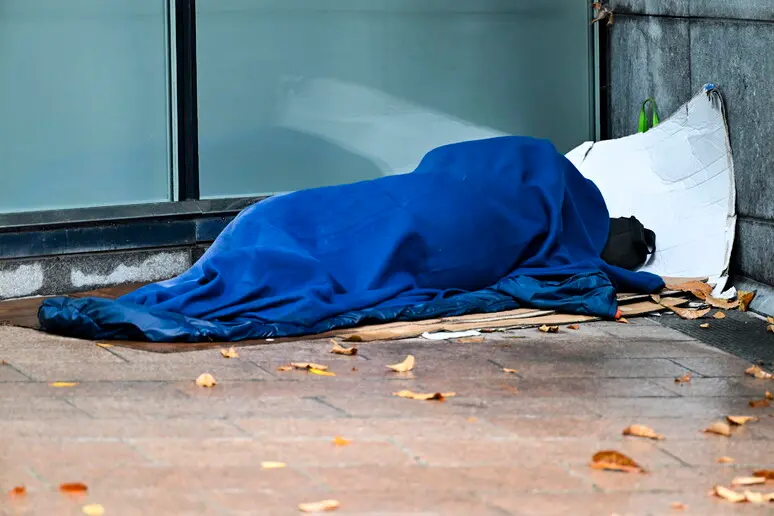
Of those sleeping on the streets, almost half were in open spaces without any shelter: on streets and squares (35 percent), in green areas (11 percent). A third under porticoes and underpasses. 9 percent in train stations. One in twenty in a tent or car.
In Rome and Naples we sleep mainly on the street, in the direct cold. In Turin and Genoa, under the porticoes – those long colonnades that the cities of the North have built over time as if to foresee that someone would need them. In Venice, 38 percent of the homeless were stationed near the piers: the lagoon city has its invisibles hidden among the vaporettos and canals.
This census is not a statistical exercise. It is a political and moral act. It is the choice of a State to look its forgotten people in the face, to count them, to give them, at least, the weight of a number. Because you can’t face what you can’t measure.
The challenge that this report poses is enormous. It’s not just about increasing the number of beds, which is necessary but not sufficient. It’s about understanding how one comes to sleep on the streets: the paths of loss, addictions, separations, untreated mental illness, unemployment that slides into desperation. The second phase of the research, direct interviews with the homeless, will try to answer precisely these questions.
Meanwhile, ten thousand people wait. Not an abstract answer. A room. A meal. Someone to call them by name.