




Luke 2,22-35 – Fifth day between the Octave of Christmas
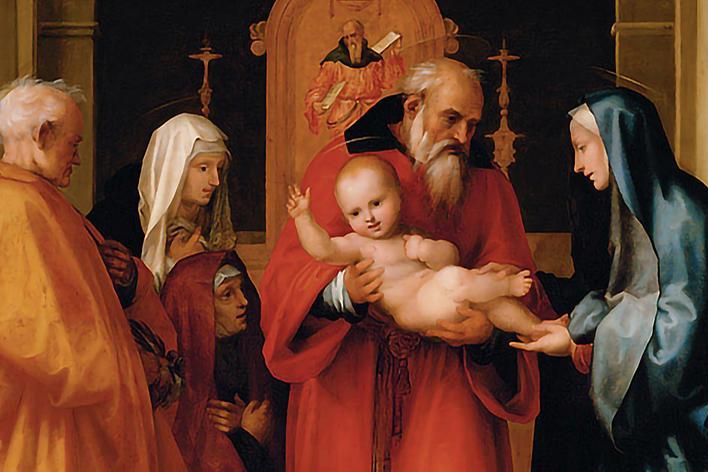
When Mary and Joseph bring Jesus to the Temple, as today’s Gospel page tells us, they are not doing something extraordinary: they are simply obeying the Law. Yet it is precisely within this everyday, taken-for-granted obedience that a decisive encounter occurs. Simeone takes a child in his arms who does not speak, does not perform miracles, does not teach anything, and yet recognizes salvation in him. It is one of the great provocations of the Gospel: God does not manifest himself where there is power, but where there is smallness. Not where everything is solved, but where everything is entrusted.
Simeon waited. He did nothing but this: he waited faithfully. He hadn’t grown tired of the time, he hadn’t turned the wait into bitterness. He had learned that true hope is not the illusion that something will happen quickly, but the certainty that something happens even if we don’t see it right away. This is why when he finally sees Jesus he can say: “Now you can let me go in peace”. Not because life ends, but because it finally makes sense.
Simeon, however, adds very harsh words to Mary: “A sword will pierce your soul”. As if to say: true love costs. Those who truly love are not spared from pain, but are mysteriously saved precisely through it. Jesus does not come to take away the cross from us, but to teach us that the cross is sometimes a road not a wall. And Jesus is a “Sign of contradiction”, he is not neutral. Either you welcome it or you reject it. You cannot remain indifferent. Because He enters exactly at the points where we are most fragile, most contradictory, most in need of being saved.
So that’s it this child, apparently so fragile, becomes the light that reveals hearts. Not because it judges, but because it enlightens. And when something is illuminated it becomes true, it becomes livable. Without Jesus we are in the dark.