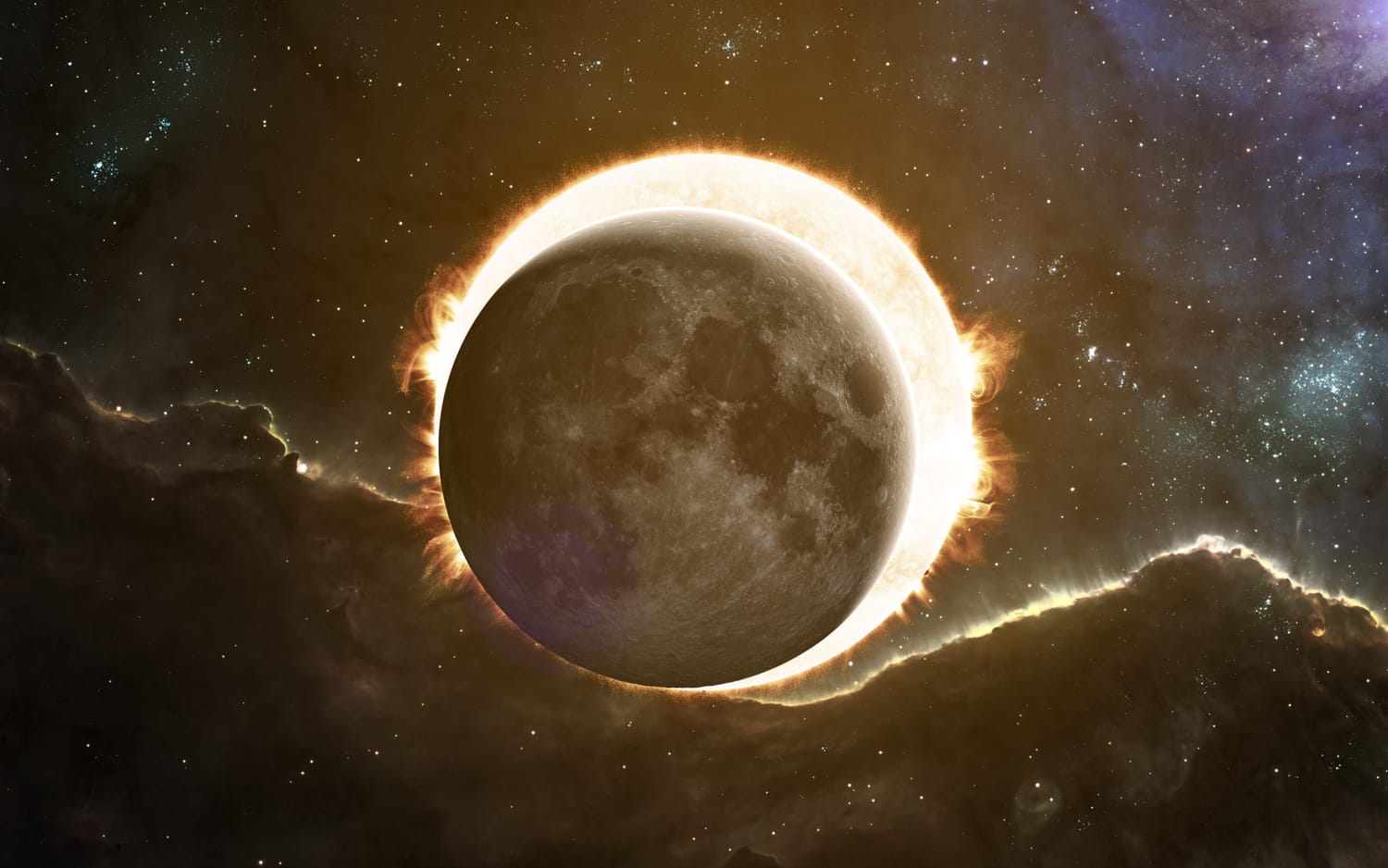






France will be plunged into darkness for several minutes. Observing a solar eclipse with the naked eye can burn the retina: you will absolutely need special “eclipse” glasses.
Right now, everyone is talking about an eclipse and it’s no coincidence. This comes from a double event. First of all, we just experienced a total lunar eclipse on March 3. If it was not visible everywhere in France, it offered spectacular images of “Blood Moon” throughout the world, which aroused the curiosity of the French. Then, astronomy enthusiasts and casual observers are already starting to talk about the biggest celestial event since 1999.
This event is none other than the next total solar eclipse, in other words the perfect alignment where the Moon passes between the Earth and the Sun, completely obscuring its disk and plunging part of the world into sudden night in broad daylight. If the “band of totality” (where the black is complete) will pass through Iceland and the North of Spain, France will also have the chance to experience a historic phenomenon. The country will be plunged into an ashen and unreal light for between 10 and 15 minutes depending on where you are. In Biarritz, the sun will be 99.5% hidden, while in Paris, obscuration will reach 92%. The temperature will drop suddenly and the animals, disoriented by the sudden night, may stop singing.
To see the Sun “disappear”, you will have to wait until Wednesday August 12, 2026, around 8:15 p.m. in Paris, 8:20 p.m. in Lyon and 8:25 p.m. in Bordeaux. PTo see the phenomenon clearly, make sure you have a clear view to the West/Northwest. Unfortunately, we will not be able to observe itnaked eye at the risk of “burning” the retina. Even though the Sun is 99% hidden, the tiny remaining crescent emits enough radiation to burn out your retinal cells in seconds. It is all the more treacherous since the retina does not have pain sensors: we do not feel that we are injured, but the after-effects (permanent black spots in the center of vision) appear a few hours later.
You will absolutely need special eclipse glasses with CE marking and ISO 12312-2 standard (see photo above), according to the Paris Observatory (PSL). Never use classic sunglasses (even stacked), x-rays, CDs or smoked glass. They do not filter destructive infrared and ultraviolet rays.
Even if you have to have a little more patience, the show is worth it. The last time that France was plunged into such darkness was during the memorable total eclipse of August 11, 1999. At the time, millions of French people looked up to the sky to observe this “big black” which remains, even today, a memory engraved in the memories. Since then, we have only had minor partial eclipses.