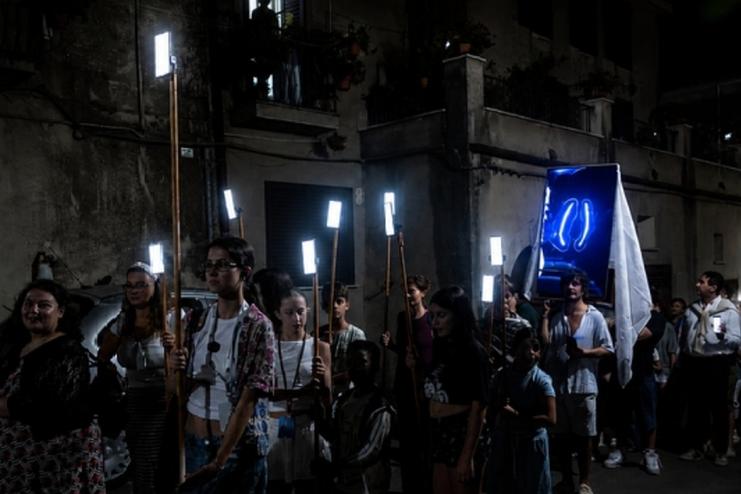
TO Woodsa hamlet of San Giovanni a Piro, in the heart of Cilento, a procession never seen before crossed the streets of the village. There was no statue carried on the shoulder, nor a traditional sacred image accompanied by the faithful. In its place a large bright screen, held up by the participants, and a community of smartphones transformed into small digital “lights”.
AND “Sacred Machine”the performance created by artists Max Magaldi and Matteo Mandelli as part of the festival MicroCosmscreated by Vittorio Cosma and directed with Annarita Masullo. The work, presented as the first digital procession created in Italy, has tried to bring technology, spirituality and community dimension into dialogue, questioning the increasingly close relationship between man and the digital tools that accompany daily life.
The procession took place on the evening of July 8. The procession passed through the alleys of Bosco with a rhythm similar to that of traditional processions: people gathered, a shared path, a symbolic object at the center of attention. But what changed was the language of the ritual. An engraving dedicated to the search for light appeared on the screen carried by the participants; through a QR code the smartphones of those present were connected to the work and coordinated by an artificial intelligence system.
Telephones, normally instruments of individual consumption, have thus become elements of collective participation: small points of light capable of generating a sound composition together made of synthetic voices and sounds produced by AI. At the end of the journey, the work was placed in the Cappella del Carmine, where it will remain open to visitors until 12 July.
The authors made it clear that the intent was not to replace or question religious faith, but to reflect on the meaning of collective gestures in contemporary society. «A procession always tells something about community, belonging and what we decide to follow», he explained Matteo Mandelliposing a provocative question: in a ritual where men and machines participate together, “who is praying to whom?”.
Avvenire’s reflection: technology as a daily ritual
The provocation of “Machina Sacra” was collected on the pages of Future also from Don Davide Imeneo, an expert in artificial intelligence and the challenges it also poses to pastoral care, who saw the Cilento experiment as an educational and cultural opportunity to understand our relationship with technology. «Those who scroll through the screen with their heads down are convinced they are experiencing an intimate moment», writes Imeneo, «and yet in that same moment they participate in a collective liturgy that almost no one recognizes as such, in which we all give up the same things: data, attention, time, presence».
According to the expert, the strength of the performance lies precisely in making visible an often unconscious daily gesture: «Before the rules of use comes the awareness of the gesture”. The theme is not only how much we use digital tools, but the ability to recognize the symbolic and ritual value that they can take on in our lives.
Educating awareness in the era of artificial intelligence
The Bosco procession thus also opens a reflection on the educational role of communities. Around which symbols do the new generations gather today? What are the objects that attract their attention and build belonging? To create “Machina Sacra”, the artists first of all chose dialogue with the territory. They lived Ortega Housethe home of the Spanish painter José Ortega, an anti-Franco exile who lived in the village, opening it up to comparison with the local community, the parish and the Pro Loco. Technology entered the country not as an element imposed from outside, but through a process of mutual listening.
A choice that also recalls Pope Leo XIV’s reflection on education and the relationship between person and technology in his encyclical Magnificent Humanitas. As Imeneo observes, the educational challenge it cannot be limited to the ban on digital tools, but must above all help to develop awareness and freedom. And the case of Bosco shows an interesting paradox: while in schools the smartphone is often removed from the classrooms, in the Cilento procession the same object was transformed into a symbol of participation. No longer just a device to control, but an instrument to interrogate.
The final question left by “Machina Sacra” is perhaps precisely this: in a time dominated by automatic answers and always available algorithms, do we still know how to guard the space of questions? Because even a machine can generate sounds and images, but the meaning of a shared journey remains a profoundly human responsibility.