





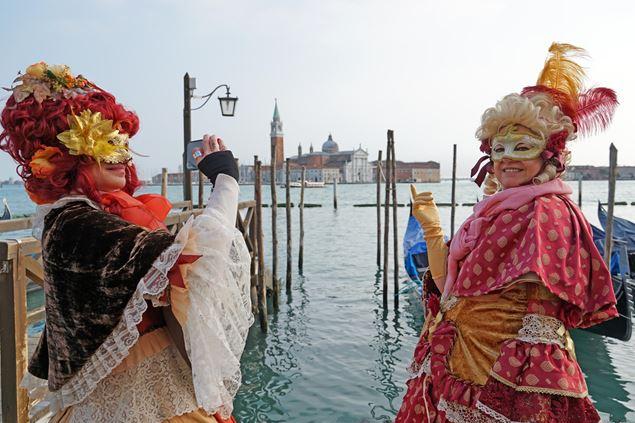
«Aren’t we a little schizophrenic when it comes to Carnival? On the one hand we very willingly say that carnival has the right to citizenship in Catholic land, on the other hand we avoid considering it spiritually and theologically. Is it therefore part of those things that Christianly cannot accept, but which humanly cannot be prevented? Then it would be legitimate to ask: in what sense is Christianity truly human?”. Thus begins the reflection of the then cardinal Joseph Ratzinger on Carnival, the period preceding Lent and in some way has to do with the Catholic liturgical calendar. The reflection is contained in the book Mustard seed hope (Queriniana, Brescia 1974).
«The origin of the carnival», Ratzinger explained, «is undoubtedly pagan: the cult of fertility and the evocation of spirits go together. The church had to rise up against this idea and talk about exorcism which drives away demons which make men violent and unhappy. But after the exorcism something new, completely unexpected, emerged, a demonized serenity: Carnival was linked to Ash Wednesday, as a time of joy before the time of penanceas a time of serene self-irony that cheerfully tells the truth that can be very closely linked with that of the preacher of penance. In this way the carnival, once demonized, in the line of the Old Testament preacher can teach us: “There is a time to cry and a time to laugh…” (Ecclesiastes 3:4)”.
For this reason, he continued, «even for the Christian it is not always a time of penance in the same way. There is also a time to laugh. Christian exorcism has destroyed demonic masks, causing frank and open laughter to erupt. We all know how carnival today is often far from this climate and to some extent has become a business that exploits man’s temptability. Director is Mammon and his allies. This is why we Christians do not fight against, but in favor of happiness. The fight against demons and rejoicing with those who are happy are closely united: the Christian must not be schizophrenic, because the Christian faith is truly human.”
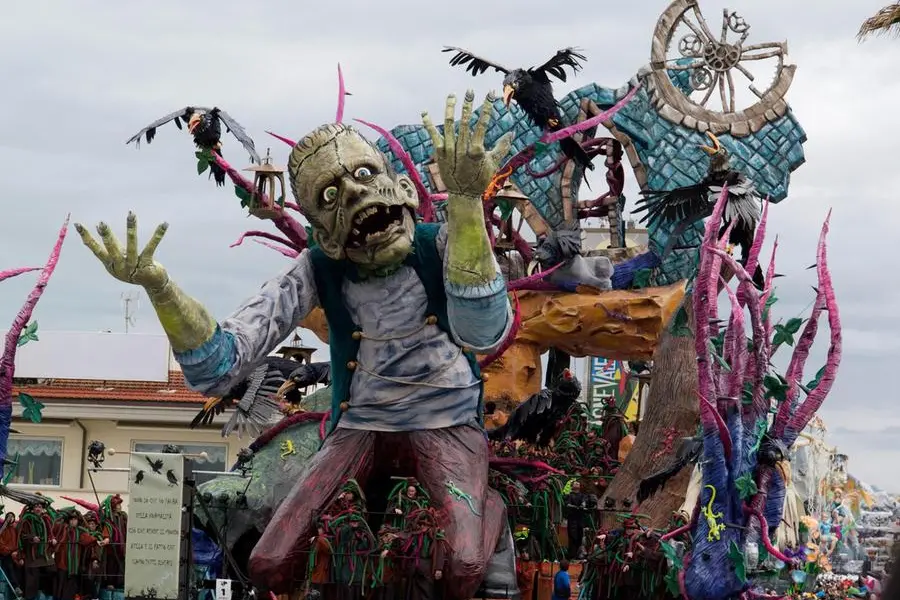
One of the floats of the Viareggio Carnival 2025
(HANDLE)
In another intervention, contained in the volume Seek the things that are above. Reflections for the whole year (Pauline), Benedict XVI focused on the origins of Carnival by investigating the link with Christianity.
Here is his reflection: «Carnival is certainly not a religious celebration. However, it is not conceivable without the calendar of liturgical holidays. Therefore a reflection on its origin and meaning can also be useful for understanding faith. The roots of carnival are multiple: Jewish, pagan, Christian. In the calendar of Jewish holidays it roughly corresponds to the festival of Purim, which commemorates the salvation of Israel from the looming persecution of the Jews in the kingdom of Persia.
The unbridled joy with which the festival is celebrated is intended to be an expression of the sense of liberation which, on this day, is not just memory, but promise: whoever is in the hands of the God of Israel is free from the start from the snares of his enemies.
At the same time, behind this wild and profane celebration, which had and still has its place in the religious calendar, there is that knowledge of the rhythm of time, validly expressed in the Book of Ecclesiastes. Every moment is not the right time for everything: man needs a rhythm, and the year gives him this rhythm, in creation and in the history that faith presents over the course of the year.or. We have thus arrived at the liturgical year, which takes man through the entire history of salvation in the rhythm of creation, thus ordering and purifying the chaos and multiplicity of our being. In this cycle of creation and history no human aspect is left out, and only in this way is everything human saved, the dark sides as well as the bright ones, sensoriality as well as spirituality.
Everything receives its place in the whole which gives it meaning and frees it from isolation. Therefore it is foolish to want to prolong the carnival as business and timetables would like: this arbitrary time becomes boredom, because in it man becomes only the creator of himself, he is left alone and truly abandoned. Time is no longer the multiple gift of creation and history, but the monster that devours itself, the empty gear of the eternally equal, which makes us turn in a senseless circle.
But let’s go back to the roots of the carnival. Alongside the Jewish precedents there are the pagan ones, whose grim and threatening face still stares at us from the masks of the Alpine and Swabian-Germanic countries. Here the rites of the expulsion of winter and the exorcism of demonic powers were celebrated. At this point we can notice something very significant: the demonic mask is transformed, in the Christian world, into a fun masquerade, the very dangerous fight with demons is changed into joy before the gravity of Lent. In this masquerade what we often find in the psalms and prophets happens: it becomes a mockery of those gods, whom those who know the true God no longer have to fear.
The masks of the gods have become a fun spectacle, expressing the unbridled joy of those who can find reasons for comedy in what used to be scary. In this sense, Christian liberation is present in the carnival, the freedom of the one God, which makes perfect that freedom remembered by the Jewish festival of Purim.”