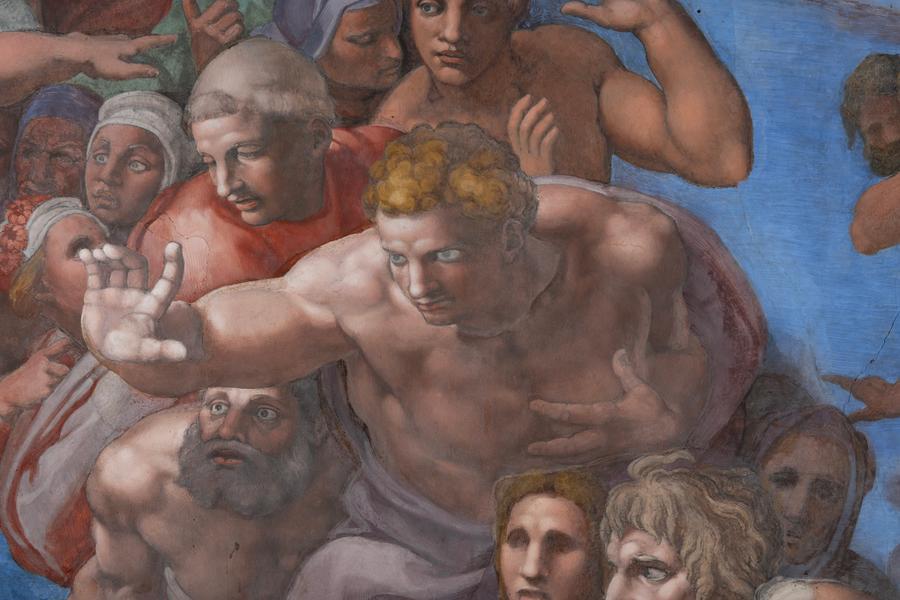




«It is not a restoration, but an extraordinary maintenance». Barbara Jatta, director of the Vatican Museums, explains the work being done on the Last Judgment after constant monitoring of the work highlighted a uniform patina of calcium lactate which, «acted almost like a cataract. Hardly perceptible to the naked eye, it ended up obscuring the original colors of the work.”
Because of this, having mounted seven floors of scaffolding, reaching a height of twenty meters, 20 specialized restorers have begun the cleaning work which should be completed by Easter. «We started with the two lunettes which are the first frescoes by Michelangelo» explained Fabrizio Biferali, the curator of the Renaissance Art department of the museums who has expertise on the Sistine Chapel. The phenomenon of “whitening” on the walls of the chapel, evident above all on the Last Judgement, derives from the formation of calcium lactate. Human perspiration (sweat and, to a lesser extent, breath) introduces lactic acid into the air; the air flows, also from the purification plant installed by Carrier about 15 years ago, combined with warmer temperatures from year to year and the growing number of visitors, as well as the inclination of the wall desired by Michelangelo himselfconvey these microparticles towards this part of the work. Combining with the available calcium from the plaster, they create a soluble patina which flattens color contrasts and penalizes dark colours. The Conservator’s Office, in coordination with the Technical Services Directorate of the Governorate, monitors the environment and manages the plant. The “cleaning”, underlines Paolo Violini, Chief Restorer of the Paintings and Wooden Materials Restoration Laboratory, «It is, fortunately, not difficult and is low risk: the deposit is removed with deionized water applied via sheets of Japanese paper, without abrasives or brushes, exploiting the solubility of the salt and evaporation to make it migrate onto the paper”. The result restores the original tones and depth, leaving the constituent cracks and plaster intact. «We are committed to safeguarding the readability of the work with a chemically targeted and mechanically non-invasive approach, thus counteracting foreseeable environmental causes», he concludes. The cleaning makes perceptible «the chromatic “vibration” and the texture of intertwined brushstrokes, including the small points of shadow, as, for example, under the eyes of the Madonna».
Furthermore, from the top of the scaffolding, the undulation of the ceiling is visible which Michelangelo, with a skilful use of perspective, corrected for the eye of those observing the fresco from below. Just as he did with the figure of Jonah, which is disproportionate when seen up close but instead appears to be the right size for those looking from below.
The Sistine Chapel, despite ongoing work, is open to visitors. A canvas reproduction of the Last Judgment was lowered onto the temporary scaffolding for the restoration of the fresco, enhanced by lighting, to give tourists the opportunity to appreciate the beauty of the work.