





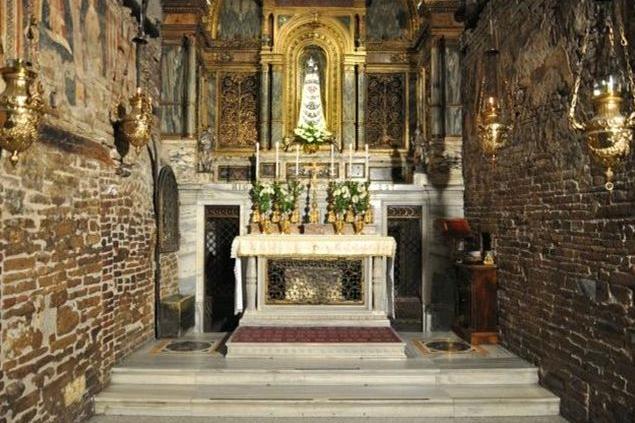
The liturgical feast of the Madonna of Loreto occurs on December 10th, in memory of the date of the arrival of the Holy House of Nazareth in Loreto. The origins of the ancient and devout tradition of the translation of the House from Palestine to the Marche city date back to 1296, when in a vision, its existence and authenticity had been indicated to a hermit, Fra Paolo della Selva and reported by him to the Authorities. This is told to us by a chronicle of 1465, written by Pier Giorgio di Tolomeiknown as il Teramano, who in turn had deduced it from an old worn ‘tabula’ dating back to 1300.
Some more significant passages are reported, which were then handed down in the narratives, more or less enriched in the following centuries; “The noble church of Santa Maria di Loreto was the chamber of the house of the most glorious Mother of our Lord Jesus Christ… Which house was in a city of Galilee called Nazareth. And in that house the Virgin Mary was born, here she was raised and then greeted by the Angel Gabriel; and finally in the same room he nourished his son Jesus Christ… Then the apostles and disciples consecrated that room as a church, celebrating the divine mysteries there… But after that people of Galilee and Nazareth abandoned their faith in Christ and accepted the faith of Muhammad, then the Angels removed the aforementioned church from its place and transported it to Schiavonia, placing it near a castle called Fiume (1291). But there she was not at all honored as befitted the Virgin… Therefore the Angels removed her from that place again and took her across the sea, to the territory of Recanati (1294) and placed her in a forest of which a gentlewoman called Loreta was the owner; from here the church took its name: ‘Santa Maria di Loreta…’.
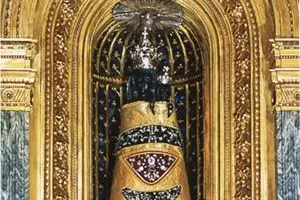
The angels moved it to the current Hill on the night between 9 and 10 December 1294
Due to the large number of people, unfortunately thefts and violence also occurred, so the story continues, the Angels moved it twice more, always for the same reasons, finally depositing it on the hill, on the night of 9-10 December 1294where it is currently located. “Then all the people of Recanati came to see the said church, which stood above the ground without any foundation. For this reason, the people considering such a great miracle and fearing that the said church would not fall into ruin, had it surrounded by another very large wall and of very good foundation, as can still be clearly seen today”.
This is the story of 1465; which is based on the historical aspect of the time, when the cultural and religious relations of the communities settled on the two shores of the Adriatic were intense, due to the crossing of the Venetian ships and then those of Ancona and current Dubrovnik, which transported pilgrims to the Holy Places of Palestine. In the background there is the conquest of the Holy Land by the Mamluks and then the slow penetration of the Ottomans into the Balkan peninsula, after the fall of Constantinople. From these events the Crusades arose, to free the peoples and countries from the Arab occupation and according to tradition, the Angels intervened to save the house of the Virgin, already transformed into a church since apostolic times.
Since then multitudes of faithful have gone on pilgrimage to the grandiose sanctuary, which contains the Holy House, begun to be built in 1468 by Pope Paul II, which soon became and is, according to a happy definition of Pope John Paul II, the “Marian heart of Christianity”.
A pilgrimage destination since the fourteenth century
Since the beginning of the fourteenth century it was already a pilgrimage destination, even for those who took the coastal road and were headed to S. Michele al Gargano or to the Holy Land; the flow in the 15th and 16th centuries became enormous, to the point of inducing Pope Leo
The the sensational prodigy of the translation of the Holy House also attracted, starting from the 15th century, the pilgrimage of kings and queens, princes, cardinals and popes, who left gifts or votive offerings for graces received; in subsequent times they were joined by leaders, poets, writers, inventors, founders of religious orders, philosophers, artists, future saints and blesseds.
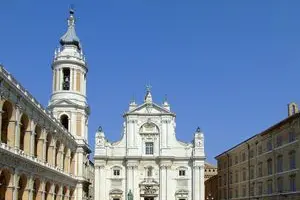
The popes and Loreto: a story of great devotion
Starting with dad Clement V which with a bull dated 18 July 1310 indirectly confirmed the authenticity of the Holy House, the popes in the following centuries once again confirmed their devotion to the Virgin of Lauretana, especially in dramatic circumstances. The grandiose sanctuary, which encloses the Holy House, was begun to build in 1468 by Pope Paul IIin short became and is, according to a happy definition of Pope John Paul II, “Marian heart of Christianity”.
Over 50 popes have gone on pilgrimage to Loreto and their devotion has always been great; Popes Pius II and Paul II turned to the Virgin to miraculously recover from their serious illnesses; Pope Benedict Loreto is considered the Italian Lourdes and many pilgrimages for the sick are organized every year, with collective ceremonies like those of Lourdes; I add a small personal experience of mine, in both places sacred to Mary, I suddenly felt the need to cry, as if I felt the spirituality in the two environments permeated by her presence.
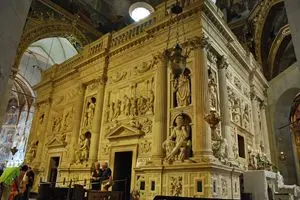
Pope Wojtyla’s reflection
“The Laureto sanctuary is a wonderful sanctuary,” the pope wrote John Paul II. «The thirty-year experience of sharing that Jesus had with Mary and Joseph is inscribed in it. Through this human and divine mystery, the history of all men is inscribed in the house of Nazareth, since every man is linked to a ‘home’, where he is born, works, rests, meets others and the history of every man is marked in a particular way by a house: the home of his childhood, of his first steps in life. And it is eloquent and important for everyone that this unique and singular Man, who is the only begotten Son of God, also wanted to link his story to a house, that of Nazareth, whichwho according to the Gospel story, hosted Jesus of Nazareth throughout the entire span of his childhood, adolescence and youth, that is, of his mysterious human maturation… The house of the Son of Man is therefore the universal home of all the adopted children of God. The history of every man, in a certain sense, passes through that house…».
Devotion
There are countless pious places, churches, hospitals or assistance, as well as religious congregations, dedicated to the name of the Virgin of Loreto, her name changed to Loredana is among the most widespread among women; finally how not to remember the “Lauretane Litanies” which since the 12th century have become a true prayer to the Virgin, focused on the titles that have been awarded to her at all times, even with biblical references. The “Lauretan Litanies” replaced in Christianity the ones called ‘Venetian’ (in use in the Basilica of St. Mark and originating from Aquileia) and the ‘deprecatory’ ones (i.e. those of supplication, originating from Germany).