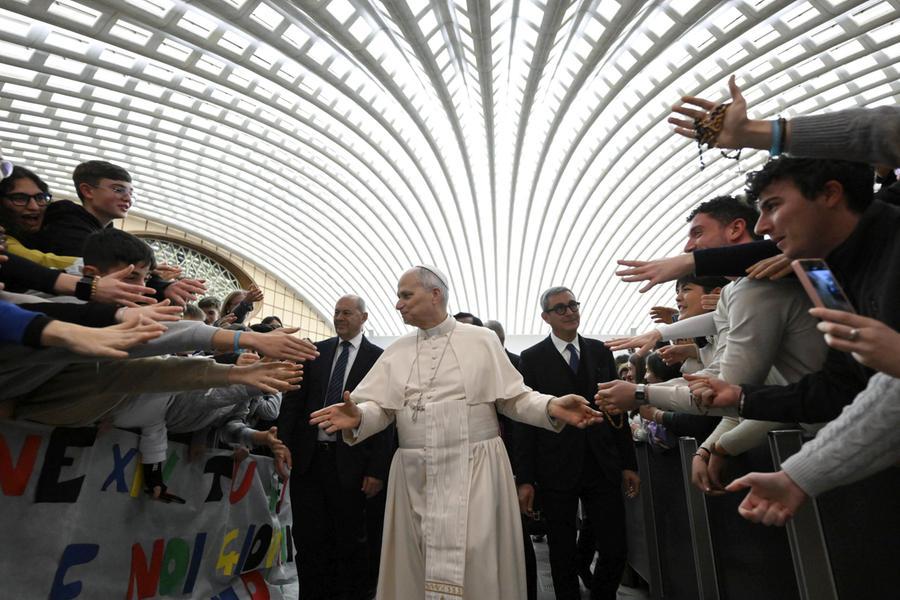



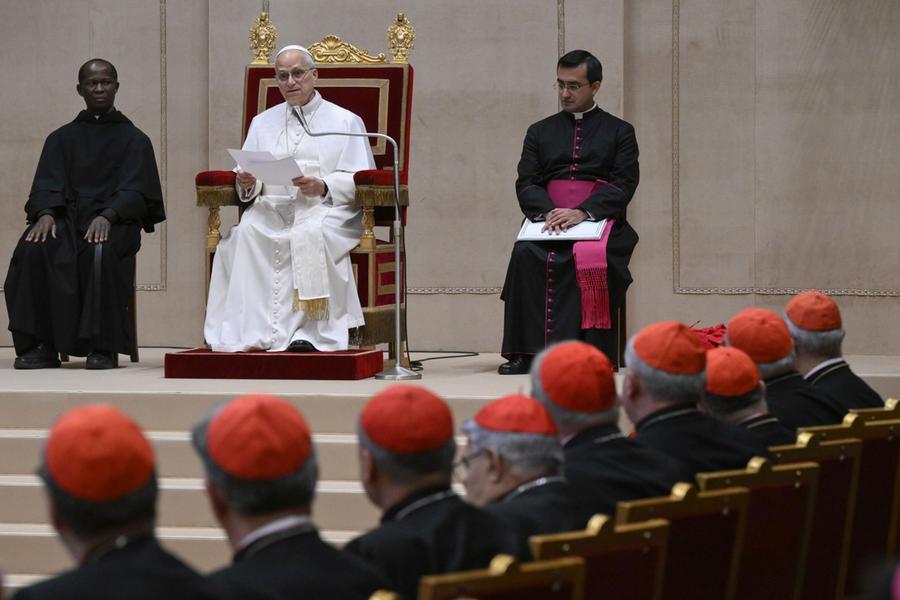
The exchange of greetings between the Pope and the cardinals and bishops of the Roman Curia is one of the traditional events of the Christmas holidays. In the Hall of Blessings, after the introductory greeting from the cardinal dean, John the Baptist KingLeo XIV opened his speech with an intense memory of his “beloved predecessor”Pope Francis, who “ended his earthly life this year”. A Pope who, said Leo
Explicitly taking up the apostolic exhortation Evangelii gaudium of Pope Francis, Leo XIV then indicated two key words for ecclesial life and for the service of the Roman Curia: mission and communion.
“The Church is by its nature extroverted, turned towards the world, missionary”, stated the Pope, inviting us to “progress in the missionary transformation of the Church”, which finds its strength “in the mandate of the Risen Christ”. A call which, as Pope Francis recalled, concerns everyone: «We are all called to this new missionary “exit”.
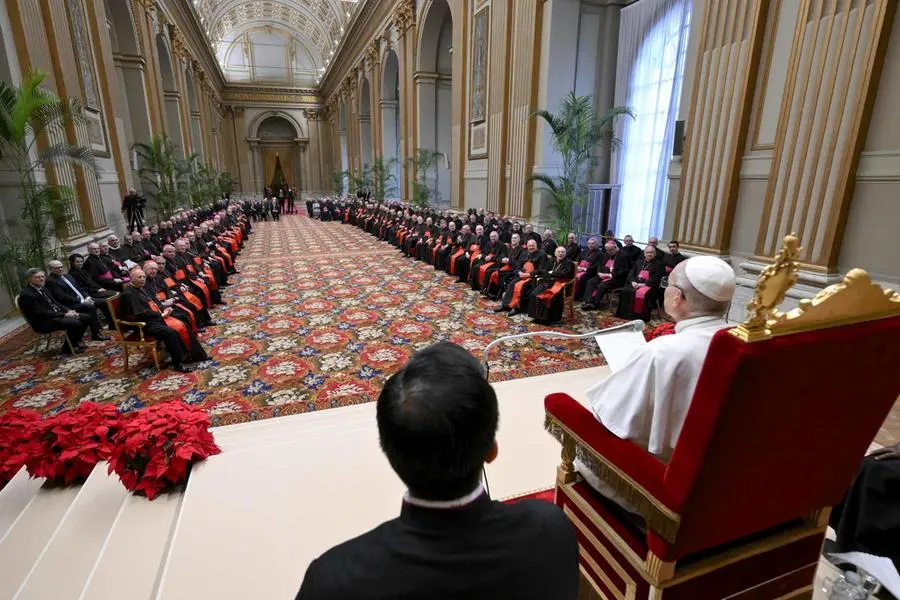
This missionary dynamic, Leo XIV explained, quoting again Evangelii gaudiumarises from the fact that “God himself was the first to set out towards us” and that “in Christ he came to seek us”. The mystery of Christmas, he added, “he announces precisely this to us: the mission of the Son consists in his coming into the world”.
For this reason, the Pope continued, “the mission of Jesus on earth, prolonged in the Holy Spirit in that of the Church, becomes a criterion of discernment” for personal life, for the journey of faith and for ecclesial practices, including the work of the Roman Curia. «Structures must not weigh down or slow down the progress of the Gospel», he warned, but they must be designed so that «they all become more missionary».
Following the vision of Pope Francis, Leo XIV recalled the “baptismal co-responsibility” of all: «The work of the Curia must also be animated by this spirit» and must “promote pastoral concern at the service of the particular Churches and their pastors”. Hence the invitation to an “increasingly missionary” Curia, capable of looking at “the great ecclesial, pastoral and social challenges of today”, and not just the management of ordinary administration.
Alongside the mission, the Pope forcefully raised the theme of Communion, recognizing that “there always remains a challenge in the life of the Church”. Not without realism, Leo «some dynamics linked to the exercise of power, the desire to excel, the care of one’s own interests are not difficult to change». Hence the direct question posed to those present: “Is it possible to be friends in the Roman Curia?”.
The Pope’s response comes from the concreteness of daily life: «In the daily grind it is nice when we find friends we can trust», when «masks and subterfuge fall away», when «people are not used and bypassed» and when “each person recognizes their own value and competence”, avoiding fueling “dissatisfaction and resentment”.
Leo indicated “mission and communion” as “very urgent tasks ad intra and ad extra”: “Ad intra because communion in the Church always remains a challenge that calls us to conversion”, “we are the Church of Christ, we are his members, his body. We are brothers and sisters in Him” and “despite being many and different, we are one”, he added, quoting his motto, “In Illo uno unum”. «We are also and above all called here in the Curia – Leone lashed out -, to be builders of the communion that asks to take shape in a synodal Churchwhere everyone collaborates and cooperates on the same mission, each according to their own charism and the role received. But this – he warned – is being built, more than with words and documents, through concrete gestures and attitudes that must manifest themselves in our daily lives, also in the workplace. There is a personal conversion that we must desire and pursue, so that the love of Christ that makes us brothers can shine through in our relationships. This also becomes a sign ad extra”, he underlined, “in a world wounded by discord, violence and conflicts, in which we are also witnessing a growth in aggression and anger, often exploited by the digital world as well as by politics”.
Christmas, Leone again recalled, «brings with it the gift of peace and invites us to become a prophetic sign of it in an overly fragmented human and cultural context. The work of the Curia and that of the Church in general must also be thought of in this broad horizon: we are not little gardeners intent on tending their own vegetable garden, but we are disciples and witnesses of the Kingdom of God, called to be in Christ the leaven of universal brotherhood, between different peoples, different religions, between women and men of every language and culture. And this happens if we live as brothers first.”
Leo XIV then returned to the risk of divisions, reiterating that “sometimes, behind an apparent tranquility, the ghosts of division stir”, which lead to oscillating “between two opposite extremes”: “uniforming everything without valorising differences” or “exacerbating diversity and points of view, instead of seeking communion”.
A concrete risk, he warned, which concerns “interpersonal relationships”, “the internal dynamics of offices and roles” and also the discussion on sensitive topics such as “faith, liturgy, morality and more”. In these cases, he concluded, “we risk falling victim to rigidity or ideology”, with the resulting conflicts.
In his first Christmas message to the Roman Curia, which always also has a “programmatic” value, Leo XIV thus forcefully recalled the legacy of Pope Francis, indicating a Church called to be both missionary and united: capable of going out to meet the world without losing communion, and of preserving differences without losing the unity of the Gospel.