



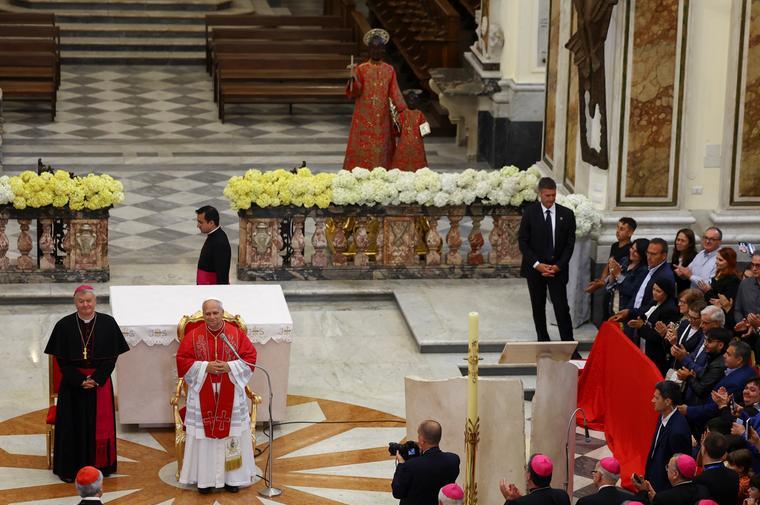
He asks for “a word that shakes the consciences”, those “of the institutions, of the citizens and also of our Church, so that it is more courageous in denouncing evil and more determined in inserting the education of creation into the preaching and journeys of faith of the parish communities”. Monsignor Antonio Di Donna, bishop of Acerra, welcomes the Pope to the cathedral with a resounding “Welcome”. Within the walls of Santa Maria Assunta there are the prelates of the area together with the clergy, the men and women religious, the families of those who have been victims of environmental damage. Di Donna explains the drama of this land which, since the 1980s, has been scarred by unscrupulous industrialists and an organized crime group that has sought profit at the expense of the health and lives of fellow citizens. The bishop doesn’t give discounts. It denounces the Northern industries that have dumped their toxic waste here and the small local businesses that work illegally and dispose of waste in illegal landfills which they then set on fire.
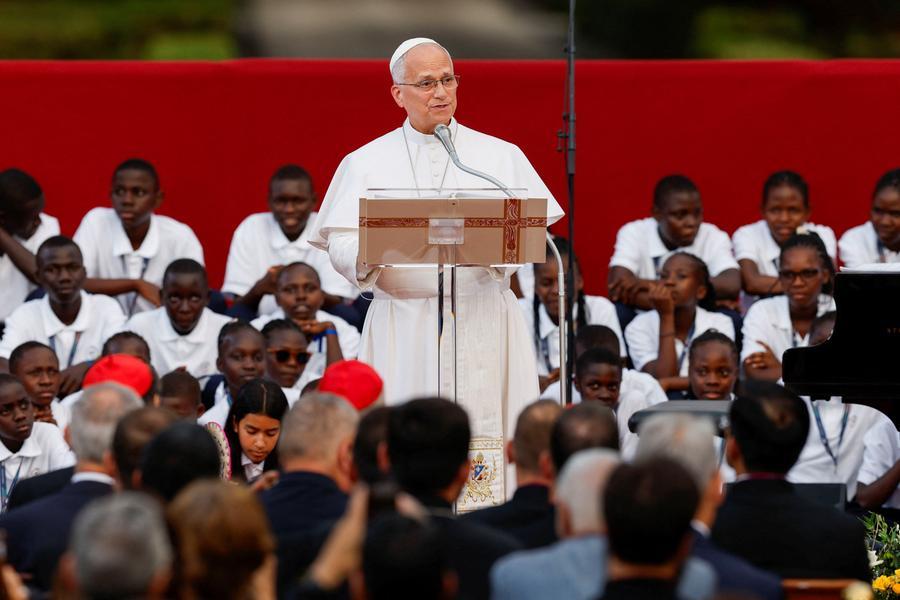
He lists, amidst the tears of those present, the names of the latest victims and the courage of those who have always fought to uncover the crime. And not even Pope Leo makes any concessions as he begins by recalling the great gift «that the Encyclical Laudato si’ represented the mission of the Church in this land” and Pope Francis’ dream of coming here. He immediately speaks of the “cry of creation and of the poor” which “has been felt most dramatically among you, due to a deadly concentration of obscure interests and indifference to the common good, which has poisoned the natural and social environment. It is a cry that asks for conversion!
An emotional meeting. «I have come first of all to collect the tears of those who have lost loved ones, killed by environmental pollution caused by unscrupulous people and organizations, who for too long have been able to act with impunity»says Leone looking at the faces of the mothers who have lost their children and those who are still struggling with their children’s illness. And yet he thanks the Pontiff also for a Church that has been able to respond to evil with good, that has gathered the people in hope by daring “the denunciation and the prophecy”. Use the words of the prophet Ezekiel to call to life in a land where death has been sown in abundance.
“In the last 30 years, around 150 children and young people have died in Acerra alone, without counting the adults and the deaths in other areas of the territory”, the bishop recalled. Faced with these deaths and this pain, the Church rallied the people, pushed for the creation of committees, brought the requests of the territory to Brussels. Leo speaks of the vision of the prophet brought, by God, to a plain full of bones. Even this land, once called «Campania felix», due to the fertility of the place, has been filled with death. “We can identify with the prophet’s bewilderment before that expanse of dry bones”, says the Pontiff. And he underlines that, faced with this reality, there can be two attitudes: that of indifference and that of responsibility. “You have chosen responsibility and, with God’s help, you have begun a journey of commitment and search for justice.” Remember the Lord’s question to Ezekiel: «He said to me: “Son of man, can these bones live again?”. I replied: “Lord God, you know it”» and explains that those questions are addressed to everyone. They are “new questions that broaden our horizon”. And not a distant horizon. On the contrary, «the Churches have the mission of making the Word of God resonate here and today. This Word asks us if we believe in its own possibilities: it is the Word of life. If we meet today, it is to respond to this Word. And we answer like this: Lord, death seems to be everywhere, injustice seems to have won, crime, corruption, indifference still kill, good seems to remain withered. However, if you ask us, “Can these bones live again?”, we believe and say: “Lord God, you know it!”».
And then, the Pope insists, we can say to God «You know that we can get up againbecause you yourself take us by the hand. You know that our desert can flourish. You know how to change mourning into joy”.
And taking up Laudato si’ in which Pope Francis, «while denouncing a paradigm of death, has clearly announced the silent eruption of new life»asks, as the encyclical did, to be witnesses of a «”stubborn resistance” that becomes rebirth, where the Gospel illuminates and transforms life». Continue with the command given to Ezekiel, to prophesy on the bones to revive them. On the obedience of the prophet and on the bones that are close to each other, but still lifeless. «We understand, therefore, that the miracle does not happen all at once. The prophet is certainly amazed at what he sees and hears, but it is still not enough, something is still missing. It also applies to us: we need to trust again, listen again, believe again. The choices you have made, the ecclesial path you have taken, the small and large restarts with which you have faced the pain are not yet everything. If you stop, you go back”. We must continue to commit ourselves, to entrust ourselves to the Lord, to pray because life enters those bones, so that they stand up, so that they become a “great, endless army”.
The Pope also wishes the people of Acerra «to see an “army” of peace that stands up and heals the wounds of this land and its communities. No longer a fire that destroys, but a fire that revives and warms, the fire of the Spirit that lights the hearts and minds of thousands and thousands of men and women, of children and the elderly and inspires care, consolation, attention, true love.” In particular he wishes the families affected by death to be able to generate “new life by transmitting to sons and daughters, grandchildren and neighbors that sense of responsibility that has too often been missing up to now. Let resentment die, be the first to practice the justice you ask for, bear witness to life, educate people to care.” He asks priests, religious men and women for service: «Demonstrate the authority of service daily, who lowers himself and comes closer, who takes the first step and forgives. In fact, a culture of privilege, of arrogance, of non-accountability, which has done too much harm to this land, must be underminedas in many other regions of Italy and the world.” To change, however, we need to start from the heart. «Changing the world, in fact, always starts from the heart», he underlines. And he concludes: «Ezekiel himself, before this prophecy of death and resurrection, announced the renewal of which only God is capable: “Thus says the Lord God: I will give you a new heartI will put a new spirit within you, I will take away the heart of stone from you and give you a heart of flesh. I will place my spirit within you and make you live according to my laws and make you observe and put into practice my rules. You will live in the land that I gave to your fathers; you will be my people and I will be your God'”.