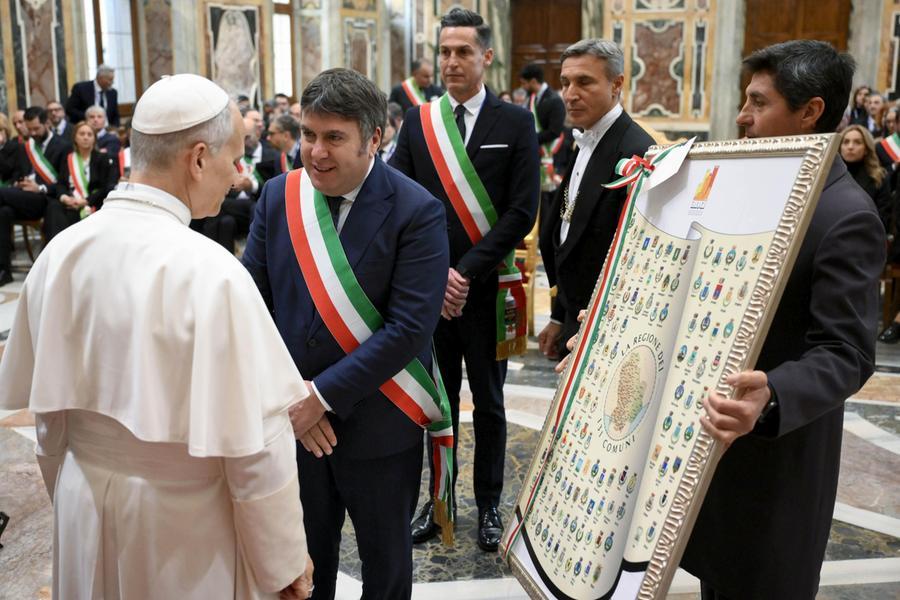





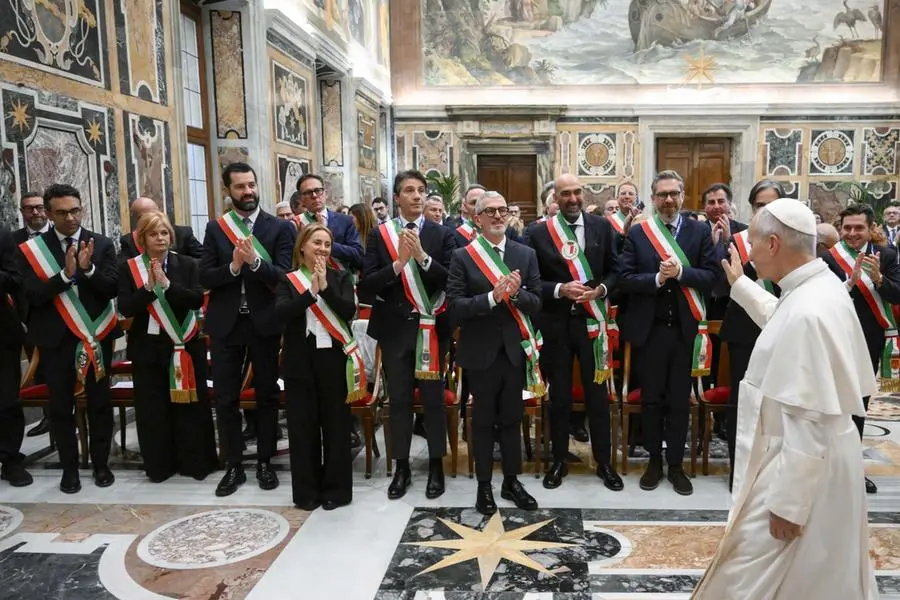
Cities, families, young people, the elderly and the poor: Pope Leo Matteo Maria Zuppi, president of the CEI.,
“The demographic crisis and the hardships of families and young people”, “the loneliness of the elderly”, “the silent cry of the poor”, “pollution of the environment”, “social conflicts” and, again, “psychic disorders, depression, cultural and spiritual poverty, social abandonment”: these are some of the problems listed by the Pontiff, who wanted to underline how concrete responses from institutions are necessary, with particular attention to the most vulnerable.
Among all, the Pope forcefully drew attention to a real social emergency: gambling. “It is a plague,” he said, “which ruins many families,” noting how the statistics of recent years show “a sharp increase” in Italy. Citing the Caritas Italiana report on poverty and social exclusion, Leone XIV highlighted how the phenomenon represents “a serious educational, mental health and social trust problem”.
The Pope’s words have therefore raised the alarm again about a social plague that is all in the numbers, which up to now have been underestimated above all by the political world. The Caritas report, last November, depicted a dramatic situation. Since the end of the 1990s, the editors of the Report underlined, the betting and gambling offer has been enriched with over fifty methods, online and in person: there are over 150 thousand public places scattered throughout all the Italian provinces.
The monetary volume shows unstoppable growth, jumping from 35 billion euros played in 2006 to 157 billion in 2024 (+349%). Yet the tax collection only increased by 83% (from 6 to 11 billion), all in favor of the large manufacturing companies. The data also highlights an inverse correlation between average income per taxpayer and average gambling loss, with a higher percentage weight in the poorest Italian regions. In 2024, total losses amounted to 20 billion euros.
All this aggravates the picture of social marginalization present in the country. Again according to Caritas, in Italyabsolute poverty concerns 9.8% of the population, almost one Italian in 10, or over 5.7 million people, and 2.2 million families (8.4% of households).
Leo XIV called attention to the role of politics and administrators: «Social cohesion and civic harmony require, first and foremost, listening to the little ones and the poor: without this commitment, democracy atrophies, becomes a nominalism, a formality, loses representativeness, becomes disincarnated because it leaves the people out in their daily struggle for dignity, in the construction of their destiny”.
To mayors, in particular, the Pope addressed a clear exhortation: «Both in the face of difficulties and with respect to opportunities for development, I urge you to become masters of dedication to the common good, encouraging a social alliance for hope».
The meeting also offered the opportunity to remember the example of the venerable Giorgio La Pira, the “holy mayor” of Florence, who stated: «If there is someone who suffers, I have a specific duty: to intervene in all ways, with all the precautions that love suggests and that the law provides, so that that suffering is either diminished or alleviated…».
Finally, Leo XIV underlined the importance of recovering the joy of living, recalling the words of Pope Francis in the Jubilee bull Spes non confundit: «Everyone needs to recover the joy of living, because human beings cannot be satisfied with surviving or getting by, with adapting to the present by allowing themselves to be satisfied by merely material realities. This locks us into individualism and corrodes hope, generating a sadness that nestles in the heart, making us acidic and intolerant.».
For Leo also of a way of feeling, of living, a way of looking at oneself, a way of brotherhood.”