

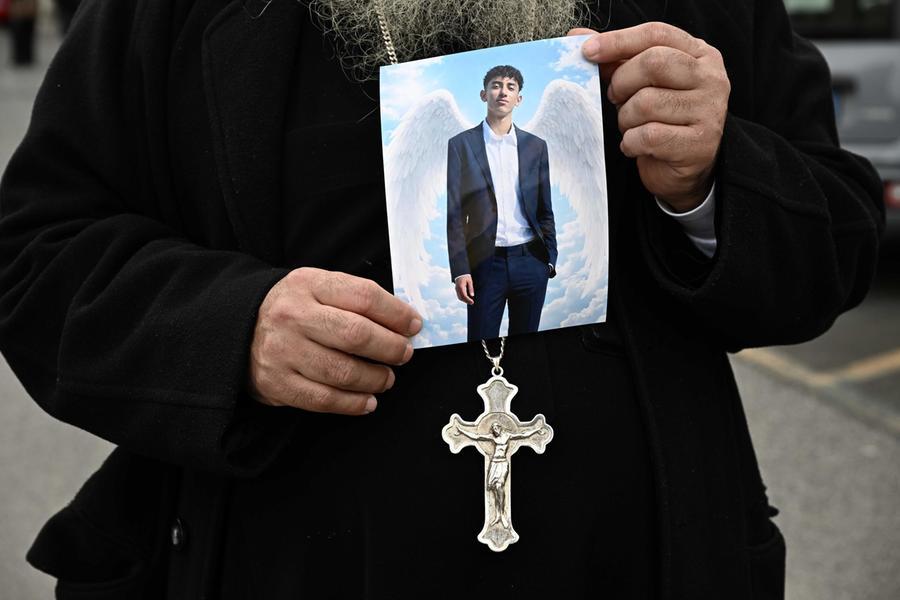


Andrea Cornetto today he is president of the Presidi association of La Spezia, but for 24 years he worked in the Einaudi-Chiodo technical institute in La Spezia, precisely where the drama of Youssef Abanoub stabbed by his classmate took place.
Professor, what is the context of that school like?
«In professional institutes it is always a different context. In 1993 the ministry – it was the time of the arrival of the first Albanians in Italy – had carried out a survey to find out how many nationalities there were in the various institutes. We had done the math, we had 27. Undoubtedly these institutes suffer, they have different peculiarities compared to the others. They need different attention. Families with little presence, families with difficulties. Professionals are all complicated that way. In professional schools there are many more facets in children’s educational paths.”
It’s the first time something so serious has happened at school…
«I also picked up a knife. It happens. The problem is that kids don’t know how to manage conflict, we should work on this. Resolving their conflicts, feeling different because this also leads to certain behaviors that we call “bad”, in the sense of predominant. They don’t know how to resolve conflicts, so when there is one, within the school or class, they find themselves displaced so that the problems then become even more acute and, unfortunately, lead to these things.”
Why can’t they find other channels to express themselves? Why do they reach such violence that they kill?
«He gets a crazy internal rush, not being able to speak. It seems like it’s the communication society, but it’s not like that. For them, communication means putting yourself on social media, talking on social media, with WhatsApp. It’s not communicating, it’s not sharing. Sharing, for example, is another peculiarity, socialization: a lot of work should be done on this within all schools. Starting from childhood, from primary school to middle school; because these kids, in my opinion, are more fragile than the young people of twenty-thirty years ago.”
There were those who pointed out that he was a foreigner…
«It’s not just a problem that concerns foreigners; it’s a problem that affects everyone: technology has something to do with it, the family is less and less present. Sociality, there are no more associations. I was born in the oratory and this undoubtedly helped me, both internally and externally, in seeing the kids and helping kids in difficulty because I was a person who, when I was in the oratory, looked around. And therefore he was able to have a 360° view to see the things that were happening around him. All of this is difficult to “exercise” if there are no longer these environments in which to grow and train.”
When such a serious event happens, it takes much longer than the time the news breaks to recover. Where do we start again?
«From dialogue, exclusively from dialogue. We need to try to recover slowly, talk to the kids individually first, see the problems, see why this situation arose. Then the teachers will also need to be helped because the professors are not used to having these difficulties and dealing with such serious episodes. We will also need to help them to act in a certain way to reconnect the fabric, calmly. Trying to talk to the kids individually first and then in groups, little by little. Trying to make things right. In the year my mother died, it was 1979, I had a boyfriend who died because he had a car accident and his parents – Jehovah’s Witnesses – didn’t want to have a blood transfusion. He passed away in December and we started working again in February. You have to see who is in front of you and speak with your eyes, then slowly build bridges.”