


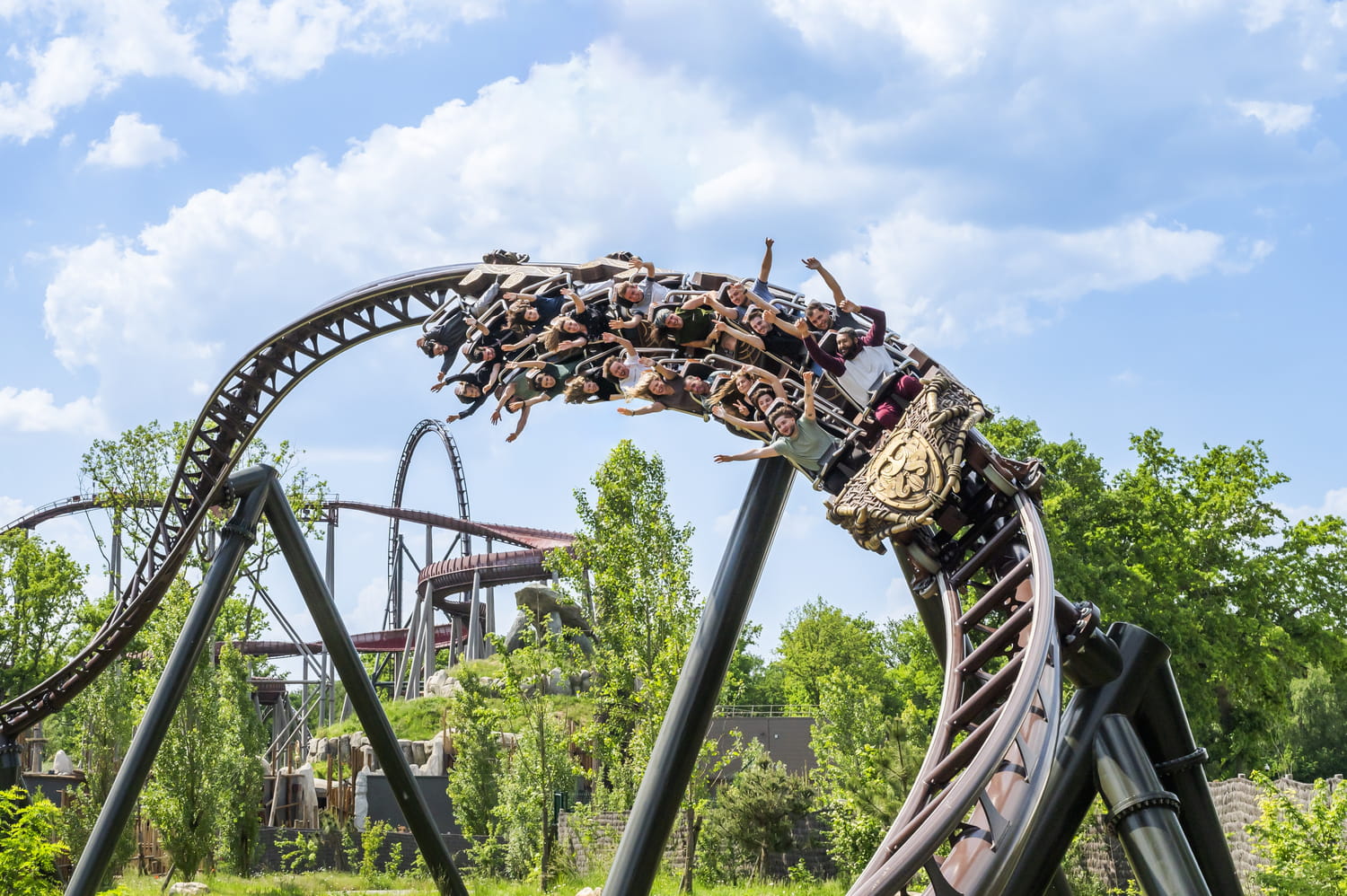
While amusement parks compete in gigantism and speed, a question crosses our minds once harnessed into the seat: how do these metal structures manage to avoid bending under the weight of trains launched at full speed? The answer lies in an unsuspected manufacturing detail.
Disneyland, Astérix, Europa-Park, PortAventura… For decades, amusement parks have become a must for outings with family or friends, competing with new features to attract ever more thrill-seekers. Being propelled at 200 km/h and tens of meters in the air, doing loops, and finding yourself glued to your seat under the effect of the G force for a few minutes… This is the adrenaline promise of rollercoasters, these metal monsters that millions of visitors trust to give them the thrill.
But before we get on one of these rides, we’ve all wondered if they’re really safe. How do they resist such force and weight, without ever bending? How do these rails that only seem to fit on a few posts manage to withstand so much pressure? To try to understand, we turned to Matthieu Galus, project manager in charge of designing attractions at Parc Astérix. Of course, it’s all a question of physics and engineering, but by sparing ourselves the mathematical equations and the complex jargon of professionals, we discover that this feat lies in particular in the shape of the rails… which are for the most part hollow.
Yes, these are not steel rods as one might imagine, but tubes, that is to say empty inside. The reason? For equal weight, a tube is stronger than a solid rod, because its surface is greater: all the quantity of steel that has been removed from the inside is distributed to the outside. “If we take a sheet of paper, it’s a bit the same thing. If we lay it flat, and we press on a slice, it will bend. But we make a square with it, and we press, it becomes resistant. It’s exactly the same logic. The only thing that has changed is that we have created a support surface”explains Matthieu Galus.
It must be said that the rails of attractions need resistance to all tests: a train of the Toutatis attraction at Parc Astérix for example, between its passengers, its decorations and its safety equipment, weighs around 20 tonnes. But the pressure it exerts depending on its speed is much higher: “At a force of 4G, a train will weigh four times as much. So a 20-ton train presses as if it weighed 80. The rails in the station, which are therefore not subject to any stress, have a much lower steel thickness than on certain sections of the route, which are more reinforced.” Concretely, the more acceleration there is, the more force there is, and the stronger the rail must be. And stronger rails also mean fewer posts to support them, therefore less steel… and less costs! But the specialist assures us, this has no impact on the safety of roller coasters: “Everything is governed by very strict standards. A rollercoaster must be able to withstand several million cycles, the equivalent of several decades of operation. The standard imposes the result, not the solution.”
In addition to better resistance to weight and pressure, this hollow in the middle of the rod also gives it greater flexibility: it is therefore more manageable at the time of construction, which allows more turns and sinuous shapes to be made with the rails, without risking breaking the material. “You need strength, but not too strong, because when it’s too strong, the risk is that it will break suddenly. The experience we’ve all had at home is to take a small spoon and twist it. But we can see that, when we twist it too much, it heats up and ends up breaking. That’s what we want to avoid.”schematizes Matthieu Galus. Far from being simple metal assemblies, roller coasters are true demonstrations of applied physics: the alliance between rigidity and flexibility allows engineers to push the limits of sensations while respecting drastic standards. Ultimately, knowing that these rails are hollow does not make them more fragile, quite the contrary: the next time you are in the queue for an attraction, you will surely look at these structures with new eyes.