





«The relationship between Europe and the United States is like that of an elderly married couple who do not divorce, but decide to sleep in separate rooms», writes the Politico Europe newspaper to describe the state of transatlantic relations in the era of the second Trump presidency.
The ongoing Security Conference a Munich it is now an opportunity to measure how great the distance is between Washington and the European capitals. A year ago it was freezing, with a very harsh and contemptuous speech from the vice president JD Vance which began the deterioration of transatlantic relations, characterized in the following months by economic (think of tariffs) and ideological clashes.
Vance didn’t come this year. In his place is the Secretary of State Marco Rubiousually characterized by a more pragmatic, less ideological approach than the vice president. On Friday, Rubio listened to speeches from German Chancellor Merz and French President Macron.
Merz noted that the global order to which we were accustomed “no longer exists”, he noted that «a gap has been created between Europe and the United States», but this happened because «the cultural war of the MAGA movement is not ours», as if to say that the values that inspire “make America great again” are not ours (Merz’s position from which Giorgia Meloni, engaged in a mission in Africa, dissociated herself).
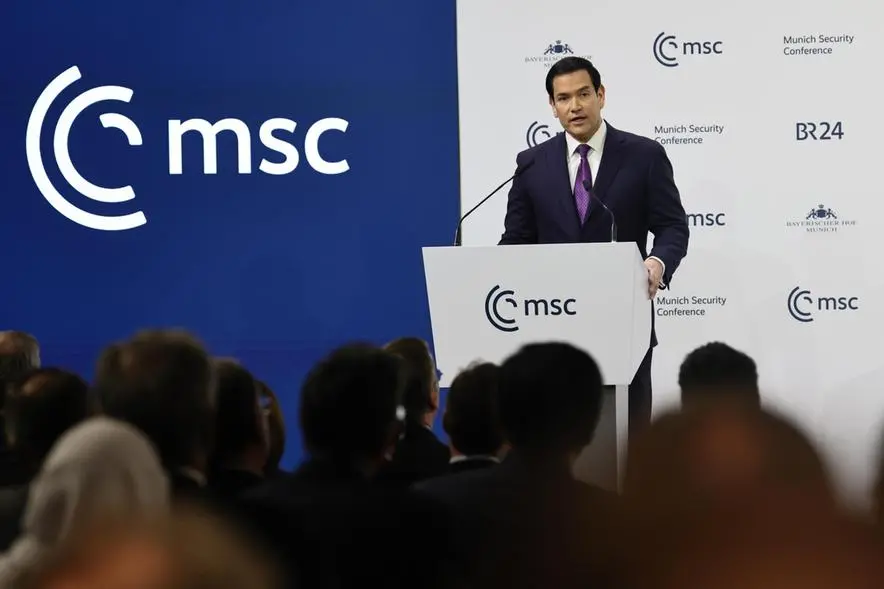
US Secretary of State Marco Rubio during his speech
(EPA)
Switching from German to English, Merz added that «in an era of great power rivalry, not even the United States will be powerful enough to act alone. Dear friends, being part of NATO is not only a competitive advantage for Europe, it is also a competitive advantage for the United States.”
Merz found the support of French President Macron, according to whom “everyone should take inspiration from us and should stop criticizing us”.
Rubio listened and spoke Saturday morning, marking his difference from the tone used a year ago by Vance. Rubio described the United States and Europe as linked not only economically and militarily, but also “spiritually” and “culturally”, stating that the United States wants to collaborate with Europeans, not against them. “We want Europe to be strong,” Rubio said, adding that the two world wars of the 20th century remind us that “our destiny is and will always be intertwined with yours.”
To please the audience, Rubio also quoted Mozart, Dante, Shakespeare, the Beatles and the Rolling Stones.
But Rubio didn’t just reserve Europe caresses. He launched severe criticism on the mass migrations, on environmental policies and on the “erasure of civilization”, as well as on what he called the decline of post-World War II institutions such as the United Nations, which he said are in need of profound reform. “We Americans have no interest in being polite and orderly guardians of the controlled decline of the West,” he said.
At the end applause and Wolfgang Ischinger, president of the conference, spoke of a collective “sigh of relief” from the audience. Even the president of the European Commission, Ursula Von der Leyen, after Rubio’s speech she said she felt “very calm”, Von der Leyen described Rubio as “a good friend, a strong ally” and said she understood that “nSome in the (US) administration have a harsher tone on this issue, but the Secretary of State was very clear: we want a strong Europe in the alliance and that is why we are working intensely in the EU.”
An issue that still divides Europe from the United States is undoubtedly the approach to the war in Ukraine. In his speech in Munich the Ukrainian president Volodymyr Zelensky He said that European unity is the “best interceptor” against Russian aggression, but accused the United States of focusing on Ukrainian concessions, “not on Russian ones.” A judgment also shared by many observers.